
Minnesota gives cover crops a tight, cold-bounded season: seeding depends on soil warmth after a frost date that arrives late (mid-to-late April) and closes early (mid-October), and winter survival hinges on a mean minimum near 9°F. Get those two limits right, and the choice of species mostly answers itself.
When the soil is warm enough in Minnesota
The question every Minnesota gardener asks first is “when can I seed?” The honest answer starts with a date most people misuse. NOAA’s 1991-2020 Climate Normals put the last spring frost for the Twin Cities (station USW00014922) at April 17 to April 30, based on the 30-70% probability band for a 32°F freeze. That’s a probability, not a promise: some years slip past it, some years don’t. Northern Minnesota runs two to three weeks tighter at both ends, so a gardener in Bemidji or Duluth should shift this whole conversation earlier in fall and later in spring.
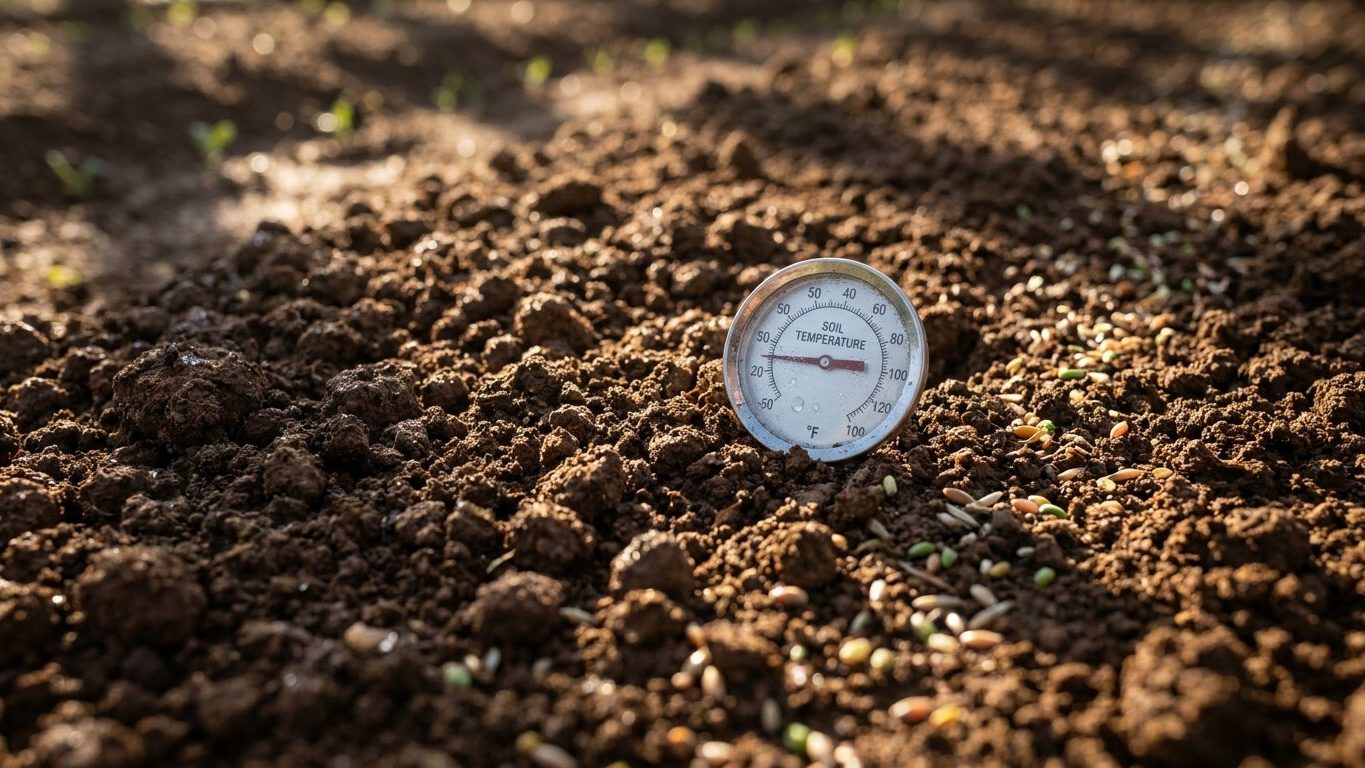
Here’s the part that trips people up: frost date is a stand-in for something else entirely. Cover crops don’t care about frost risk. They care about soil temperature, and soil warms on its own schedule, days to weeks after the air stops threatening to freeze. A patch of clay under morning shade lags well behind a raised bed of sandy loam in full sun. That gap is why two gardeners a mile apart, both past their last frost, can get completely different germination results on the same sowing day.
Cool-season cover crops don’t need to wait for that lag to close. Oats, field peas, and brassicas like forage radish tolerate a light frost and can go into ground that’s still cool, right around the NOAA window. Warm-season types, buckwheat, cowpeas, sorghum-sudangrass, want the soil itself to have shed its spring chill, which usually means holding off several weeks past that April window, not sowing the day the frost risk clears.
How much seed goes down, and at what depth, isn’t a number this page will hand you. Rate depends on the species, the drill or broadcast method, and the seed source, and a wrong number here wastes an entire season’s cover. That decision belongs to the University of Minnesota Extension, which publishes rates calibrated to this state’s soils and climate.
Termination follows the same logic used across this site: mechanical, not chemical. Mowing, crimping, or simply letting a hard fall frost finish off a tender species are the tools in play here. A legume’s nitrogen contribution to next season’s bed depends on how much biomass it built and when it was cut down, not on a fixed number stamped on a seed bag, so treat any such figure you see elsewhere with suspicion.
How long the season lasts here
Subtracting the two NOAA windows gives a real, if fuzzy, answer to how much growing time Minnesota actually offers. Using the earliest last-frost date (April 17) against the latest first-frost date (October 23), the outer edge of the window runs about 189 days. Using the later last-frost date (April 30) against the earlier first-frost date (October 11), the tighter edge comes out to roughly 164 days. So call it somewhere between 164 and 189 days, five and a half to just over six months, depending on how the year breaks.
That range is short enough that it changes real decisions, not just numbers on a calendar. A window under six months rules out the kind of long, layered succession plantings that milder territories can pull off, a spring cover crop, a summer cash crop, and a second cover crop before frost, all in one season. In Minnesota, the first sowing is often the only sowing a bed gets before the ground closes for winter, especially in the northern two-thirds of the state where that window shrinks further.
That constraint pushes the timing math earlier than gardeners in warmer states are used to. If a cover crop needs 60 days of growth to build meaningful biomass before a hard frost, and the fall frost risk begins climbing in mid-October, the sowing date for that crop needs to land in mid-August at the latest, not September. Miss that window and the cover crop enters winter thin, which matters more here than almost anywhere else because thin cover offers little protection against a soil surface that’s about to see its coldest month.
It also reframes whether transplanting is worth the trouble. In a longer growing region, starting a cover crop indoors and transplanting it out buys extra weeks. In Minnesota’s compressed window, that head start matters more, but it also means checking root development before transplant shock costs you days you don’t have to spare. For gardeners who want to stretch this short season into more than one planting, the site’s guide to succession sowing walks through how to sequence plantings around a frost-bounded calendar like this one.
Heat and water in Minnesota
Minnesota does see stretches of genuine summer heat and its share of heavy rain, but for cover crops the number that actually decides outcomes here isn’t a heat count or a rainfall total. It’s cold. The whole question this territory poses to a cover crop is whether it survives winter, or whether it’s supposed to die, and how it dies determines what the gardener does with it come spring.
Start with the fall frost date, because it does double duty. That October 11 to October 23 window from NOAA doesn’t just end the growing season, it sets the last useful sowing date for anything meant to establish before winter. Sow too close to that date and a cover crop never builds enough root or top growth to matter, whether it’s meant to overwinter or die back.
Then comes the figure that actually separates one type of Minnesota garden from another: 8.8°F, the mean daily minimum of the coldest month at the Minneapolis reference station. That’s not a record low and not a seasonal average, it’s the temperature a plant faces routinely, night after night, through the coldest stretch of winter. A species has to survive that repeated exposure to come back alive in spring. The USDA Plant Hardiness Zone Map, built on a related measure (the average annual extreme minimum), places the state across zones 3a to 5a, a wide spread that means a plant hardy enough for the Twin Cities can still fail in International Falls.
That 8.8°F figure is what turns a cover crop into either living mulch or dead mulch by April. Species built to survive Minnesota’s winter come through as a green, rooted stand that needs a mower, a roller-crimper, or a blade to terminate. Species that aren’t built for it die on their own sometime in that cold stretch, collapsing into a dry mat that protects the soil surface all winter without any gardener needing to touch it in spring. Neither outcome is a failure. They’re just two different tools, and this territory’s winter decides which one a given species delivers.
Which cover crops suit Minnesota
Reasoning by type, rather than by variety, is the only honest way to approach this. A short, frost-bounded season favors cover crops that establish fast and do their job early, rather than slow-building species that need a long runway. A winter that regularly drops to a mean minimum near 9°F splits candidates into two clean categories: those that reliably winterkill in this cold, and those bred and proven to survive it.
Winterkill types, oats and spring-planted field peas among them, make sense for a gardener who wants that dead-mulch outcome without doing anything in spring. Sown in late summer within the season’s frost-bounded window, they grow, then collapse cleanly once the coldest month arrives, leaving a mat that suppresses weeds and holds soil through the thaw. Winter-hardy types, cereal rye and hairy vetch fall into this category broadly, are built to shrug off that 8.8°F minimum and resume growth in spring, which means they need mechanical termination, mowing, crimping, or cutting, before a gardener plants into that bed.
This page won’t name a cultivar, and that’s a deliberate choice, not an oversight. A named variety that performs reliably in one hardiness zone can underperform or fail outright one zone over, and Minnesota spans 3a to 5a within its own borders. The only trial data worth trusting is data run on Minnesota soil, in a Minnesota winter, which is exactly what University of Minnesota Extension publishes for gardeners across the state’s different zones.
The same holds for seeding rate and nitrogen contribution. How thick to sow, and how much nitrogen a legume banks for the following season, both depend on species, stand density, and when termination happens, not on a fixed figure that travels well between gardens. Extension’s regional guidance accounts for those variables in a way a general answer never could, and it’s worth the short visit before committing seed to a bed that only gets one shot this season.