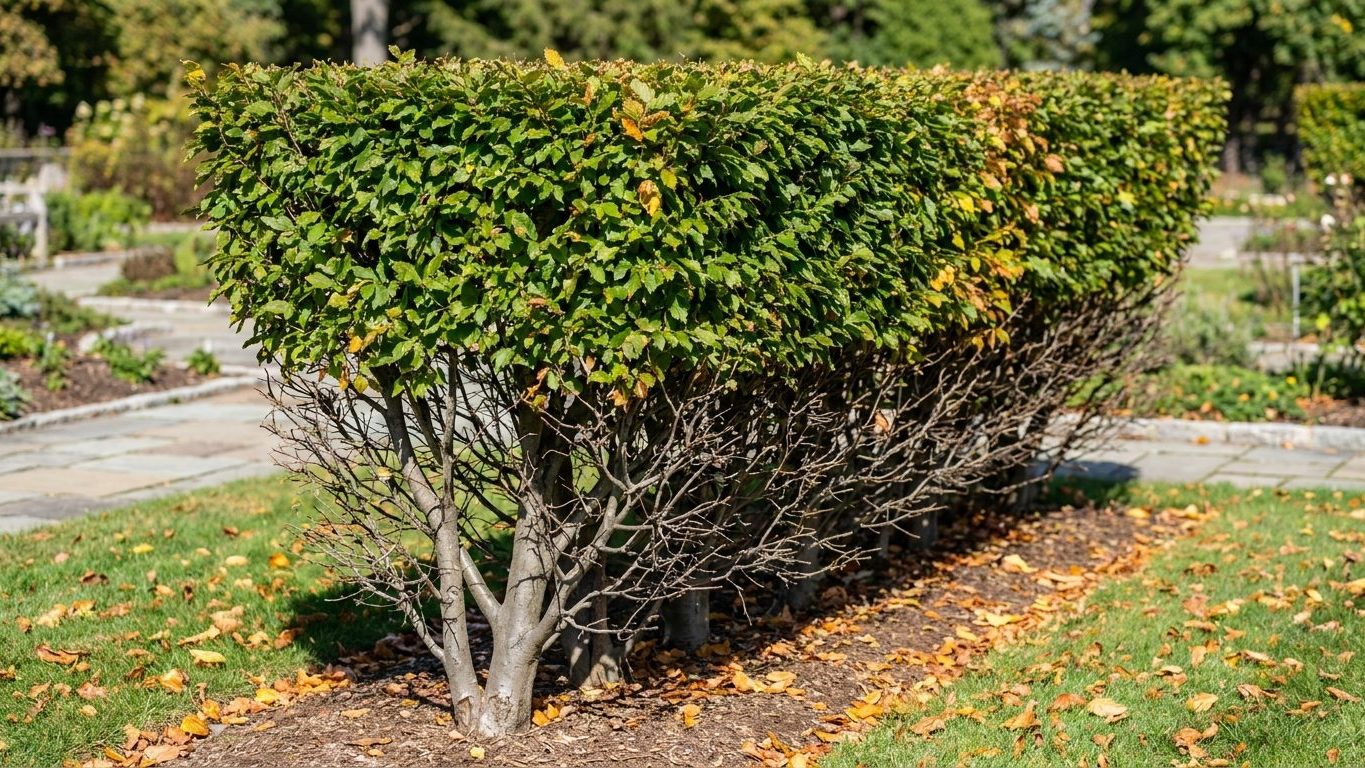

American hornbeam hedges bare out at the base almost always because of how they’re cut, not because the plant is dying. Vertical or inward-tapered sides starve the lower branches of light until they drop off entirely. The good news: this species carries dormant buds under the bark and regrows from old wood, so a bare bottom is a shape problem you can correct, not a death sentence.
Telling apart what makes american hornbeam bare at the bottom
Before cutting anything, look at where the bare band sits and how it lines up with the seasons. A hedge that’s thin at the base along its entire length, all year round, regardless of rainfall or temperature, is telling you about light, not disease. That pattern points to the shape of the cut: sides that lean in toward the top, or run perfectly vertical, shade the lower foliage until it stops photosynthesizing and drops. The plant isn’t sick. It’s starved of sun on the one part of itself that needs the most of it.
A different pattern means a different cause. If the bare patch is localized to one section of the hedge, especially where a tree canopy or a building casts shade on just that stretch, competition for light from something outside the hedge is the driver, not the pruning cut. If dieback shows up suddenly, with wilting foliage, sunken bark, or oozing cankers concentrated on a few branches rather than spread evenly across the base, that’s a tissue problem, and it needs an identification, not a pruning fix.
The test you can run today
Reach into the hedge at chest height and check the width of the canopy up top against the width at knee height. If the top spreads out wider than the base by more than a few inches on either side, the hedge is shaped like an upside-down cone, and that shape is doing the shading itself. That’s the single most common finding on a hornbeam hedge with a bare bottom, and it’s fixable with a taper, which the next sections cover.
| Cause | Where it shows | Season pattern | Quick check |
|---|---|---|---|
| Pruning shape (shading) | Uniform along the whole hedge base | Present year-round | Top wider than base by several inches |
| Outside shade competition | One section only, near a tree or wall | Worse in leaf-on season | Bare zone lines up with the shadow, not the pruning |
| Disease or canker | A few branches, not the whole base | Sudden, often spring or after wet weather | Sunken or discolored bark, wilting leaves |
| Old age, natural legginess | Whole base, slow onset over years | Gradual, no seasonal spike | Interior branches thin and woody, few live buds |
If the pattern in the table doesn’t fit cleanly, or if there’s active canker or dieback that spreads season to season, that’s the point to send a sample or photos to your state extension service before doing any cutting. Shape problems, you can fix yourself. Tissue disease needs an ID first.
Will it come back?
Yes, if the cause was light and shape, American hornbeam will regrow from the bare wood, including old, thick, brown branches that look permanently dead. This species holds dormant buds tucked under the bark along its full length, not just at the growing tips, which is exactly what a lot of common hedge conifers lack. Cut a hornbeam back hard into brown wood and, within a season or two, those buds break and push new growth from spots that hadn’t carried a leaf in years.
The mechanism matters because it changes what “coming back” means. On a plant without dormant buds under the bark, cutting into bare wood removes the plant’s only chance to regrow that section, permanently. On American hornbeam, that same cut is an invitation. The bark is a wrapper around living tissue that’s been waiting for light. Open the hedge up, and the wood answers.
Where the answer changes is disease, not shape. If the bare section traces back to a canker or vascular problem rather than shading, cutting into that wood won’t reliably produce new growth, because the tissue itself is compromised, not just under-lit. That’s the case where an extension identification before pruning saves a wasted season.
Doing nothing has its own cost. Left as is, a shaded-out bare base doesn’t recover on its own, because the branches above keep casting the same shadow year after year. The longer the taper problem runs, the more wood has to be removed to fix it, since the dead zone thickens each season the shading continues. A hedge that’s been bare at the bottom for two years takes a lighter renovation cut than one that’s been that way for eight.
Stopping the cause
Watering and spacing rarely explain a bare bottom on American hornbeam, this species tolerates a wide range of soil moisture and isn’t particular about air movement the way some fungus-prone hedges are. Sanitation, removing fallen leaves and dead wood from inside the hedge, helps general plant health but won’t undo a shading problem on its own. What actually decides the outcome is the shape of the cut.
The fix is a taper: wider at the base, narrower at the top, so sunlight reaches the lower branches instead of sliding past them onto the canopy above. Reshape the hedge in that direction over one or two seasons rather than all at once, cutting harder at the top than at the bottom each time.
- Cut the top narrower than the base, every time you shape, not just once
- Prune during the pruning window most extension services recommend for this species, in midsummer after the first flush of growth, since your local frost dates set the exact timing
- Thin a few interior branches near the base to let light and air reach the trunk, not just the surface
- Hold off on fertilizer as a fix, since the problem is light, not nutrition
American hornbeam responds well to hard structural correction, this is a species built to survive it. It does not respond to feeding, extra watering, or waiting it out, because none of those change the amount of light reaching the base. If the bare patch turns out to be disease rather than shape once you’ve ruled shading out, your state’s cooperative extension service is the right place to send a sample or photo for identification before you decide on any treatment.
What to do with what is left
Once the cause is removed, there are four honest paths, and they don’t cost the same in time. Living with it means leaving the bare band as is, which costs nothing now but keeps the hedge looking hollow at eye level indefinitely. Renovation, the hard taper cut into old wood, is where American hornbeam earns its reputation: because it regrows reliably from bare brown wood, a full refill of the lower hedge typically shows results within one to two growing seasons, at the species’ rate of about 12 inches a year.
Interplanting, tucking a low shrub or perennial screen in front of the bare section, hides the problem without fixing it, and it’s a reasonable stopgap while a renovation cut fills back in over its one or two seasons. It costs the price of a few plants and an afternoon, not months of waiting.
Replacement is the honest answer only where the cause turns out to be tissue disease that’s spread through a long run of the hedge, not shading. In that narrow case, renovation pruning won’t rebuild dead tissue, and pulling the affected section is faster than nursing wood that can’t respond. But for the far more common shading cause covered above, replacement is overkill: a hedge that regrows from old wood this reliably rarely needs to be dug out over a shape problem that a taper cut solves.
Common questions
How long does it take American hornbeam to fill back in after a hard renovation cut?
At roughly 12 inches of growth a year, most bare sections start showing visible new leaf cover within one growing season and fill out fully by the second, assuming the shading cause was corrected at the same time as the cut.
Can I fix a bare bottom without cutting into old, thick wood?
Only if the bare band is thin and recent. Once branches have been shaded out for more than a season or two, the interior wood has already gone leafless and needs a real renovation cut, not a light trim, to reach the dormant buds underneath.
Does American hornbeam lose its leaves in winter like other deciduous hedges?
It holds many of its dead leaves through winter instead of dropping them, which is why a hornbeam hedge still reads as a solid screen at a time of year when most other deciduous hedges next to it are completely bare.
What USDA zones support American hornbeam as a hedge?
It’s hardy across USDA zones 3 through 9, and as a hedge it typically runs 6 to 15 feet tall, which covers most residential screening needs without pushing into tree-sized maintenance.