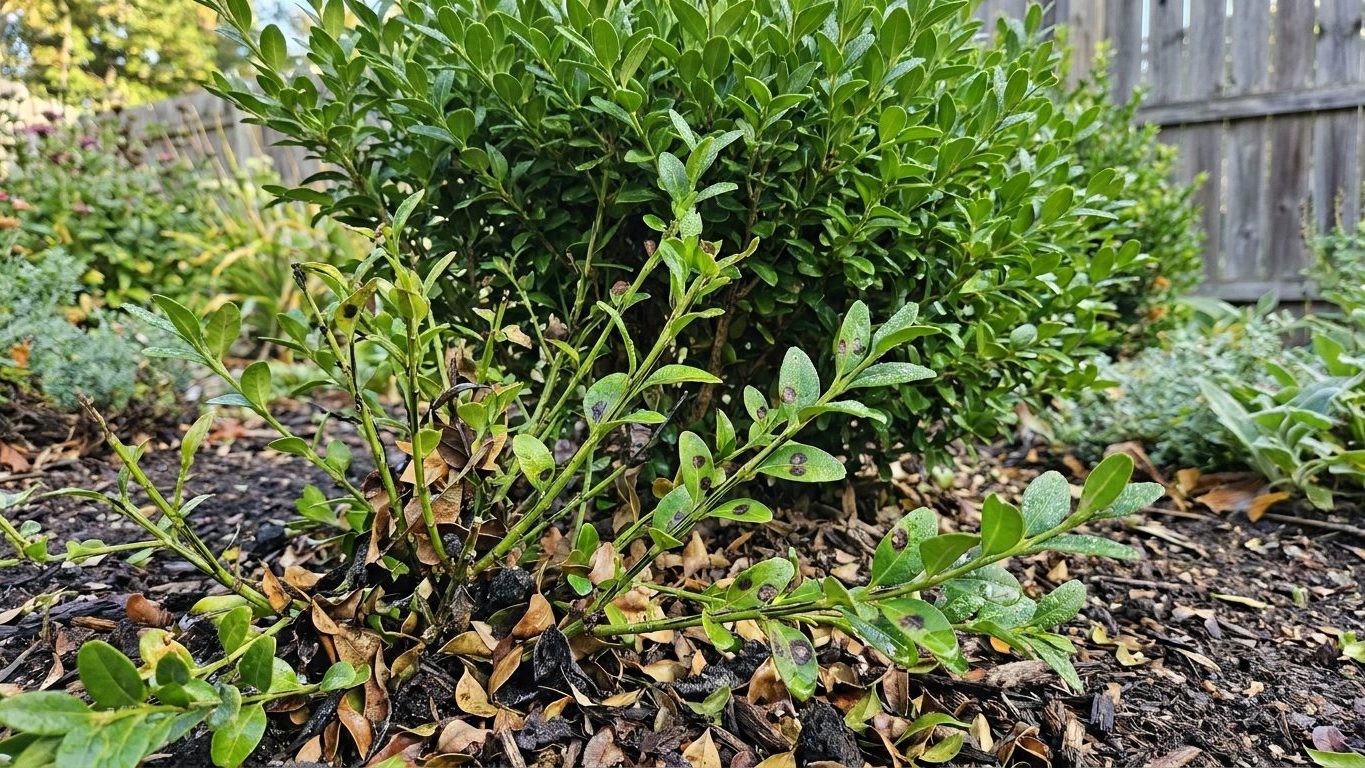

Boxwood blight is a fungal disease marked by dark leaf spots, black stem streaks, and rapid leaf drop starting at the bottom of the plant. That bottom-up pattern is what separates it from leafminer damage and volutella blight. The fungus survives for years in fallen leaves, so a hedge that loses its lower third in one season, while the top stays green, is the one to test first.
Telling apart what makes boxwood blight
Before treating anything, walk the hedge and check three things: where the damage starts, what season it showed up, and whether the leaves show spots or the inside of the leaf is hollowed out. Those three answers narrow the cause faster than any label on a shelf.
Boxwood blight begins low. The fungus favors the lowest branches, where fallen leaves from an earlier infection sit against new growth and humidity lingers longest. Look for dark, almost circular spots on individual leaves, sometimes rimmed with a lighter edge, and thin black streaks running along otherwise green stems. Within weeks the lower third of the plant can go bare while the top stays full and green, because the fungus works from the ground up, not from the tips down.
Boxwood leafminer damage looks different and shows up on a different clock. Instead of spots, leaves develop pale, blistered patches where larvae have tunneled inside the tissue, usually noticeable in spring as new growth expands. The damage scatters across the whole plant rather than concentrating at the base, and the leaf stays attached.
Volutella blight belongs to a different set of conditions. It shows up in hedges that were never thinned, where branches touch each other and air never moves through the center. Leaves turn a dull tan or pink and tips die back in patches, clustered wherever growth is thickest rather than following top or bottom.
One test tells you more than a walk-through. Grab a lower branch where leaves look spotted and shake it gently. If a cluster of leaves drops at the lightest touch, the pattern points to blight, because infected tissue loses its grip on the stem fast. Leafminer damage stays put when shaken. Volutella tissue tends to dry and cling rather than fall.
| Cause | Where it starts | Season | Pattern |
|---|---|---|---|
| Boxwood blight | Lowest branches, near soil | Warm, humid stretches | Bottom-up defoliation, black stem streaks |
| Boxwood leafminer | Scattered, on new growth | Spring | Blistered pale patches, leaves hold on |
| Volutella blight | Dense, unthinned centers | Any crowded season | Tan or pink dieback in patches |
A hedge can carry more than one of these at once, especially if it was already crowded before blight arrived. When the pattern does not match cleanly, a state extension office can confirm which fungus, or which insect, is actually present.
Will it come back?
Yes, but only the plant comes back on its own. The fungus does not fade out with time. Boxwood carries dormant buds tucked under the bark along every stem, even on wood that looks bare and brown, and those buds are what let a hard-pruned plant refill with new leaves over a season or two. That is the part of the plant that recovers.
The blight itself works differently. It survives inside fallen leaves on the ground, sometimes for years, waiting for the next wet stretch to spread spores back onto fresh growth. Cutting the plant back removes the damaged wood, but it does nothing to the fungus sitting in the leaf litter underneath. Skip the cleanup and the same infection reinfects the fresh growth within a season, because the spore source never left the bed.
This is why the same question gets two different answers depending on what “it” means. Ask whether a hard-pruned boxwood will grow leaves again, and the answer is almost always yes, because the dormant buds under the bark do not care how bare the stem looks. Ask whether the blight will return to that same plant, and the answer depends on whether the leaf litter, the pruning tools, and the surrounding soil got cleaned up before the new leaves came in.
A plant cut back without any sanitation work is not being treated. It is being handed fresh, tender growth to feed the same fungus already established in the bed. Extension pathologists tracking outbreaks report the disease moving fastest in hedges where old leaf debris sat through a second wet season, because that debris is where the fungus overwinters and rebuilds.
The mechanism carries over to a different plant. Inherit a hedge with a blighted history, and the same rule applies: the stems can regrow no matter how bare they look, but the ground beneath them decides whether that regrowth lasts.
Stopping the cause
Boxwood blight spreads through water and contact, so the changes that matter most target moisture and touch, not fertilizer or soil chemistry. Overhead watering splashes spores from infected leaf litter onto clean foliage, so switching to drip or soaker lines at the base cuts that transmission point directly. Watering in the morning instead of the evening gives leaves time to dry before nightfall, because the fungus needs several hours of wet leaf surface to infect new tissue.
Spacing and air movement work on the same logic. A hedge planted tight enough that branches interlock holds humidity inside the canopy long after a storm passes, and that trapped moisture is the same condition volutella blight needs. Thinning out crowded interior growth, rather than only shearing the outer face, opens paths for air to move through and dry the center faster.
Sanitation is the step that actually decides the outcome. Every fallen leaf under an infected plant is a spore reservoir, so raking and bagging that litter, rather than letting it break down naturally, removes the fungus’s main overwintering site. Pruning tools carry spores from branch to branch and from yard to yard, so wiping blades between cuts with a disinfectant keeps a localized infection from becoming a hedge-wide one.
The shape of the cut matters less than these other steps, but it still counts. Clean, angled cuts made with sharp tools heal faster and give the fungus less damaged tissue to colonize than a ragged cut from dull shears.
Sanitation is the one step the plant cannot compensate for on its own, since better drainage or thinner growth only slows the spread, while leaf litter left in place reinfects the plant every wet season regardless of how well it is watered afterward. Fertilizer and soil pH, by contrast, do not move the needle on blight either way.
Because blight, leafminer, and volutella produce overlapping symptoms, and treatment decisions differ for each, a state extension service is the right place to send a sample or photo for confirmation before committing to a renovation plan.
What to do with what is left
Living with a light case is a real option, not a compromise. If only the lowest branches show spots and the rest of the hedge stays healthy, removing the affected stems and staying on top of sanitation can hold the disease at a low level for years without pulling the plant.
Renovation is the next step up, and it works because of how the species is built. Boxwood regrows from old wood, so a hedge cut back hard, even down to bare brown stems, can refill within a season or two once dormant buds under the bark push new growth. Renovation only pays off if the cause was already removed. Cutting back a plant while the leaf litter underneath is still infected just produces a fresh crop of tender leaves for the same fungus to reinfect.
Interplanting buys time on a hedge that is only partially failing. Setting disease-free boxwood, or a different species entirely, into gaps left by dead sections keeps the hedge line while weaker plants either recover or get pulled later. It works best as a bridge, not a permanent fix, since a mixed-age hedge rarely reads as uniform as one planted all at once.
Replacement is the honest answer once infection has moved through most of the hedge, or once it returns after a full renovation. At that point the soil around the roots is carrying enough fungal load that fresh planting on the same line, without addressing the ground first, tends to catch the same disease. Replacing the run is usually the faster path back to a full hedge once bare sections have already gone through one failed cutback.
Growth rate sets the timeline regardless of the choice. At three to six inches a year, a replanted line reaching a hedge height of two to six feet takes several seasons either way, so the real decision is where those seasons go: into a plant still fighting an established infection, or into one starting clean.
Common questions
Can boxwood blight spread to other shrubs in the yard?
The fungus infects boxwood and a small number of related plants, but it does not move into unrelated shrubs such as holly or privet. A blighted hedge can sit next to healthy plants of a different species with no cross-infection risk.
How long does the fungus survive in fallen leaves?
Research tracking outbreaks has found the fungus can persist in leaf litter for years, which is why removing debris matters even after visible symptoms clear up.
Is it safe to compost boxwood leaves after blight?
Home compost piles rarely reach the sustained heat needed to kill the fungus, so infected leaves are better bagged for the trash than added to a compost bin that might later return to garden beds.
When is the right time to prune a blighted hedge?
Late spring, after the last frost, is the window boxwood tolerates best for hard pruning, since the plant channels its strongest regrowth into cuts made once frost risk has passed. A local state extension service can confirm the exact timing for a given frost zone.