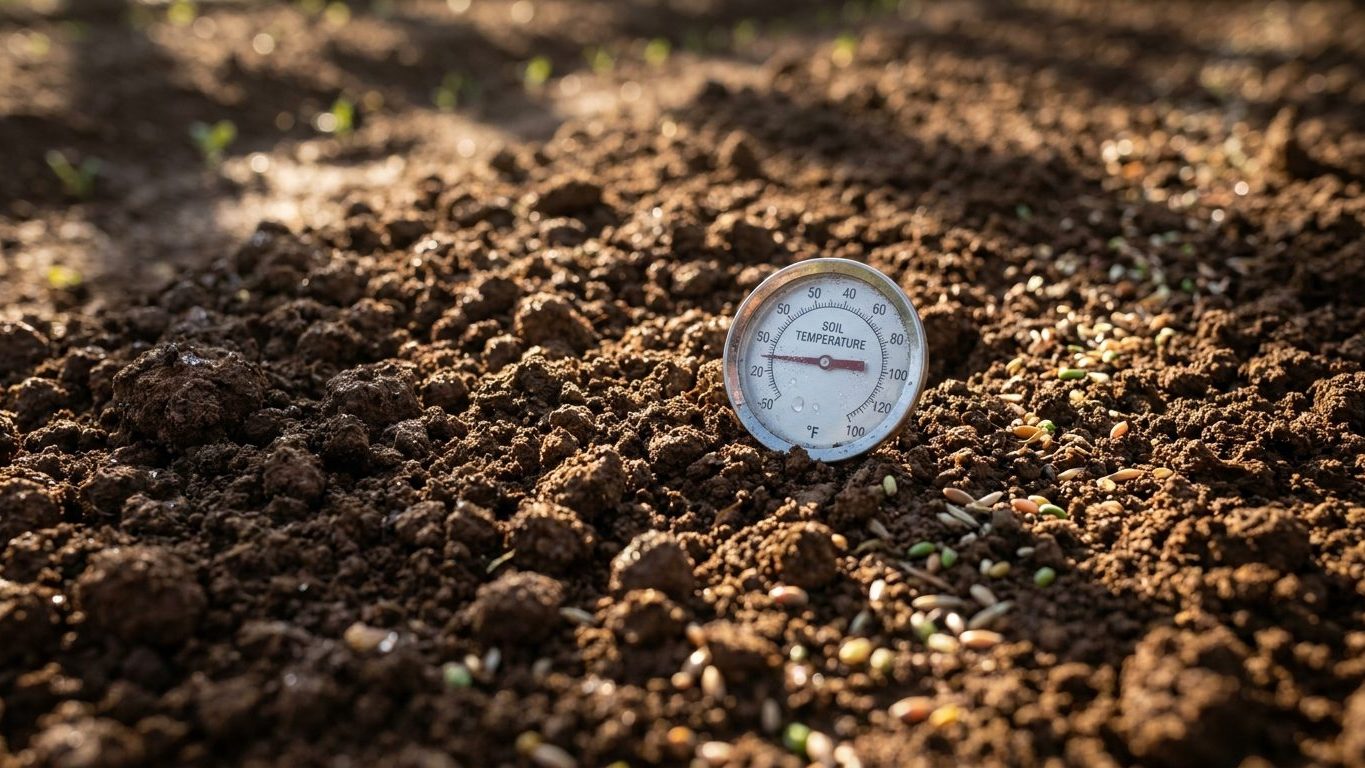

In Montana, cover crops go into the ground once the soil itself holds steady warmth, typically mid to late May around Billings, and come out by the first hard frost in early October. That margin on either end is short by national standards, shaped by a cold, high-elevation climate where the coldest month of the year barely climbs above 18°F on average. What survives winter and what turns into mulch depends entirely on species, not on a hopeful planting date.
When the soil is warm enough in Montana
The frost date is a proxy, not a rule
The calendar says April 29 to May 10 for the last spring frost around Billings, according to NOAA’s 1991-2020 Climate Normals for that station. That’s the useful number, but it isn’t the number cover crop growers actually need.
Frost dates track air temperature recorded a few feet above the ground at a weather station. Soil temperature lags behind air temperature by days, sometimes weeks, because dirt holds winter cold long after the sky above it has warmed. A cover crop seed sitting in soil still cold from winter won’t germinate just because the frost risk has technically passed. It sits, it rots, or it comes up weeks late and never catches up. Treat the frost window as the outer edge of possibility, not the starting gun.
That April 29 to May 10 range is itself a probability band, not a guarantee. NOAA builds it from three decades of freeze data, marking the dates when a 32°F freeze has a 30 to 70 percent chance of still happening. A frost outside that window isn’t rare, just less likely. Anyone gardening in a mountain valley elsewhere in the state should treat this Billings-based number as a mild-case scenario. Valleys tucked against higher terrain can see frost in nearly any month, cover crop season or not.
What actually decides when to seed
What governs the seeding date, plant by plant, is how long the soil has had to warm. Cool-season grasses like oats or cereal rye tolerate cooler soil and can go in earlier. Legumes and broadleaf species generally want more warmth before germination rates hold up. Rather than pinning one date to the whole plan, watch the soil itself: has it dried out from spring mud, does it crumble instead of clumping, has it held warmth through a full day-and-night cycle rather than just an afternoon.
How much seed to put down for a given species, and by what method, depends on stand goals, drill versus broadcast, and soil condition, none of which one article can responsibly answer with a blanket rate. Montana State University Extension (montana.edu/extension) publishes species-specific guidance suited to local conditions, and that’s the right source before buying seed.
Termination follows the same logic as seeding: mechanical, not chemical. A cover crop stand here gets mowed, crimped, cut, or simply left for a killing frost, depending on the species and what’s planted next. No herbicide step is assumed or needed in this approach.
How long the season lasts here
What a five-month window allows
Subtracting one frost range from the other gives the real planning number: the frost-free window around Billings runs somewhere between 155 and 157 days, depending on which end of each NOAA range you use, from a last spring frost as early as April 29 or as late as May 10, to a first fall frost as early as October 1 or as late as October 14.
That’s roughly five months, which sounds workable until it’s measured against a longer-season state. In much of the country, a grower can seed a fast cover crop after spring greens come out in June, terminate it by August, and plant a second cover crop before fall. Around Billings, that kind of double cropping is tight. A five-month window is enough for one solid cover crop cycle, seeded after a spring harvest and terminated ahead of the first freeze, but there’s little slack for a false start or a full second rotation.
This is where the window’s length changes the actual decision a gardener makes, not just the date on the calendar. With a longer window, it makes sense to wait, let a summer crop finish fully, and still get a full cover crop stand established before frost. With Montana’s shorter margin, the safer move is often to seed as soon as a bed opens up rather than holding out for a tidier start. A stand that goes in three weeks late, with roots barely set before the ground cools, gets far less benefit than one seeded promptly into imperfect conditions.
Anyone working a rotation where a spring crop comes out mid-summer, and there’s a real question of squeezing in two cover crop cycles versus committing to one longer stand, should check the site’s succession sowing guide for how that math works crop by crop.
Heat and water in Montana
The number that decides winter survival
Ask about cover crops in a hot southern state and the conversation centers on heat stress and humidity-driven disease. Ask the same question around Billings and the conversation flips almost entirely. This is cold country, and the number that matters most is 17.9°F, the average daily minimum temperature during the coldest month, per NOAA’s 1991-2020 Climate Normals for the reference station.
That figure isn’t a record low or a monthly average. It’s the typical overnight floor, night after night, through the coldest stretch of winter. It’s what decides which cover crop species survive the winter standing and which die back completely, leaving a dead mat of residue instead of a living plant. That same coldest-month figure underlies Montana’s USDA Plant Hardiness range of zone 3a to 6a, built from the same 1991-2020 normals. That’s a span across the whole state, not one zone, and it’s wide enough that any recommendation calibrated to Billings’ milder end won’t hold up in a colder mountain valley elsewhere.
The first fall frost, arriving October 1 to October 14, sets the other half of the equation: the last realistic date to get a cover crop seeded and rooted enough to survive winter at all. Sow too close to that date and a stand won’t have time to dig in before growth stops, regardless of species.
Why heat and rainfall matter less here
What doesn’t drive the decision here, at least not the way it does farther south, is summer heat or humidity. No days-above-90°F count or summer rainfall figure for this station changes the core equation the way winter cold does. A Montana grower isn’t managing mildew from a sticky summer or watching a cover crop bolt from sustained heat the way a grower in a hot, humid state might. The climate here runs dry and short on summer moisture more often than it runs oppressively hot, which mostly slows germination in a dry topsoil rather than fueling plant disease.
The practical upshot: a species that would overwinter and turn into a persistent, hard-to-kill weed in a milder territory behaves completely differently here. Oats are the clean example. In a warmer state, oat plants that survive winter come back the following spring uninvited, spreading past their bed. Around Billings, that coldest-month floor near 18°F kills oats outright, turning what could be a nuisance into one of the simplest species on the list: it grows fast, blankets the soil, and dies on its own schedule with no cutting or crimping required.
Which cover crops suit Montana
Sorting by type, not by variety
Given a five-month window and a winter that reliably drops near 18°F, three broad categories make sense here, sorted by how they handle cold rather than by variety name.
Cool-season cereals, oats, cereal rye, winter wheat, and triticale among them, tolerate the short window and cooler soil at planting better than most other options. Winter survival splits them further: oats reliably winterkill in this climate, dying into a soil-covering mulch without any cutting needed, while cereal rye, winter wheat, and triticale are cold-hardy enough to survive the coldest month and keep growing into spring, which means they need mechanical termination, mowing, crimping, or cutting, before they set seed or crowd out whatever’s planted next.
Legumes, field peas, hairy vetch, and clovers among them, offer a different benefit: root nodules housing bacteria that pull nitrogen from the air and fix it into a form the soil can use later. How much nitrogen ends up available to a following crop depends on the specific legume, how much biomass it built before termination, and how that termination was timed, not on a fixed number that applies everywhere. Some legumes in this group winterkill in Montana’s cold; others need the same mechanical termination as the hardier cereals.
Brassicas, tillage radish and mustard among them, grow fast and put down aggressive roots that break up compacted soil, useful in a short season where speed matters. They tend to winterkill reliably here too, leaving loosened soil and surface residue behind.
| Type | Fit for Montana’s short, cold season | Typical winter fate here |
|---|---|---|
| Cool-season cereals (oats, cereal rye, winter wheat, triticale) | Tolerate cool soil, fast establishment | Oats winterkill; rye, wheat, triticale overwinter and need cutting |
| Legumes (field peas, hairy vetch, clovers) | Add fixed nitrogen through root nodules | Varies by species; some winterkill, some overwinter |
| Brassicas (tillage radish, mustard) | Fast growth, root channels for compaction | Generally winterkill |
None of this replaces a variety recommendation, and this page won’t try to give one. Which specific strain of winter wheat or which vetch selection actually performs in a given county depends on local trial data that shifts year to year, soil by soil. Montana State University Extension (montana.edu/extension) runs and tracks those trials. Naming a cultivar here, without that local trial history behind it, would be a guess dressed up as advice. Sorting by type, cereal versus legume versus brassica, cold-hardy versus winterkilling, is the useful decision this page can make. The variety name is the next question, and it belongs to the extension office, not to a general guide.