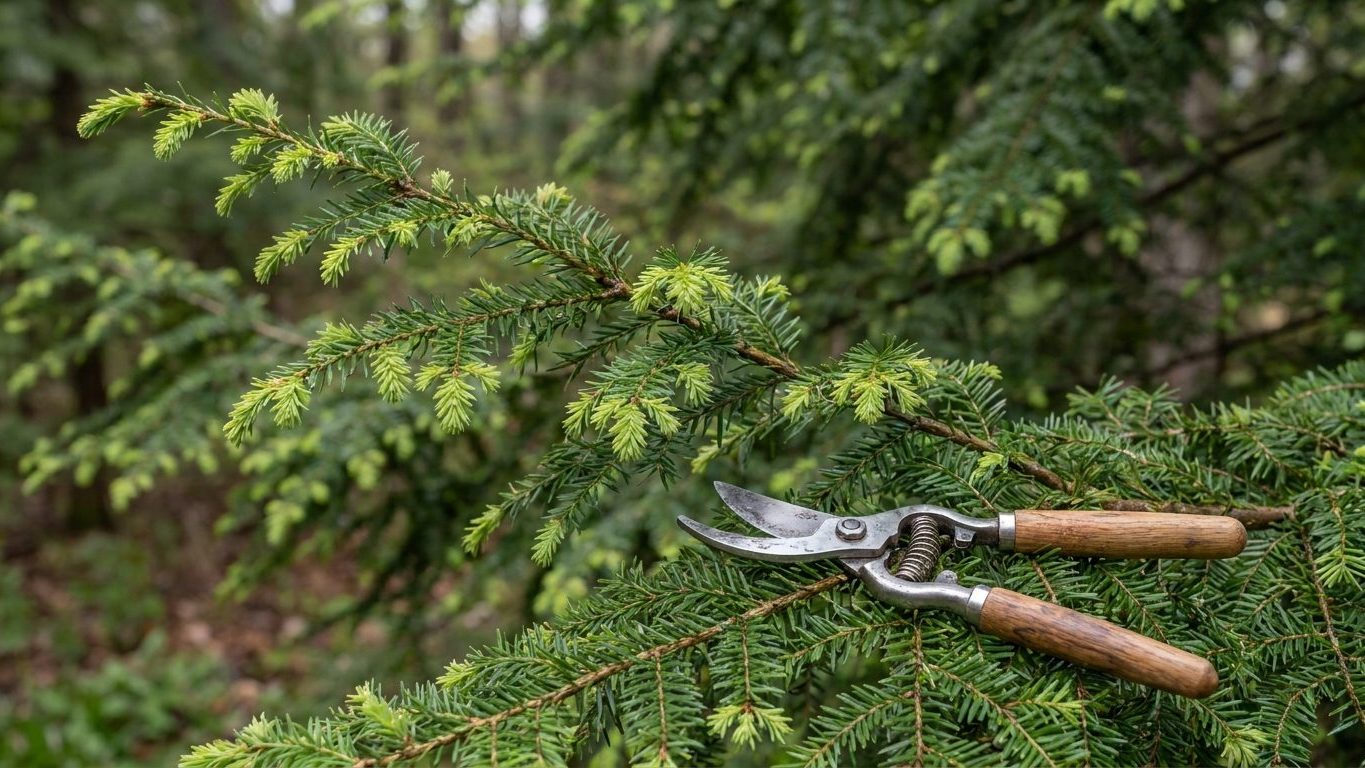

Prune eastern hemlock in late spring, right as new growth starts pushing from the branch tips. That timing works for a young hedge getting its first shape and for an old one headed into a hard renovation cut. The plant’s own growth flush, not a date on a calendar, answers the timing question.
When to Prune Eastern hemlock
The right moment to cut isn’t a date, it’s a signal: new needles pushing soft and light green from the tips of last year’s growth. That flush shows up in late spring across most of the range, though the exact week shifts by climate since hemlock grows in USDA zones 3 through 7, from northern Minnesota down to the Carolina mountains. A hedge in a zone 3 yard breaks bud weeks later than one in zone 7, so a fixed calendar date tells you almost nothing useful.
What matters is the mechanism behind the timing. Eastern hemlock puts on 12 to 24 inches of new growth a year, and that growth radiates outward from cuts made just as it starts. Trim right when the buds swell and the plant spends the whole growing season covering the cut ends with fresh foliage. Wait until midsummer and the wood has already hardened, slowing that cover-up. Cut in fall and the wound sits exposed through freezing temperatures and snow load, with no new growth coming to close it until spring finally arrives.
A late-spring cut also lines up with when the plant is actively pulling stored energy up from the roots, which is exactly what fuels that fast flush of regrowth. Cut too early, before the buds swell, and the plant hasn’t started mobilizing that energy yet, so recovery drags.
For a hedge already at its mature height, one light shearing in late spring is usually enough for the whole season, since most of the annual growth happens in that first push. A second, lighter touch-up in early summer is fine if the hedge is growing fast, but anything cut after midsummer risks sitting exposed all winter with no time left to close over. The local Cooperative Extension office is a better source for an exact local date than any national planting calendar, since frost dates and bud break vary too much region to region for one number to apply everywhere.
How hard you can cut it back
Most conifer advice says never cut into bare wood, and for pines, spruces, and firs that’s correct, since they carry no dormant buds under old bark and a hard cut leaves a permanent gap. Eastern hemlock breaks that rule. It regrows from old wood, carrying dormant buds beneath the bark on branches that look bare and brown. That single trait makes it one of the few conifers that tolerates a real renovation cut, the kind that would kill a spruce or fir outright.
An overgrown hemlock hedge that’s crept past 20 feet or spread wider than the space allows doesn’t need to be pulled out and replanted. It can be brought back over a couple of growing seasons instead. Taking the whole hedge down to bare wood in a single pass is possible on hemlock, but it costs the hedge its screening value for a full year or more while it recovers, and it stresses a plant that may already be dealing with pest pressure elsewhere on the property.
A renovation timeline
| Season | What to cut |
|---|---|
| Late spring, year one | Cut one side of the hedge back hard, to within a few inches of the main stems |
| Rest of year one | Let that side push new growth undisturbed; light shaping only on the untouched side |
| Late spring, year two | Cut the second side back hard the same way |
| Late spring, year three | Shape both sides together and resume normal light trims |
Spreading the hard cuts across two seasons keeps at least half the hedge green and doing its job as a screen while the rest recovers, instead of asking the whole root system to push a full canopy of new growth at once. Because the species adds up to two feet of new growth a year once it’s recovering, a hedge cut back hard in year one can regain several feet of height by the end of year two, putting it back within the 10 to 20 foot range typical for hemlock grown as a hedge inside three growing seasons total. Doing the hard cut outside the late-spring window, on old wood in midsummer or fall, is what actually slows recovery down, since the plant has already shifted energy away from active growth by then.
The shape that keeps the bottom alive
A hedge sheared with flat, vertical sides looks tidy from the front yard, but it’s shading out its own lower branches. The top grows wide and catches all the light, the middle gets less, and the bottom, blocked by everything above it, thins out until it’s bare wood with nothing left to shear. That’s the most common way a hemlock hedge goes bald at the bottom, and once those lower branches die back from lack of light, the plant doesn’t push new growth low enough on old wood to fix it on its own.
The fix is shape, not more water or fertilizer. Cut the hedge with a slight taper, wider at the base and narrower at the top, sloping the face in by roughly an inch for every foot of height. That angle lets sunlight reach the lower branches even as the hedge climbs toward its mature 10 to 20 foot height, keeping the whole face green from the ground up instead of just the top third.
The other number that matters here is how much to remove at once. The standard is the one-third rule: never take more than a third of the plant’s live foliage in a single maintenance trim, outside of a planned renovation cut on old wood. Since the hedge adds 12 to 24 inches a year, letting it grow that much between trims and then removing only a portion of it keeps every cut within that one-third guideline. Take more than a third in a normal seasonal trim and the hedge responds with weak, sparse regrowth instead of the dense flush a light cut produces, because it’s rebuilding lost foliage rather than simply extending what’s already there.
Combine the taper with the one-third rule and a hemlock hedge holds its shape and its lower branches for the long run, needing only that one late-spring pass most years to stay in bounds.
What actually kills eastern hemlock
Pruning mistakes rarely kill a hemlock outright. Drought and poor drainage barely register next to the real threat, which is hemlock woolly adelgid. This tiny, aphid-like insect has killed hemlocks across the tree’s entire eastern range, and it’s the reason several university extension services no longer recommend planting the species at all, even though it can still work as a hedge for anyone willing to watch for it.
Pruning changes exposure, not immunity. A crowded, never-thinned hedge holds still air and damp needles inside its canopy, conditions that let fungal needle diseases take hold and spread branch to branch. An open, well-tapered hedge dries out faster after rain and gives fungal problems less to work with, which is a real benefit of regular light trims. It does nothing, though, against the adelgid itself, which feeds on sap at the base of the needles no matter how the hedge is shaped.
- Small white, woolly masses clustered at the base of needles, visible without magnification
- Needle drop starting from the inside of the branch and working outward
- Thin, grayish-green foliage where growth used to be dense
Anyone planting or maintaining eastern hemlock as a hedge should check with their state’s Cooperative Extension service, the same office that can confirm the local pruning window. Offices such as Penn State Extension, Clemson, NC State, and UMass Extension track adelgid spread county by county and can say whether it’s active nearby right now. Skipping that check risks putting years of careful renovation work into a hedge that’s already lost to a pest no amount of pruning can reverse.
Common questions
Can you prune eastern hemlock in fall?
Light shaping in early fall generally heals before frost, but any hard cut into old wood should wait for the late-spring growth flush, since a fall wound sits exposed all winter with no growth coming to close it.
How often does a hemlock hedge need trimming?
One light shearing a season is typical once the hedge reaches its mature size, since most of the plant’s 12 to 24 inches of annual growth comes in a single spring flush.
Can eastern hemlock be cut back to a stump and regrow?
It carries dormant buds under the bark and tolerates cutting into bare wood, which is why it can handle a staged renovation that would kill most other conifers, but cutting an entire hedge to stumps in one pass still means a long recovery.
Is eastern hemlock still a good choice for a new hedge?
Several extension services now advise against new plantings because of hemlock woolly adelgid, so anyone considering it should check current guidance from their state’s Cooperative Extension before planting.