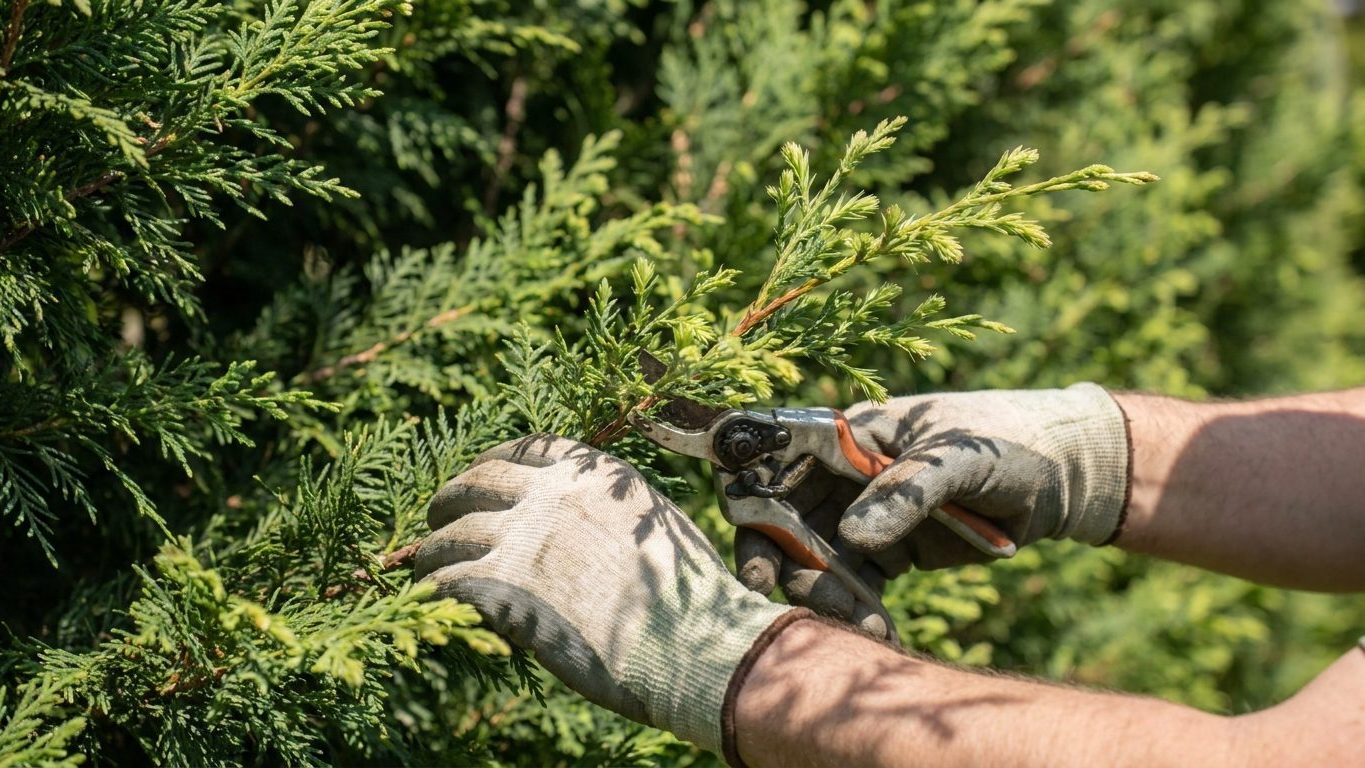

Leyland cypress takes its cue from its own growth, not from a date on the calendar. The right window falls in late spring to midsummer, once the year’s first flush of new growth has pushed out and started to firm up. Cut before that flush and you’re shaping unset wood. Cut well after it and you’re heading into a scar that won’t heal before winter.
When to prune leyland cypress
The plant’s own growth cycle sets the timing more reliably than any date on a calendar. Leyland cypress puts out a strong spring flush of soft new growth, and that flush is what makes the timing work. Cut once that new growth has started but before it’s fully hardened, and the plant has weeks of active growing season left to cover the cut edge with fresh foliage. The scar disappears into the next flush of growth almost before you notice it.
Make the same cut later, once the plant has slowed down heading into fall, and there’s no more growth coming to hide it. The cut sits there, bare, through the entire dormant season. That’s the real difference between a good and a bad pruning date for this species: not the calendar, but whether the plant still has active growth ahead of it to cover the wound.
Because Leyland cypress grows across USDA hardiness zones 6 through 10, that spring flush doesn’t arrive on the same week everywhere. A yard in coastal South Carolina sees new growth push out well ahead of a yard in central Pennsylvania. That’s exactly why a page like this can’t hand you a month and call it done. What it can do is tell you what to watch for: once you see the new growth on the tips has started to firm up and lose its bright, almost yellow-green color, you’re in the window.
A local university extension office is the most reliable place to pin that window down for a specific frost-date zone, since they track it against regional bud break rather than a national average. What matters for the plant itself is simpler. The cut needs enough growing season left after it to close over, and for a species that adds 3 to 4 feet a year, that recovery usually happens fast once the timing is right.
How far back you can cut, and what happens if you go past it
This is the fact that decides almost every pruning decision for this species: Leyland cypress does not regrow from bare brown wood. There are no dormant buds hiding under the bark of the older, woody interior, the way there are on many broadleaf hedge plants. Cut past the green foliage into that bare wood and nothing comes back there. Not next month, not next year. The plant simply has no mechanism to push new growth from that spot.
That leaves one workable rule for every cut you make: cut into the green, never through it. As long as some green foliage remains on the branch beyond your cut, the plant can push new growth from that point and fill back in. Go past the last bit of green and you’ve created a hole in the hedge that stays open for good, a bare gap that every other branch around it has to try, and usually fail, to cover.
That single fact answers the question most people are really asking when they search for how far back this plant can be cut: can an overgrown hedge be brought back down to size. For Leyland cypress, the honest answer is no, not the way you’d renovate a boxwood or a privet by cutting it back hard to bare wood and waiting for it to resprout. If a hedge has grown well past the height or width you wanted, and the green foliage doesn’t extend back far enough to hide a cut that would bring it back into bounds, cutting it back that far leaves permanent bare wood.
There are still real options at that point, just not a quick fix:
- Live with the current size and switch to lighter maintenance cuts that only ever touch the green outer layer
- Thin selectively from within the green zone to open the interior for light and air, without changing the overall footprint
- Remove and replace the hedge, choosing a species or a planting distance that fits the space over the long term
Given that this species is often planted as a fast privacy screen meant to reach 15 to 25 feet, the mismatch between what people plant and the space they actually have is common. Planning for that mature width from day one avoids the whole problem later.
The shape that keeps the bottom alive
A hedge with straight vertical sides, or sides that lean slightly inward toward the top, shades its own lower branches from the moment it reaches any real height. Those lower branches get less light every year as the canopy above them fills in, and a conifer that isn’t getting enough light simply drops that foliage rather than holding onto it. That’s the mechanism behind the most common complaint about overgrown Leyland cypress hedges: a full, green top sitting over a bare, woody bottom that never fills back in, because by the time it’s bare there’s no green left there to cut back to.
The fix is shaping the hedge as a trapezoid rather than a rectangle. Extension guidance for conifer hedges generally calls for keeping the base noticeably wider than the top, tapering the sides inward as they rise so that sunlight can reach all the way down the face of the hedge to the lowest branches. A hedge shaped this way holds its foliage from top to bottom for its entire life instead of losing the bottom third after ten or fifteen years.
The other number worth keeping in mind is how much foliage to remove in a single pass. The long-standing guideline across most woody plants, Leyland cypress included, is to take off no more than about one-third of the green growth at any one pruning. Removing more than that in one session pushes the plant past what it can recover from in a single growing season, and because this species can’t regrow from bare wood, overcorrecting isn’t something you can just fix with a heavier cut next year. Staying inside that one-third limit, cutting on the seasonal window, and keeping the base wider than the top together do most of the work of keeping a Leyland cypress hedge full and green at every height.
What actually kills leyland cypress
The two fungal diseases most often blamed for killing established Leyland cypress are Seiridium canker and Botryosphaeria canker, both of which kill whole limbs outright rather than just thinning foliage. Bagworms are the other major threat, feeding on the foliage in numbers large enough to strip sections of a hedge bare. All three problems share a common trigger: a dense, unthinned hedge that holds moisture in its interior and gives disease and pests exactly the humid, still conditions they need to spread.
Pruning changes that equation directly. A hedge trimmed on schedule and thinned enough to let air move through its interior dries out faster after rain, and that alone cuts down the conditions cankers need to take hold. An overgrown, never-thinned hedge does the opposite: it traps moisture against the trunk and inner branches, and once canker gets established in one limb, the disease typically moves down that limb toward the trunk and kills it outright, with no possibility of the plant regrowing that section from the bare wood left behind.
The growth rate that makes this species so popular as a fast privacy screen, 3 to 4 feet a year, is the same trait that gets it into trouble. A hedge that size in ten years is a hedge most homeowners never planned for, and the crowding that follows is exactly what invites canker and bagworms in. Several university extension programs, including Clemson, NC State, and Penn State, now caution against planting Leyland cypress in tight spacing or high-disease-pressure areas for this reason. Checking with a state extension service before planting, and again before any major pruning decision, is the most reliable way to get guidance specific to local disease pressure and frost dates.
Common questions
Can I prune Leyland cypress in fall?
A light trim that stays well within the green is generally tolerated, but a hard cut made in fall leaves an open wound through the entire dormant season with no active growth left to cover it. The safer window is late spring through midsummer, while the plant still has growing season ahead of it.
Why is the bottom of my Leyland cypress hedge bare?
Straight or inward-leaning sides shade the lower branches as the top fills in, and those branches eventually stop getting enough light to hold their foliage. Because the species can’t regrow from bare wood, that bottom section stays bare permanently once it’s lost.
Can I cut Leyland cypress back hard to control its size?
No. Any cut that goes past the last green foliage on a branch hits wood with no dormant buds, and that section will not regrow. A hedge that’s outgrown its space can be thinned or maintained at its current size, but it can’t be renovated back down the way many broadleaf hedges can.
How do I know if my Leyland cypress has canker instead of just a dead branch?
Canker typically kills an entire limb at once, often with a sunken or discolored patch near where the dead section meets healthy wood. A single dead branch on an otherwise healthy, well-spaced hedge is more likely routine dieback, but a state extension office can confirm it from a sample if there’s any doubt.