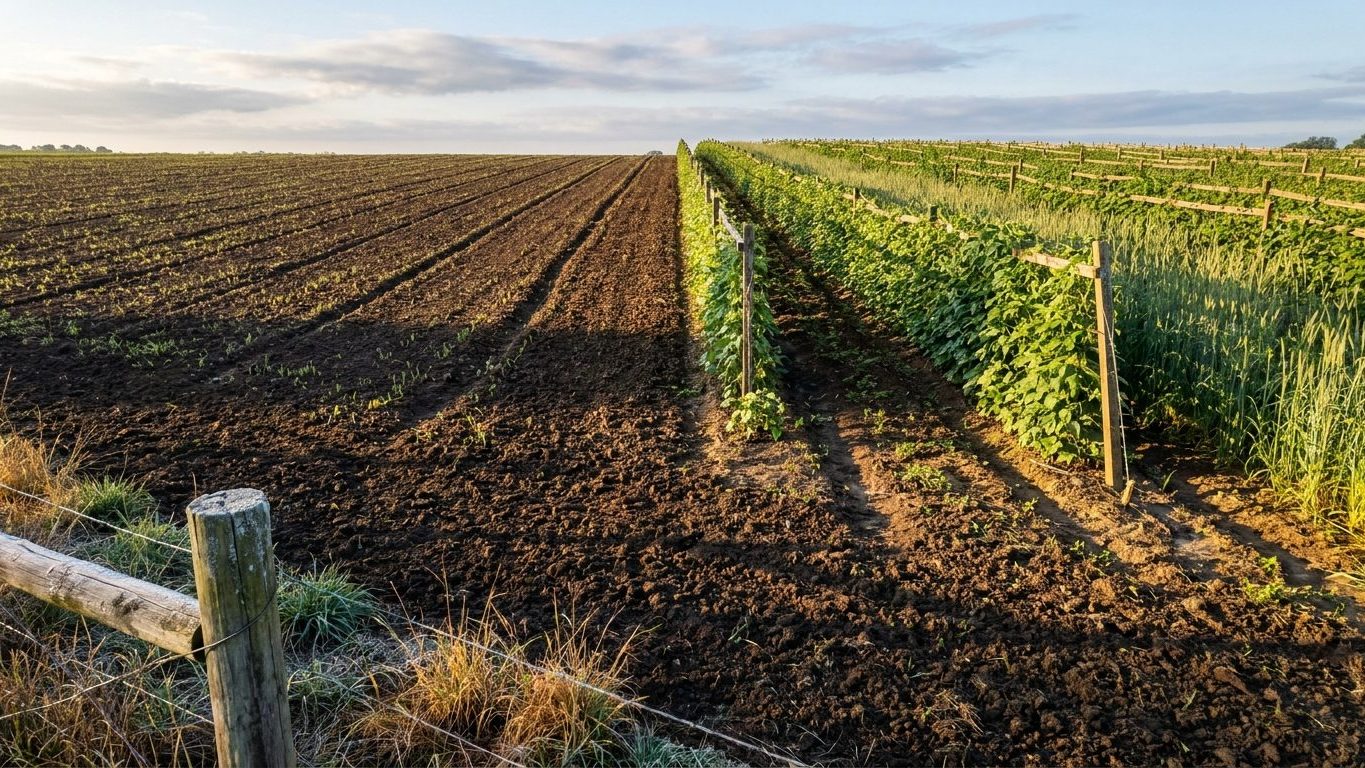

In Arkansas, cool-season cover crops like cereal rye, crimson clover, and hairy vetch go into the ground from late August through mid-October, timed to root in before the first fall frost lands, on average, between November 7 and November 20. Warm-season cover crops such as buckwheat, cowpeas, and sorghum-sudangrass wait until after the last spring frost window, March 12 to March 28. Those dates are probabilities, not promises.
The short answer for Arkansas
Cool-season cover crops belong in Arkansas soil between late August and mid-October. Warm-season cover crops go in after the spring frost risk clears, and the frost dates that define both windows come straight from NOAA’s 1991-2020 Climate Normals for station USW00013963: a last spring frost between March 12 and March 28, and a first fall frost between November 7 and November 20.
Those two date ranges describe a 30 to 70 percent probability band for a 32°F freeze. That means on the early end of each range, there’s still roughly a 30 percent chance frost has already happened (in spring) or hasn’t happened yet (in fall). On the late end, the odds flip toward 70 percent. There’s no single “safe” day hiding in there, just a sliding scale of risk. A gardener who sows crimson clover on September 1 is playing it safer against frost interruption than one who waits until October 15, but is also risking summer heat still lingering in the soil.
Here’s where it gets more specific for tender cover crop species. Buckwheat, cowpeas, and sorghum-sudangrass don’t just dislike a hard 32°F freeze, they get knocked flat by a light 36°F frost. For that threshold, NWS Little Rock gives a tighter and more useful window: April 3 to October 31. If you’re planting one of these frost-tender warm-season covers, plan around those dates, not the 32°F band. Waiting until after April 3 to seed buckwheat, and getting it terminated or harvested before October 31, keeps it clear of the light-frost damage that the 32°F numbers would understate.
For the cool-season crew, rye, oats, winter peas, hairy vetch, crimson clover, the fall sowing math works backward from the November 7-20 window. These species need roughly six to eight weeks of fall growth to establish a root system before winter dormancy sets in, which is why late August through early October is the operative range across most of the state. Sow later than that and you’re gambling on a warm autumn to make up the difference.
What will not work here
The Arkansas failure mode isn’t a short season. The 36°F frost-free window runs from April 3 to October 31, which is a solid seven months. The failure mode here is mismatching a crop’s cold tolerance to what actually happens in an Arkansas winter, and the number that exposes this is the coldest month’s mean daily minimum: 30.9°F. That’s not a record low, it’s the average nightly floor in the coldest month. Winter peas and oats, both marginal in cold tolerance, routinely take damage in years when actual lows dip well below that average, which they do regularly given the state’s hardiness zone spread of 6b to 8a.
Sowing a frost-tender warm-season cover crop before April 3 is the other predictable failure. Buckwheat seeded in mid-March because the calendar says “last frost has probably passed” runs straight into the tighter 36°F window and gets burned back by a light frost that a 32°F-only forecast wouldn’t have flagged. The same logic applies at the back end of the season: leaving sorghum-sudangrass or cowpeas in the ground past October 31, hoping for one more cutting, invites a frost that kills the stand before it’s terminated on your terms.
Timing mismatches that cost a stand
- Sowing hairy vetch after mid-October: it won’t rack up six to eight weeks of growth before the November 7-20 frost window closes in, leaving a thin, vulnerable stand heading into winter.
- Sowing buckwheat before April 3: a single 36°F night can wipe out a stand that a 32°F frost forecast never warned you about.
- Leaving oats or winter peas unmanaged through a cold winter: the 30.9°F average coldest-month minimum undersells how often actual nights drop into the low 20s or teens across the northern half of the state, which these species don’t reliably survive.
None of this is a season-length problem. It’s a threshold problem, matching the crop’s actual cold or frost tolerance to the specific number that governs it, rather than to a single frost date that hides the range underneath it.
What changes across Arkansas
Arkansas isn’t one climate, and the USDA Plant Hardiness Zone Map makes that concrete: the state spans zone 6b to zone 8a. That’s a two-zone spread built on the average annual extreme minimum temperature, and it’s wide enough that a single statewide sowing date doesn’t hold up on the ground.
A grower in the colder end of that range, generally the Ozark highlands and northern counties, is working with winter extremes closer to the 6b end, meaning a shorter effective fall window and less margin for cool-season covers to establish before hard cold sets in. Someone in the warmer end, the southern lowlands and Delta counties near 8a, has more slack: fall sowing can push a bit later into the window, and winter-tender legumes have a better shot at overwintering without significant dieback.
There is no single sowing date that fits both ends of that spread, and this page isn’t going to manufacture one. The practical shift is this: readers toward the northern or higher-elevation parts of the state should lean toward the earlier side of the late-August-to-mid-October fall window, and treat the frost-tender summer covers with extra caution near the April 3 and October 31 edges. Readers toward the southern half have more room to wait a little longer in fall and push a little earlier in spring.
Figuring out which end of that spread applies to a specific address means checking the actual USDA Plant Hardiness Zone Map rather than guessing from a county name. This page can tell you the range exists and how much it matters; it can’t tell you which zone your backyard sits in.
Where to check this for your own county
The University of Arkansas Division of Agriculture’s Cooperative Extension Service is the source built for county-level answers. This page has given the statewide picture built from frost-date probabilities and a two-zone hardiness spread. A county extension office narrows that down to soil types, local rainfall patterns, and the specific varieties that have actually performed in trials near you.
Two things are worth pulling up when you visit: the local planting calendar for cover crops, which will adjust the late-August-to-mid-October fall window and the April-to-October spring window to your specific county’s conditions, and the variety trial results for species like cereal rye, crimson clover, and hairy vetch, which tell you which cultivars have actually held up against Arkansas winters and summers rather than just surviving in a seed catalog description.
A county recommendation beats a state one every time, because it accounts for microclimate factors this page can’t: elevation, soil drainage, proximity to water, and local frost pockets that don’t show up in a station-level climate normal. This article is the state-level starting point. The extension office is where that starting point gets adjusted to fit an actual piece of ground.
Checking this against your own garden
Every date on this page comes from averages and probability bands. Your own garden will tell you something more current, and it doesn’t take instruments to read it.
Start with soil warmth by feel. Push a hand into the top few inches of soil where you’re planning to sow. If it feels cool and slightly damp rather than cold, it’s likely warmed past the point where warm-season cover crop seed will germinate reliably, generally somewhere in the low 50s Fahrenheit and up. This matters more than a calendar date, especially in years running warmer or cooler than the 1991-2020 average this page is built on.
Second, watch for the first flush of common warm-season weeds, crabgrass or pigweed germinating in bare patches nearby. These weeds share a similar soil-temperature threshold with many warm-season cover crops, so their emergence is a free, real-time signal that the ground has crossed the line buckwheat or cowpeas need.
Third, if you’ve got a fast-germinating test patch of buckwheat in, watch for its first bloom, typically within about a month of sowing. That bloom timing tells you how much growing season realistically remains before the fall frost window closes in, which is a more honest read of your specific plot than any regional average can offer.