
Arkansas gardeners can start seeding cover crops from mid-March through late fall, but the real trigger isn’t the calendar. It’s soil temperature and moisture, shaped by a hardiness range that spans 6b to 8a and a winter mild enough that species selection matters more than sowing date.
When the soil is warm enough in Arkansas
NOAA’s 1991-2020 Climate Normals, drawn from station USW00013963, put the last spring 32F freeze anywhere between March 12 and March 28 across the reference period. That’s a 30-70% probability band, not a guarantee, and it’s worth saying once clearly: a frost date describes odds, not a promise that the cold is finished on any single year.
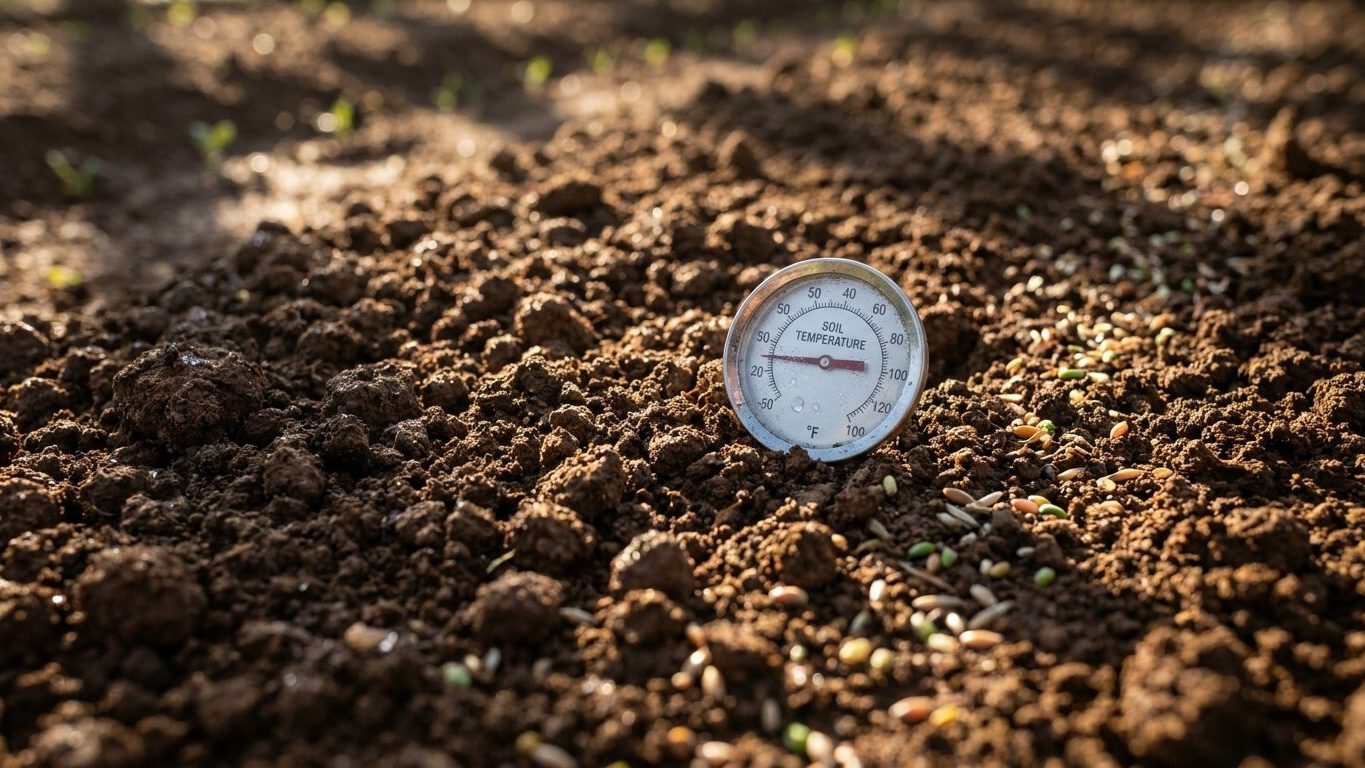
Here’s the part that trips up a lot of new cover-crop growers: that frost date is a proxy, not the actual signal you should be watching. Cover crop seed doesn’t care what the air did last Tuesday night. It cares whether the soil a couple inches down has warmed enough for germination, and soil lags behind air temperature by days or sometimes weeks depending on how wet and shaded it’s been. A frost-free morning in mid-March doesn’t mean the ground has caught up yet, especially after a wet winter that left clay soils cold and saturated.
This matters more for cover crops than for tender vegetable transplants, oddly enough. Many of the species used as cover crops, cereal rye, oats, crimson clover, hairy vetch, tolerate cool soil far better than tomatoes or peppers do, which is exactly why they get planted in fall and again in early spring when a vegetable garden would still be bare dirt. The frost date matters less for whether the seed will survive and more for how fast it germinates and gets established before summer heat arrives.
What actually governs how much to plant
Seeding rate isn’t a single number you can memorize from a chart. It shifts with the species you’re using, whether you’re broadcasting or drilling, how much residue is already on the soil surface, and what you’re trying to accomplish, whether that’s erosion control, weed suppression, or building organic matter. A rate that works for cereal rye drilled into clean ground will overseed or underseed if you switch to a legume mix broadcast over stubble. Because getting this wrong wastes a whole season’s seed and effort, the right move is to check with the University of Arkansas Division of Agriculture’s Cooperative Extension Service for current recommendations before buying seed.
Termination follows the same logic as sowing here: no herbicide is part of the plan on this site. Cover crops get knocked down mechanically, by mowing, crimping, cutting, or simply letting a hard frost finish the job. Timing that termination to the crop’s growth stage, rather than to a chemical label, is a separate skill worth learning before you plant your first acre or your first raised bed.
How long the season lasts here
Run the two dates from the NOAA normals against each other and the window opens up nicely. Last spring frost falls between March 12 and March 28; first fall frost arrives between November 7 and November 20. Even taking the more conservative ends of each range, that’s roughly seven and a half months of frost-free growing season, and that’s before accounting for how many cover crop species don’t need frost-free conditions at all.
What that length actually buys the gardener is flexibility most colder territories don’t have. A season stretching from mid-March into mid-November is long enough to run a full warm-season vegetable crop and still fit a cover crop before it and after it, rather than choosing between the vegetable garden and the soil-building season. In a shorter window, further north, gardeners often have to pick one planting and live with it. Here, succession becomes the default plan rather than a stretch goal.
That length also changes the transplant math. Because there’s enough season to spare, it’s worth pulling a few cover crop plants and checking root development before deciding whether to till them under or transplant vegetables directly into the residue. A shorter season doesn’t leave room for that kind of experimentation; a longer one does. Arkansas’s window sits comfortably in the “experiment a little” category.
The practical upshot is that most Arkansas gardens can fit at least two cover crop plantings into a single year, a cool-season stand from fall through early spring and a warm-season stand slotted into any gap in the vegetable rotation. Timing those successive plantings so they don’t collide with what you actually want to eat is its own puzzle, and it’s covered in more detail in this site’s succession sowing guide, which walks through how to stagger planting dates across a long season without losing track of what’s where.
Heat and water in Arkansas
For most vegetables, Arkansas summers are defined by heat and humidity. For cover crops, though, the more useful question runs the other direction: what happens in winter. That’s the season that actually decides which species survive to spring and which ones don’t need to.
The coldest month here has a mean daily minimum of 30.9F, according to NOAA’s 1991-2020 Climate Normals referenced to Little Rock. That’s just below freezing on an average night in the coldest stretch of winter, not a hard, sustained deep freeze. It’s a threshold that sits right on the edge of what separates a cover crop that dies back cleanly into a protective mulch from one that limps through winter half-alive and has to be dealt with by hand in spring.
Oats are the clearest example of how this cuts both ways. In territories with a harder winter minimum, oats reliably winter-kill, leaving a flat, easy-to-manage mat of dead material that breaks down through spring without any termination effort at all. In a mild winter close to Arkansas’s 30.9F average, that same crop can survive stretches of the cold season and keep growing, turning what was supposed to be a self-terminating cover crop into something closer to a weed that needs mowing or tilling before spring planting. Whether oats behave as the easiest cover crop option or an extra chore depends entirely on how consistently the coldest month drops below that survival line, and Arkansas sits close enough to the edge that year-to-year variation matters.
Species that are bred to survive winter, like cereal rye and crimson clover, don’t face that ambiguity. They’re expected to keep growing through the cold months and get terminated deliberately in spring, mechanically, by mowing or crimping timed to their growth stage. In Arkansas’s climate, that predictability is often the more useful trait than trying to guess whether a supposedly winter-killed crop actually died.
On the humidity side, the specific rainfall and heat-day counts for individual Arkansas locations vary enough across the state’s 6b-8a hardiness range that a single figure would mislead more than it would help. What holds true broadly is that a humid summer climate raises the stakes on airflow and disease resistance for any cover crop left standing into the hot months, a point worth carrying into which species you actually choose.
Which cover crops suit Arkansas
Reasoning from this territory’s own numbers narrows the field usefully, even without naming a single variety. A frost-free season running from mid-March to mid-to-late November, paired with a winter minimum hovering near freezing rather than well below it, points toward legumes and cereals suited to a 6b-8a range: crimson clover, hairy vetch, and cereal rye for the cool season, and warm-season options like buckwheat or cowpeas for summer gaps between vegetable plantings.
The humid summer climate common across Arkansas shifts the priority list, too. Disease resistance and airflow matter here in a way they don’t in a drier territory, because standing residue in warm, damp conditions is exactly the setup that favors mildew and slow decomposition rather than the clean breakdown a cover crop is supposed to provide. A stand that’s too dense, or terminated too late into wet weather, invites problems a drier climate simply wouldn’t produce.
Why this page won’t name a variety
What it deliberately won’t do is recommend a specific cultivar, and that’s not an oversight. Variety performance depends on local disease pressure, soil type, and trial results that shift from county to county, and a name that performs well in one part of the state’s 6b-8a range can underperform in another. The only recommendations that actually mean something are the ones tested against local conditions, and that’s the job of the University of Arkansas Division of Agriculture’s Cooperative Extension Service. The same logic applies to seeding rates and nitrogen contribution from legumes: both depend on species, biomass produced, and how late termination runs, none of which a general guide can respectably guess at for your specific plot.
Termination, as with the earlier sections, stays mechanical, mowing, crimping, or cutting timed to growth stage, or simply letting the plant reach the end of what a mild Arkansas winter allows it to survive.