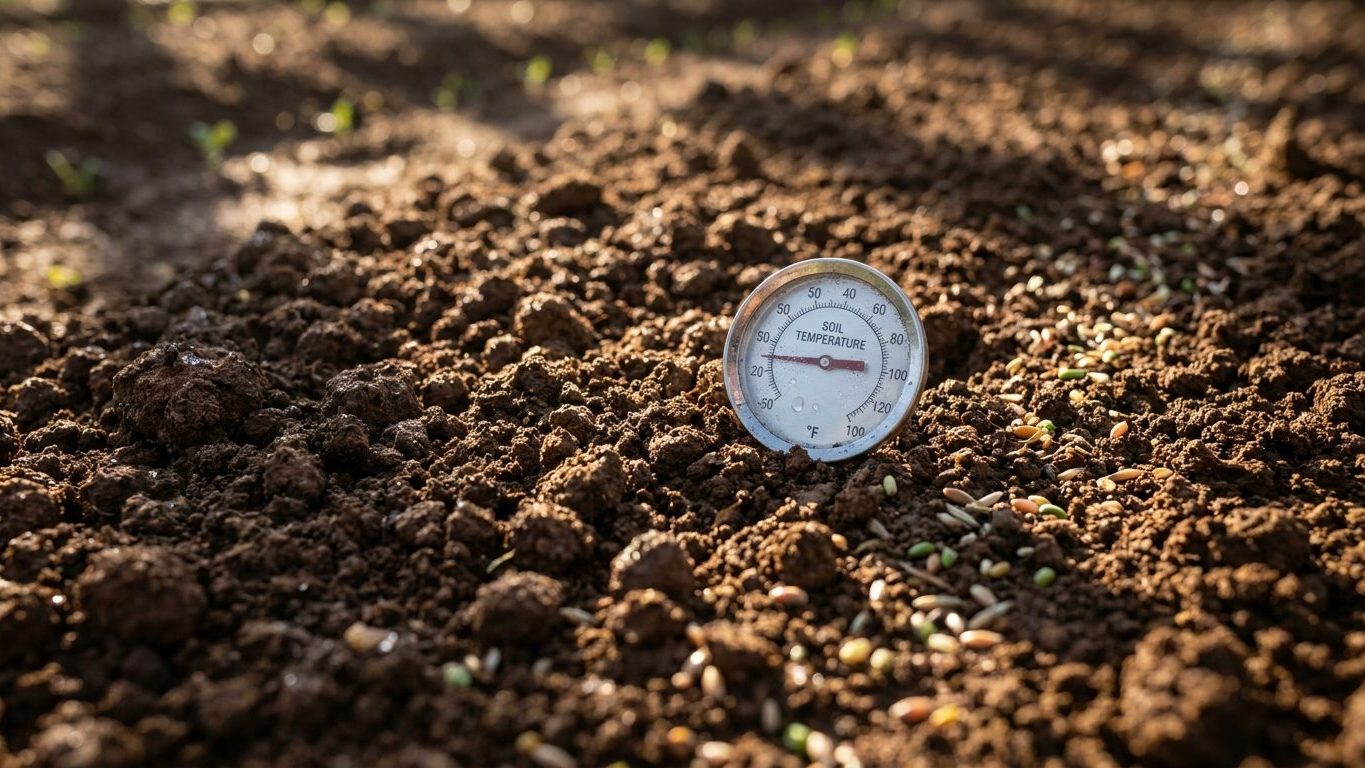

New York gardeners plant cover crops once the frost risk has passed and soil has warmed, which in the New York City area runs from late March into April, with upstate counties and the Adirondacks lagging weeks behind. The right week depends less on the calendar than on where in the state’s 3b to 7b hardiness range a garden sits, and on which species is going into the ground.
When the soil is warm enough in New York
The question every gardener asks first is simple: what date? For the New York City area, NOAA’s Climate Normals for 1991-2020 put the last spring freeze at 32°F somewhere between March 23 and April 3, based on data from the Central Park reference station. That’s a real number, tied to a real weather station, and it should be treated as exactly that: a range, not a single magic day.
But that frost date is a proxy, and treating it as the answer is where a lot of cover crop plans go wrong. Cover crops don’t respond to air temperature on a single morning. They respond to soil temperature over days and weeks, and soil warms on its own schedule, usually trailing behind the disappearance of frost risk by a stretch of time that depends on how wet the ground is, how much sun it gets, and whether it’s covered in old mulch or bare and dark. A raised bed in full sun in Brooklyn can be workable soil well before a shaded clay plot two counties north even thaws out.
That March 23 to April 3 window is also a probability, not a guarantee. NOAA builds it from three decades of freeze data, which means a frost event outside that window is unusual, not impossible. A late cold snap in the second half of April has happened before and will happen again. Treat the date as a planning tool, not an insurance policy.
Species matters more than the calendar here. Cool-season legumes and small grains tolerate cooler soil and can go in earlier; warm-season options need real warmth in the ground before they’ll germinate reliably. This is exactly why seeding rate isn’t something to guess at from a general chart: it shifts with the species chosen, the seeding method (broadcast versus drilled), and the seed source itself. Cornell Cooperative Extension is built for this kind of local calibration, and its regional offices, reachable through the Cornell Cooperative Extension network, can match rate to garden and goal in a way no blanket number can.
Termination follows the same local logic. This site sticks to mechanical methods only: mowing a stand down before it sets seed, crimping to lay it flat and kill it without cutting, or simply letting a hard frost do the work on a tender species that won’t survive winter anyway. No herbicide belongs in this conversation, and for a home garden, it rarely needs to.
How long the season lasts here
Stack the two NOAA frost windows together and New York City’s frost-free stretch runs, at its shortest estimate, from the latest possible spring frost (April 3) to the earliest possible fall frost (November 14), a span of roughly 225 days. At its most generous, using the earliest spring frost (March 23) and the latest fall frost (November 27), that window opens to about 249 days. Either way, that’s somewhere between seven and eight months of workable ground, in the city itself.
That length changes what’s worth planting, not just when. A window that long isn’t just enough for one cover crop; it’s enough for two. A gardener can seed a quick-growing, frost-tender species in spring, terminate it by early summer, grow a vegetable crop through the warm months, and still have time to establish a winter-hardy cover crop before the first hard freeze locks the ground down. That’s the logic behind succession sowing, and this site’s guide to sequencing multiple cover crop plantings through a single season lays out how to time each phase so one crop doesn’t crowd the next.
Upstate, the arithmetic changes. Counties in the Adirondacks and the higher elevations of the Southern Tier sit in colder hardiness zones (the state’s range runs down to 3b), and their frost-free windows are shorter than the city’s, sometimes considerably so, because spring frost lingers later and fall frost arrives earlier. In those areas, the two-crop rotation that works easily near the coast can compress into a single planting window, and the decision about whether to direct-seed or start transplants indoors first (to buy back some of that lost time) becomes worth checking against a root system before committing, since a plant held too long in a small container can outgrow its space and stall once it’s finally in the ground.
Either way, the frost dates are doing real work here, not just marking a season’s edges. They’re the two fixed points that everything else, sowing dates, termination timing, whether a second planting is realistic, gets measured against.
Heat and water in New York
For most garden crops, summer heat and rainfall totals set the pace. For cover crops, the more useful question points the other direction: winter. The first fall frost (November 14 to November 27 in the NYC area, per NOAA) sets the last realistic date to get a fall-seeded cover crop established before growth stalls, and the coldest month of the year decides which species survive that cold and which don’t.
That’s where New York’s numbers get specific. The mean daily minimum temperature during the coldest month, at the New York City reference station, sits at 27.9°F. That’s not a record low and not a monthly average; it’s the typical overnight floor during the coldest stretch of winter, and it’s cold enough to matter. A species that can’t tolerate temperatures in that range simply won’t make it through a New York winter standing up.
That single figure splits cover crop options into two honest categories. Some species are hardy enough to survive that cold and keep growing (slowly) into spring, which means they need to be terminated by hand, by mowing or crimping, before they set seed or compete with whatever’s planted next. Others aren’t built for that cold at all, and a 27.9°F average overnight low in the coldest month is exactly the kind of temperature that kills them outright, leaving a dead mat of organic matter on the surface, a natural, no-effort termination that some gardeners plan for deliberately.
This is the part of the country where that second category earns its keep. In warmer states, a species that reliably winterkills in New York might survive mild winters and turn into a volunteer weed the following spring, an unwelcome surprise for a gardener expecting it to be gone. Here, the cold does the job instead. As for summer conditions, the humid stretch between the last spring frost and first fall frost in the New York City area brings the kind of muggy, damp air that favors fungal disease and slows the ripening of some plants more than sustained heat does, so airflow and spacing matter as much as sun exposure when a stand gets thick.
Which cover crops suit New York
None of this points to a single named variety, and that’s deliberate. The right choice in New York breaks down by type, not by brand or cultivar, because the varieties that perform well in one county’s clay soil and short season can underperform two hours away.
Three traits, drawn straight from the numbers above, should guide the decision:
- Season length: in a shorter upstate window, the earliest-maturing types within a category (fast legumes, quick-growing grains) make better use of limited frost-free days than slower options.
- Winter survival: given a coldest-month minimum near 27.9°F, a gardener has to decide upfront whether they want a species that winterkills cleanly (self-terminating, no spring mowing required) or one hardy enough to overwinter and need hand termination later.
- Disease pressure: in the humid stretch of a New York summer, disease resistance and airflow through a dense stand matter as much as growth speed, particularly for anything left standing into the muggier months.
Seeding rate follows the same rule as everywhere else in this piece: it depends on the species chosen, whether it’s broadcast or drilled, and the seed source itself, so no single number belongs on this page. The same goes for how much nitrogen a legume cover crop contributes to the soil; that depends on how much biomass it produces and exactly when it gets terminated, not on a fixed figure that can be quoted regardless of conditions.
What can be said with confidence is where to get the local answer. Cornell Cooperative Extension runs county-level offices across New York specifically to match species and timing to local soil and climate, and its statewide directory, linked through Cornell Cooperative Extension, is the resource built for exactly this kind of question. Refusing to name a variety here isn’t a gap in this page; it’s the correct answer, because the trials that actually matter, the ones run on New York soil, in New York winters, are the only ones worth trusting.