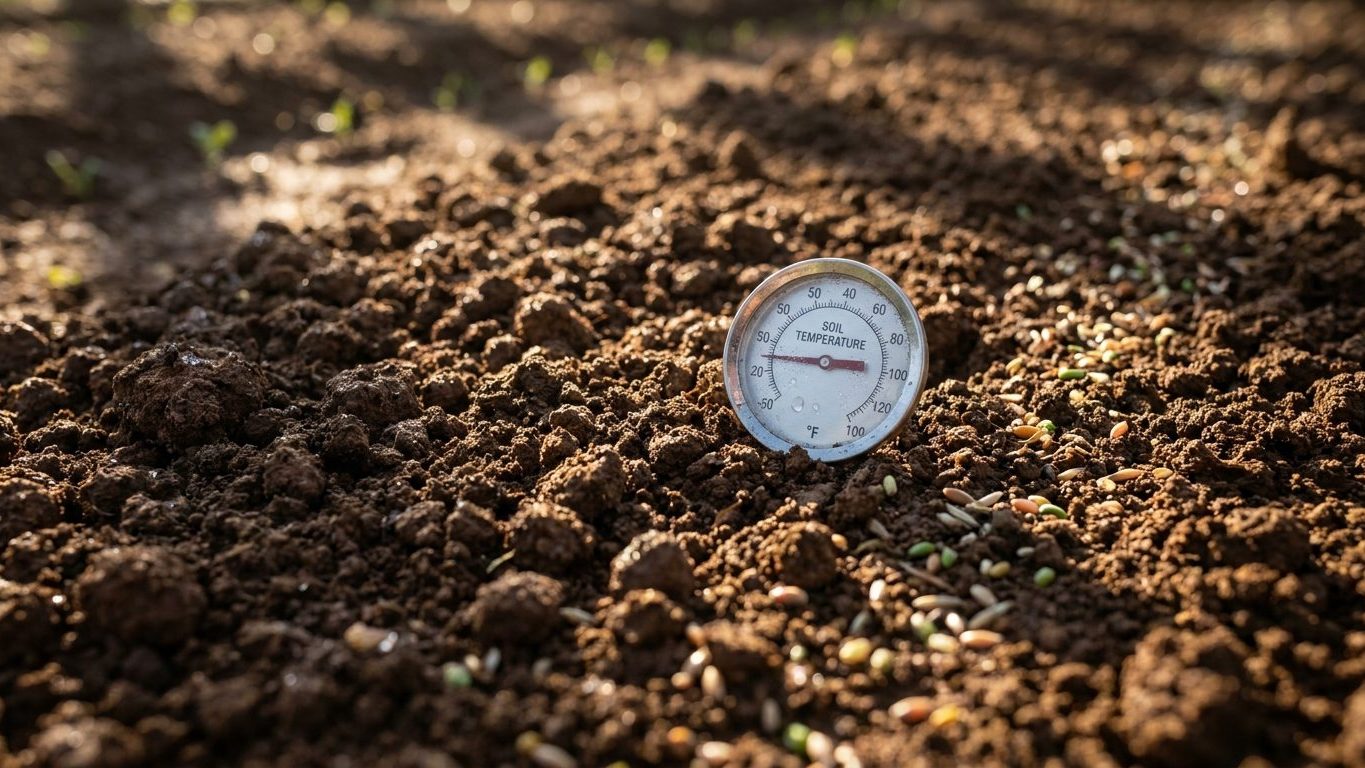

In the Fargo area, cover crops go into ground that has been frost-free for roughly two to three weeks, once soil temperature rather than air temperature gives the green light. Timing, season length, and winter severity all shape which species make sense here, and none of that depends on a bag of pre-mixed seed.
When the soil is warm enough in North Dakota
The question everyone asks first is simple: what date can I put cover crop seed in the ground? For the Fargo reference station, NOAA’s 1991-2020 Climate Normals put the last spring frost (32°F, in the 30-70% probability band) between May 4 and May 15. That’s the number, straight from the source, and it shouldn’t be rounded to “mid-May” or nudged earlier because a warm April made the calendar feel generous.
But frost date is a proxy, not the real trigger. Cover crop seed doesn’t care what the thermometer read at 6 a.m.; it cares whether the soil a few inches down has warmed enough for germination to start. Soil lags behind air temperature by days, sometimes close to two weeks in a cool, wet spring. So the practical rule is: let the frost date pass, then wait for the ground itself to warm rather than seeding the moment the frost window closes.
Treat that May 4-15 window as a probability, not a guarantee. A freeze arriving on May 20 in a given year isn’t a broken forecast; it’s the tail end of a normal distribution. And remember the caution behind the number itself: it comes from an airport weather station. Suburban yards and rural gardens tend to see later last frosts and earlier first frosts than the station reports, sometimes by one to two weeks, more if there’s elevation involved. Check your own county’s frost history rather than importing the airport’s numbers wholesale.
What actually governs how much seed to use is a mix of species, seeding method (broadcast versus drilled), and seed size, and getting that number wrong from a generic chart can waste an entire planting. That’s a conversation for North Dakota State University Extension, which tailors rates to local conditions and current seed lots.
On termination, this site sticks to mechanical methods: mowing, crimping, cutting, or simply letting a hard frost do the work. No herbicide recommendations here, and for cover crops in a state with winters like North Dakota’s, frost alone handles a surprising share of the job.
How long the season lasts here
Subtracting the two NOAA-sourced dates gives a frost-free window that runs somewhere between about 133 and 154 days, depending on which end of each range shows up in a given year (May 15 to September 25 on the short side, May 4 to October 5 on the long side). Call it roughly nineteen to twenty-two weeks. That’s a modest window by national standards, and it shapes what’s realistic to plant and when.
What that window allows
Nineteen to twenty-two weeks is enough room for one full cash crop cycle plus a cover crop planted afterward, but it rarely leaves space for two full rounds of anything demanding a long maturity. In practice, that means the first sowing decision (spring cover crop ahead of a summer vegetable bed, or fall cover crop after harvest) tends to be the one that matters most. There usually isn’t a second window wide enough to reset the clock.
That also changes the transplanting calculus. In a longer-season state, starting seedlings indoors and setting them out later barely costs anything. Here, with barely five months of guaranteed frost-free ground, every week spent in a tray is a week not spent building root mass outdoors. For a fall-seeded cover crop meant to protect soil over winter, direct sowing right after the cash crop comes out is usually the more reliable path, since transplanting cover crop starts is rarely worth the trouble anyway.
Gardeners weighing whether to squeeze in a second planting, or how to sequence a spring cover crop with a summer vegetable and a fall cover crop after it, will find the mechanics laid out in the site’s succession sowing guide. The short version for North Dakota: plan on one deliberate cover crop window per season, not two, and build the calendar backward from the first fall frost rather than forward from the last spring one.
Heat and water in North Dakota
Detailed day-count figures for 90°F-plus days and summer rainfall totals aren’t part of the verified dataset for this reference station, and it wouldn’t serve anyone to guess at them. What the record does show clearly is that heat isn’t the defining stress here. The defining stress is cold, and it arrives early.
The first fall frost lands between September 25 and October 5 at the Fargo reference station, again per NOAA’s 1991-2020 Normals. That date, more than any summer heat wave, sets the last useful sowing date for a fall cover crop. Miss it by much and a newly seeded crop won’t establish enough biomass before growth stops.
The number that really separates North Dakota from a warmer territory is the coldest month’s mean daily minimum: 0.2°F, per NOAA Climate Normals for the Fargo station. That’s not a record low, and it’s not a monthly average; it’s the typical overnight low for the coldest stretch of winter. It’s also the figure that decides, species by species, what survives the winter here and what doesn’t. Combined with the USDA hardiness zone range of 3a-4b for this territory, it points to a hard truth: a species that overwinters comfortably in a milder state can simply die here, and a species that behaves like a nuisance weed further south can be the easiest, most predictable choice in North Dakota because the winter kills it for you.
Where summers do run cool and damp, as they often do in the northern Plains relative to the Corn Belt or the South, the practical concerns shift too: slower ripening for anything grown for seed, and a higher chance of foliar disease on crops that stay wet longer after rain or dew. That’s a different management conversation than drought stress, and it’s the one that actually applies here.
Which cover crops suit North Dakota
Given a roughly nineteen-to-twenty-two week window and a coldest-month minimum near 0°F, the sorting logic for cover crop types in North Dakota comes down to one question: does this species need to survive winter, or is winterkill actually the plan?
Sorting by type, not by brand
Broadly, three functional groups cover most of what gardeners use:
- Cool-season cereal grasses (oats, spring-type grains): fast to establish in the short window, and in a zone 3a-4b winter, most winterkill reliably, leaving a dead mulch that needs no spring termination pass. In a milder state that same grass might overwinter and turn weedy; here, the cold does the work.
- Cold-hardy legumes (clovers, vetches suited to northern zones): these fix nitrogen through a root-microbe partnership, and how much nitrogen becomes available to the next crop depends on how much biomass grew and how the legume is terminated, whether that’s mowing, crimping, or a hard frost. There’s no fixed number to quote, because the mechanism, not a pounds-per-acre figure, is what matters.
- Brassicas (radish, turnip types): useful for breaking up compacted soil and suppressing weeds, and most also winterkill in this climate, though a damp fall can slow their die-back and invite the same foliar disease pressure mentioned above.
| Type | Winter behavior in zone 3a-4b | Main role |
|---|---|---|
| Cool-season grasses (e.g., oats) | Typically winterkill | Fast cover, dead mulch by spring |
| Cold-hardy legumes | Species-dependent; some survive, some winterkill | Nitrogen contribution via root activity |
| Brassicas (e.g., radish) | Typically winterkill | Soil structure, weed suppression |
None of this is a cue to reach for a specific cultivar, and that’s deliberate. Seed trialed and recommended by North Dakota State University Extension reflects local disease pressure, soil types, and current-year performance data this page simply doesn’t have. Naming a variety here would be a guess dressed up as advice. The honest answer is to pick the type that matches the season length and winter risk described above, then let the extension service point to the specific variety and seeding rate that fits a particular county and soil. Termination, once the season’s done, stays mechanical: mow it, crimp it, or let the North Dakota winter finish the job on its own.