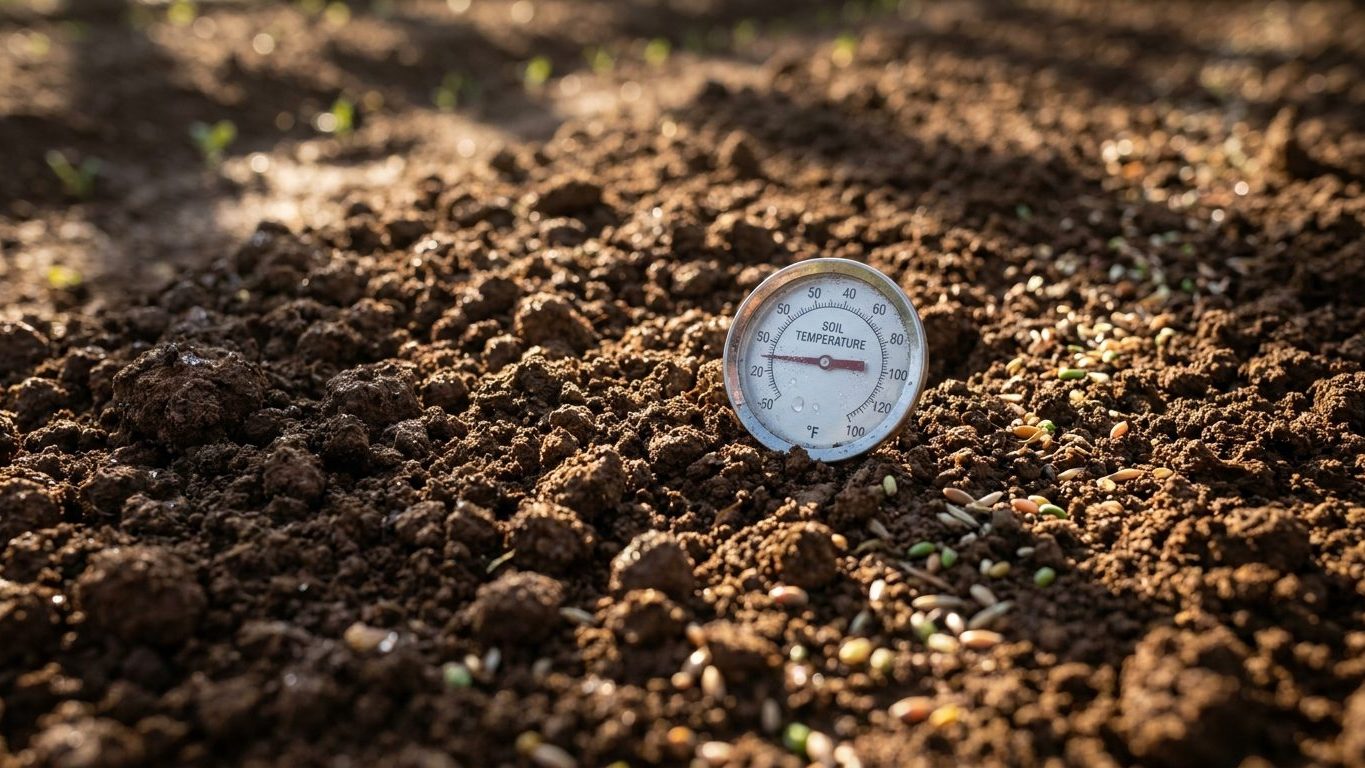

Nova Scotia gardeners can start warm-season cover crops once soil has shed its spring chill, typically from mid-to-late May onward, and switch to winter-hardy species by late summer so growth is established before the first fall frost arrives, on average, October 18. The province’s cool, damp climate and short cold-season window shape almost every choice that follows.
When the soil is warm enough in Nova Scotia
The question every gardener asks first is a date. Environment and Climate Change Canada puts the average last spring frost at May 7, drawn from the Canadian Climate Normals 1981-2010 at the Halifax Stanfield Int’l A station. That number is useful, but it is not the number that actually governs cover crop seeding.
Frost date is a proxy. What a cover crop seed actually needs is warm soil, and soil lags behind the air by days, sometimes weeks. A morning with no frost risk can still sit over ground barely above 50°F, cold enough to leave buckwheat or field peas sulking in the row rather than germinating. So treat May 7 as the earliest point worth checking soil temperature, not the day to sow.
There’s a second catch with that date. It’s a mean, not a guarantee. Environment and Climate Change Canada’s own normals mean that in roughly one year out of two, frost lands later than May 7. Gardeners who sow warm-season covers the moment the calendar hits that mark are gambling on the better half of the odds. And the station behind the number, Halifax Stanfield, sits on the coast; inland valleys and higher ground across the province often lag it by a week or two more.
Species over dates
Rather than chase a single date, match the species to the risk. Oats, field peas, and buckwheat tolerate a light frost and can go in earlier with less worry. Warm-blooded types like cowpea or sorghum-sudangrass want soil that’s genuinely warm, well past the average frost date, with margin built in.
Skip the temptation to lean on a bagged commercial mix name or a fixed rate in pounds per acre. How much seed goes down depends on the species, whether it’s broadcast or drilled, and the seed source itself, and a rate borrowed from the wrong context can waste the whole planting. Nova Scotia’s own extension service, reachable at novascotia.ca/agri, is the right place to get a rate matched to your ground and your method.
Termination follows the same low-tech logic throughout this guide: mowing, crimping, cutting, or simply letting frost do the work. No herbicide step belongs in this picture.
How long the season lasts here
Both frost dates in the Canadian Normals come from the same station, so the subtraction holds: May 7 to October 18 is a 164-day frost-free window. That’s the span cover crop planning has to work with in most of the province, coastal microclimates aside.
A window that long changes the math on how many cover crops fit in a season. Rather than one planting from spring to fall, a gardener can run a fast-maturing cover early, terminate it, and follow with a second species before the first fall frost sets in. Buckwheat, for instance, can complete a full cycle in under two months, leaving room for a legume or a winter-hardy grass to follow before October.
That second sowing decision is really a succession question, and it deserves its own treatment rather than a paragraph here. For the mechanics of stacking two cover crops in one window, timing the gap between them, and deciding when a second planting is worth the effort versus starting a single longer-season cover, see this site’s succession sowing guide.
What a shorter local window changes
Not every garden in the province gets the full 164 days. Cooler pockets inland or at elevation push the effective frost-free stretch shorter, and when that happens, the choice of a second planting evaporates. In that situation, the first sowing becomes the only sowing, and it’s worth asking whether a transplant, rather than direct-seeded cover crop, makes more sense for anything competing for that same shortened window. A root check on transplants, confirming they haven’t gone pot-bound while waiting for planting weather, matters more when there’s no slack left in the calendar to recover from a slow start.
The takeaway isn’t a single number to memorize. It’s that 164 days is an average-to-average span from one weather station, and any garden running noticeably colder or warmer than Halifax Stanfield should budget its own version of that window before committing to two plantings instead of one.
Heat and water in Nova Scotia
This province doesn’t run hot. No verified count of days above 90°F sits in the data behind this guide for a reason: high-heat days aren’t the defining feature of a Maritime climate shaped by the Atlantic on nearly every side. Cover crop planning here has to look elsewhere for its limiting factor, and that elsewhere is winter, not summer heat.
The number that actually decides the fate of a cover crop is the coldest month’s average daily minimum, and in Nova Scotia that figure is 13.3°F. That’s cold enough to kill many species outright and cold enough to make others behave completely differently than they would two provinces south. Oats are the clearest example: in a mild coastal U.S. state, oats can survive winter and turn into a weed problem come spring, needing extra work to remove. In Nova Scotia’s 13.3°F winters, oats reliably winter-kill, collapsing into a flat mulch on their own. That makes them one of the easiest cover crops to manage here precisely because the cold does the termination step for free.
The first fall frost date, October 18 on average, sets the other side of the equation. It marks the last point where sowing a new cover crop still gives it a fair shot at establishing real biomass before growth stops for the season. Sow later than that and a cover crop spends its energy germinating rather than building the root mass and top growth that make it worth planting at all.
What summer actually brings instead
Without a verified rainfall figure for this territory, it’s not accurate to describe Nova Scotia summers by a specific number. What can be said honestly is that a maritime climate tends toward cool, humid conditions rather than dry heat, and that combination favors slower ripening and a higher risk of fungal issues like mildew on crops that thrive in drier air. That’s a reason to lean toward species with looser canopies and better airflow rather than dense, low-growing covers that trap moisture at the soil line.
Which cover crops suit Nova Scotia
Three facts push the choice in the same direction here: a frost-free window of roughly 164 days, a winter cold enough to average 13.3°F at its coldest, and a hardiness rating of Canadian zone 6b for the reference area in these facts. Together they favor species that either finish fast within that shorter window or are built to survive genuine winter cold if the goal is overwintering ground cover.
For a short-season slot between two vegetable crops, fast-growing types like buckwheat or field peas make sense; they complete their cycle well within the frost-free stretch and leave the bed ready for whatever comes next. For a cover meant to hold soil over winter and get terminated in spring, species selected for genuine cold tolerance, rather than ones that merely survive a mild U.S. winter, matter more in a zone 6b Canadian rating than almost anywhere south of the border.
Humidity changes the calculus one more way. In a cool, damp climate, disease resistance becomes the first filter, ahead of yield or growth speed, because mildew and fungal pressure build fastest where air doesn’t move freely through dense foliage. A species that shrugs off leaf disease in a drier state can struggle here without that same resistance built in.
Why no variety name appears here
This page names types, never cultivars, on purpose. A specific variety’s performance depends on trial results local to this province, not on a general description of the species. The Nova Scotia Department of Agriculture, at novascotia.ca/agri, is positioned to point toward cultivars actually tested against this cold and this humidity, and that local trial data is the only recommendation that carries real weight. Anything narrower offered from outside the province risks steering a gardener toward a variety bred for conditions this territory doesn’t share.
The same caution applies to seeding rates and any legume’s nitrogen contribution: both shift with species, stand density, and how and when the cover crop gets terminated, and a number borrowed from a different context does more harm than no number at all. Termination itself stays mechanical throughout, mowing, crimping, or simply trusting a Nova Scotia winter to finish the job the way it already does with oats.