
Cover crops work reliably in most Oregon gardens, but timing splits sharply along the Cascades. West of the mountains, mild winters let legumes and cereals hold living ground cover well into spring; east of them, a shorter high-desert season compresses the whole calendar. What follows is how to read your own frost dates and pick species by type, instead of forcing one script onto a state with two very different climates.
When the soil is warm enough in Oregon
The seed packet says sow after the last frost. At the Portland reference station, that date falls somewhere between March 6 and March 21, based on NOAA’s 1991-2020 U.S. Climate Normals, using the 30-70% probability band for a 32°F freeze (NOAA NCEI Climate Normals). That window is a probability, not a promise: some years the ground clears earlier, some years a cold snap sneaks in after the calendar says it’s safe.
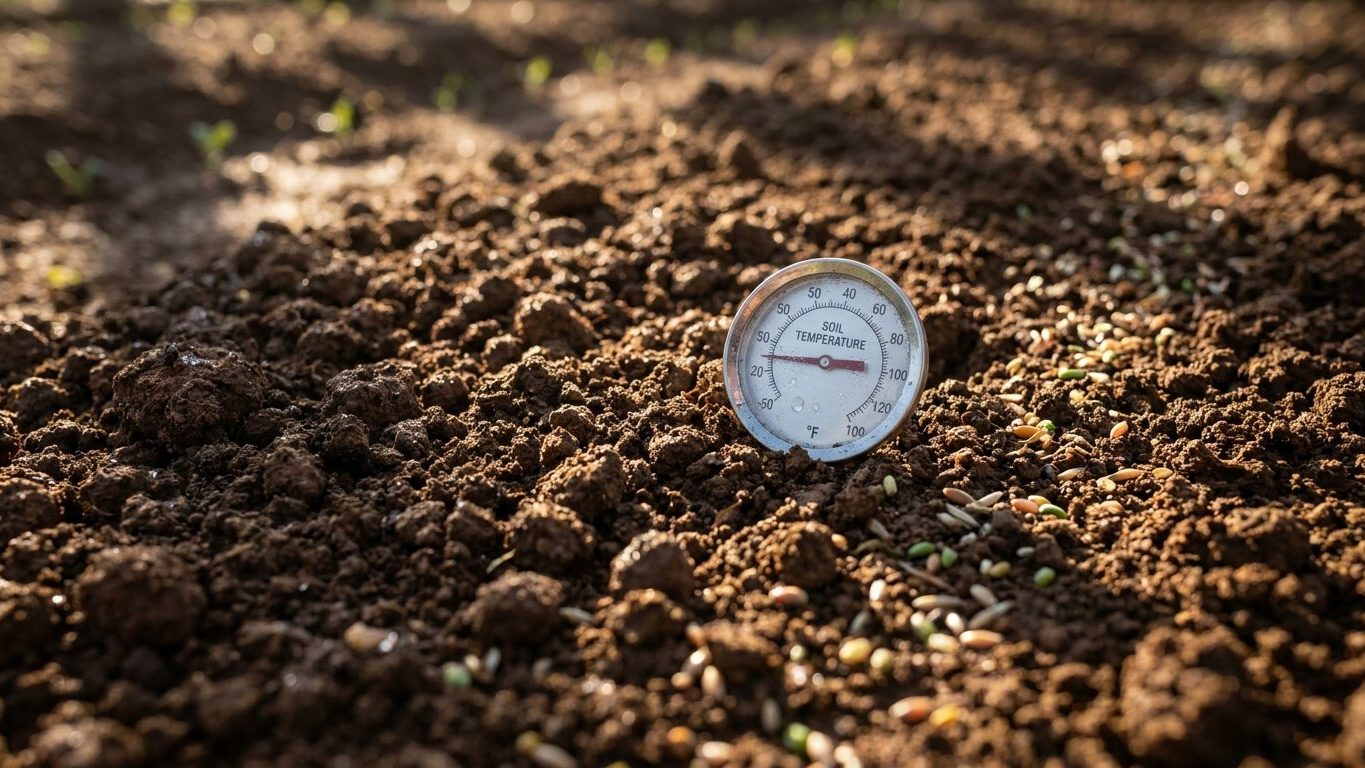
Frost is also only a stand-in for the number that actually matters, which is soil temperature. Air can warm to 50°F on a March afternoon while six inches down, the ground still sits in the low 40s, waterlogged from winter rain. Cover crop seed does not care what the thermometer on the porch says. It cares about the temperature it’s sitting in. So the last frost date marks the earliest safe planting window for cool-tolerant species, but soil warmth is what actually triggers germination, and that lag can run two to three weeks past the frost date itself.
That gap matters for species selection more than for a calendar square. Cool-season legumes and small grains, think field peas, crimson clover, winter rye, will germinate in soil still cool from winter, which is why they’re the ones sown right at or even slightly before that early-March mark. Warm-season broadleaf covers like buckwheat want soil running closer to 60°F, and pushing them into cold, wet ground just rots the seed instead of speeding things up. The fix isn’t a fixed date, it’s a soil thermometer and patience.
One more caution, straight from the source data: this frost window comes from a station west of the Cascades. Central and eastern Oregon sit in high desert, with a shorter frost-free season and colder soil lingering longer into spring. A gardener in Bend or Burns is working a different calendar than one in the Willamette Valley, and applying the Portland window statewide will burn a season.
Seeding rate is the other variable worth naming honestly: it shifts by species, by whether you’re broadcasting or drilling, and by seed source, enough that a generic number printed on a website does more harm than good. Oregon State University’s Extension Service (extension.oregonstate.edu) publishes rate guidance calibrated to this state’s conditions, and that’s the number to use, not a nationwide average. When the cover crop has done its job, this site’s approach is mechanical termination, mowing, crimping, cutting, or letting a hard frost finish the work, not a chemical pass.
How long the season lasts here
Subtract the two ends of the frost calendar and you get the real working window. Last spring frost lands between March 6 and March 21; first fall frost arrives between November 11 and November 27, per the same NOAA station data (NOAA NCEI Climate Normals). Run the math on the two extremes and the frost-free stretch runs somewhere between 235 and 266 days, depending on where a given year falls inside those probability bands. That’s close to eight months, sometimes a bit less.
That length is generous by cover-crop standards, and it changes what’s worth attempting. A window that long allows a second sowing in the same season: a spring cover crop terminated by early summer, followed by a fall-planted one that carries the soil through winter. In a shorter-season territory, gardeners often get one shot and have to make it count. Here, the calendar gives room for a spring legume to build soil structure, get mowed down before it sets seed, and hand the bed off to a fall-sown grain or clover mix that holds ground through the wet season.
The length of the window also changes a practical decision that trips up a lot of home gardeners: whether to direct-sow or start cover crop seed indoors and transplant. With close to eight months of frost-free ground, direct sowing almost always makes more sense, since most cover crop species are fast, cheap, and meant to be terminated before they’re mature anyway. Transplanting adds labor for a category of plant that’s not grown for a harvest. The exception is a gardener working the shorter windows found in central or eastern Oregon, where every week of the season counts and starting seed early indoors can buy back time lost to a late spring frost.
For the mechanics of layering a spring cover crop and a fall one into the same bed, without gaps where soil sits bare, the succession sowing guide on this site walks through the sequencing in more detail than fits here.
Heat and water in Oregon
For most vegetable crops, the summer heat count and rainfall total are the headline numbers. For cover crops, they matter less than one figure that gets overlooked: the coldest month’s average daily minimum, which at the Portland reference station sits at 36.2°F (NOAA NCEI Climate Normals 1991-2020). That’s the number that decides which species survive an Oregon winter outright, and which ones die back on their own.
A mean daily minimum barely above freezing is mild by national standards, and it changes the behavior of common cover crop species in a way gardeners moving from a colder state often don’t expect. Oats, a classic winter-kill cover crop in much of the country, rely on hard, sustained cold to collapse into a dead mulch by spring. In a territory where the coldest month barely dips below freezing on average, oats can limp through winter instead of dying, turning what’s supposed to be a self-terminating cover crop into a persistent volunteer that has to be mowed or turned under by hand come spring. Crimson clover and winter rye, by contrast, are built to survive exactly this kind of mild, wet winter, and come out the other side as functional spring cover rather than a mess to clean up.
That 36.2°F figure sits inside a hardiness range of 4a to 9b for Oregon overall, using the USDA Plant Hardiness Zone Map (2023 edition, built on 1991-2020 normals). That’s an unusually wide spread for one state, and it’s built on a single variable, the average annual extreme minimum temperature, not summer heat or rainfall. It’s a useful shorthand for winter survival, but it says nothing about how a cover crop handles a wet, cool summer, which is the other half of the Oregon story west of the Cascades. Where summer figures aren’t part of the record for this reference station, the honest note is that cool, damp summers tend to bring their own problems: powdery mildew, slower ripening, and disease pressure that a hot, dry climate wouldn’t see. A cover crop guide written for a scorching territory would spend this section on heat stress and irrigation math. Here, the real fight in summer is against fungus and slow drying, not sunburn.
Which cover crops suit Oregon
Reasoning by type, rather than by brand or variety, the mild winter (that 36.2°F coldest-month minimum) points toward species built to survive rather than winter-kill. Crimson clover and hairy vetch, both legumes, hold through winter west of the Cascades and contribute nitrogen through their root systems as they grow, though how much depends on how much biomass they’ve put on and when they’re terminated, not a number that can be printed generically. Winter rye, a cereal grain, does the same survival trick and adds a dense root mass that helps structure heavy valley clay.
Oats deserve a second mention here, because the honest answer for this territory is a caution rather than a recommendation. In a colder state, oats are the easy, forgiving choice: sow them, let winter kill them, and till in the mulch come spring. In much of western Oregon, where winter doesn’t reliably get cold enough, oats can behave more like a weed that has to be managed by hand than a self-terminating cover. That’s a direct consequence of the 36.2°F winter minimum, not a flaw in the plant.
Brassicas, mustard and daikon radish among them, bring a different function: their roots punch through compacted soil and break up plow pans, and their fast growth suits the long frost-free window (that 235-to-266-day stretch) for a quick summer planting between vegetable rotations. Buckwheat fills the same summer gap for gardeners wanting a fast-growing, easily terminated broadleaf cover rather than a soil-structuring one.
None of these species names should be read as a variety recommendation, because that’s not what this page can responsibly offer. Cultivar trials, the specific strains of clover or rye actually tested against Oregon’s soils and disease pressure, are run at the state level, and Oregon State University’s Extension Service (extension.oregonstate.edu) is where that local data lives. Seeding rates, too, depend on the exact species, the sowing method, and the seed source, which is a decision best made with that same local guidance rather than a generic number. When the cover crop has done its job, mowing, crimping, or a hard frost ends it here, no herbicide involved.