
Pennsylvania gardeners get two very different windows for cover crops: a spring one that opens once soil temperature catches up to the calendar, and a fall one built around the first hard freeze. Which window matters more, and which species make sense, depends less on the county you garden in than on how the state’s frost dates and winter cold line up with what you’re trying to accomplish.
When the soil is warm enough in Pennsylvania
The question everyone asks first is “when can I sow,” and the honest answer starts with a date that doesn’t actually answer it. NOAA’s Climate Normals for 1991-2020, measured at the Philadelphia reference station, put the last spring frost between March 29 and April 6. That’s the 30-to-70 percent probability band for a 32°F freeze, not a guarantee that frost stops on any single day.
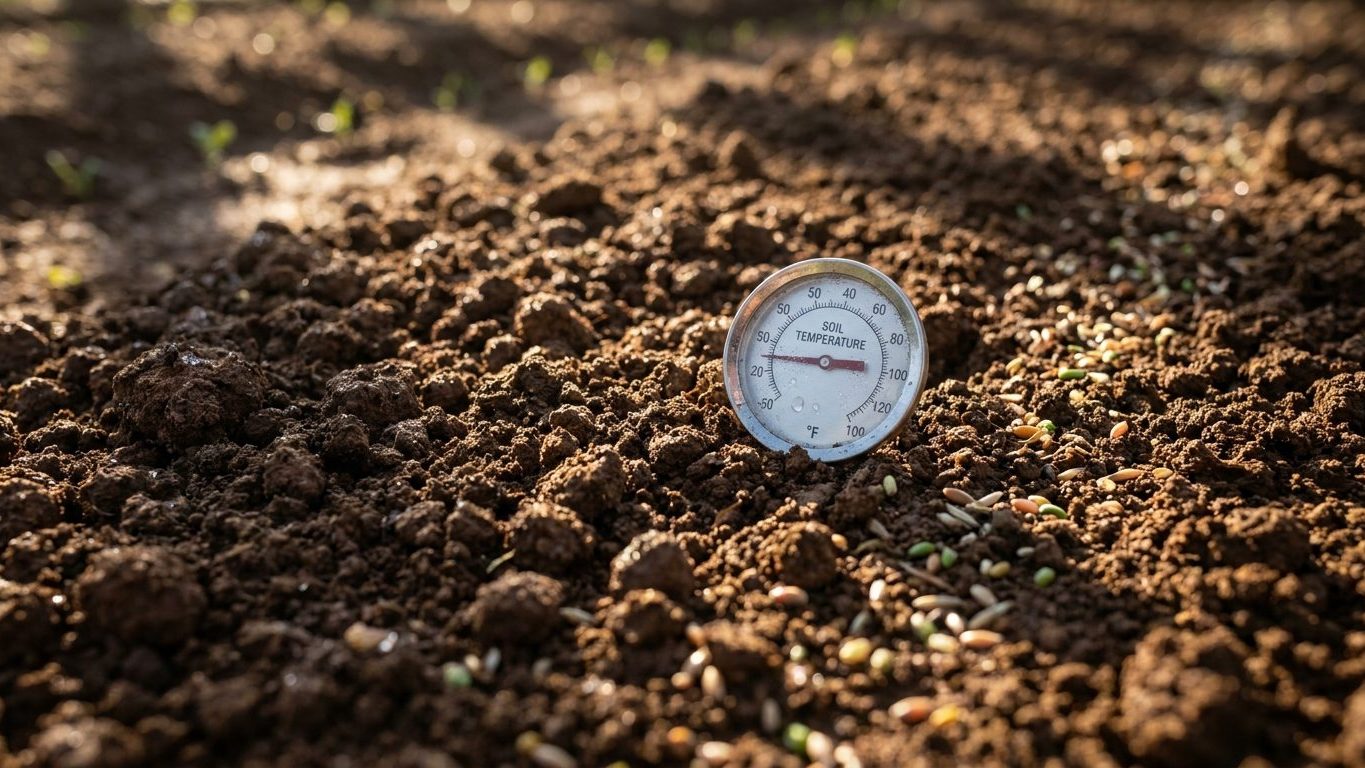
Frost dates get used as shorthand for planting dates, but for cover crops the shorthand is misleading. What actually governs germination is soil temperature, and soil warms on its own schedule, usually a week or two behind the air. A morning with no frost risk can still have cold, wet soil that rots seed before it sprouts. So treat the late-March-to-early-April window as the point where frost risk drops off, then wait for the ground itself to warm before sowing a spring cover crop.
That gap matters more in Pennsylvania than it would in a flatter state. Philadelphia sits in the mildest corner of the commonwealth. Move north into the Poconos or the northern tier, or up into the Alleghenies, and both frost dates run two to four weeks later. A gardener in Bradford County or Somerset County working from the Philadelphia date alone would be sowing into ground that’s still too cold, with predictable results: patchy stands, slow growth, seed that simply sits.
What decides how much to sow
Seeding rate isn’t a fixed number you can borrow from a bag label or a neighbor’s garden. It shifts with the species, whether you’re broadcasting by hand or drilling, and how thick a stand you actually need for weed suppression versus a light green manure. Rather than guess at a rate, or worse, use one meant for a different species, check with Penn State Extension, which publishes rates calibrated to Pennsylvania soils and calendars.
Termination follows the same logic as sowing: no herbicide involved here. Cover crops on this site come out by mowing, crimping, cutting, or simply letting a hard frost do the work on tender species. That mechanical approach is slower than a chemical burn-down, but it fits a home garden scale and it’s what the rest of this guide assumes throughout.
How long the season lasts here
Put the two frost dates together and Pennsylvania’s frost-free stretch runs roughly from the March 29 to April 6 window at one end to the November 5 to November 16 window at the other. Doing the subtraction at both edges gives a growing season of about 221 to 224 days, somewhere in the neighborhood of seven and a half months, depending on where in that range a given year falls.
That’s a genuinely long window by cool-climate standards, and it changes what’s practical for cover cropping. A gardener working with only a four-month season has one shot: sow, grow, terminate, and get the bed back in production before frost ends things. Pennsylvania’s window is wide enough to support more than that single pass. A spring-sown cover crop can be terminated in time for summer vegetables, and the same bed can carry a second cover crop through late summer into fall, ahead of the November frost that finally shuts things down.
Whether that second sowing makes sense depends on what came out of the ground first. A bed that finishes early, after spring greens or peas, has months left before the fall frost and is a strong candidate for a summer-into-fall cover crop cycle. A bed still holding tomatoes or peppers into September has a much narrower gap, maybe six to eight weeks before that first fall frost, which limits the choice to fast, cold-tolerant species rather than anything that needs a long run to establish.
This is really a scheduling problem more than a plant problem, and it’s worth working out bed by bed rather than assuming one calendar fits the whole garden. For the mechanics of stacking a second sowing after the first, the succession sowing guide on this site walks through how to time that overlap without leaving a bed bare or delaying the next vegetable crop.
One caution carries over from the frost dates themselves: gardeners outside the Philadelphia area, particularly in the higher elevations of central and northern Pennsylvania, should expect a shorter version of this window. Two to four weeks later on both ends trims the 221-to-224-day season down meaningfully, and that’s often the difference between fitting in two cover crop cycles and fitting in one.
Heat and water in Pennsylvania
For most garden crops this section would run through 90-degree days and summer rainfall totals. Cover crops flip that priority. Summer heat rarely kills a cover crop outright the way it stresses tomatoes or lettuce; what actually determines success or failure here is what happens after the leaves stop growing, going into winter.
The number that matters most is the coldest month’s average daily minimum, which at the Philadelphia reference station runs 26.0°F. That’s not a record low and not a monthly average, it’s the mean of the coldest daily lows across the coldest month, and it’s the figure that separates species that shrug off winter from species that don’t survive it. A crop with genuine hardiness for USDA zones in the 5-6 range shrugs off a 26°F average low without much drama. A tender or marginally hardy species, sitting right at its limit, gets knocked back hard or killed outright, sometimes in a way that looks fine in December and is clearly dead by March.
Pennsylvania’s USDA Hardiness Zone range spans 5a to 7b statewide, according to the 2023 USDA Plant Hardiness Zone Map built on 1991-2020 normals. That’s a wide spread for one state, from the cold pockets of the northern tier and higher Alleghenies at 5a up to the milder Philadelphia and Delaware Valley corridor near 7b. A cover crop that reliably overwinters in the 7b corner of the state can winterkill outright in the 5a corner, even though both gardeners are technically growing “in Pennsylvania.”
That range is exactly why the first fall frost date does double duty here. Sowing too late means the cover crop never gets enough top growth before frost to matter, whether as a weed-suppressing mat or as material with anything to contribute back to the soil. Sowing at the right time, with November’s frost window in mind, gives a species enough runway to establish before cold shuts growth down for the year, whatever comes next for it over the winter months.
Which cover crops suit Pennsylvania
The honest way to answer “which cover crop” is by type, reasoned from the numbers already on the table, not by naming a specific cultivar off a seed rack. Pennsylvania’s roughly seven-month frost-free window, its 5a-to-7b hardiness spread, and a 26°F average winter low each point toward a different piece of the decision.
The long season means there’s no pressure to chase the single fastest-germinating species just to beat an early frost, the way a gardener in a truly short-season territory would need to. That opens the door to slower-establishing legumes as well as quick grasses. The wide hardiness range means winter survival is a real question rather than an afterthought: species pushed to their cold limit in the 5a pockets of the state may winterkill cleanly by spring, which some gardeners actually prefer, since a frost-killed mat is easier to manage by hand than a living stand that needs mechanical termination in spring. Species with sturdier cold tolerance, meanwhile, can carry green through winter and need mowing, crimping, or cutting once the ground firms up.
Broadly, that breaks Pennsylvania’s options into a few categories:
- Cool-season cereal grasses — hardy enough to persist through most of the state’s winters, useful for erosion control and biomass, terminated mechanically before they set seed.
- Winter-hardy legumes — build soil nitrogen through root activity and residue breakdown rather than any figure a bag label could honestly promise, with the actual contribution depending on how much biomass grows and when the stand gets terminated.
- Frost-tender legumes and buckwheat — fast summer fillers for the gap between spring and fall vegetable crops, relying on the first fall frost to kill them back on schedule rather than needing hand termination.
- Brassica-family covers — often grown specifically to winterkill, leaving loosened soil and a surface mulch behind without any spring intervention at all.
What this page won’t do is put a variety name next to any of those categories. Pennsylvania State University’s trial plots, spread across the state’s climate divisions, test named cultivars against local disease pressure, local winter severity, and local soil conditions in a way a general guide never can. A variety that performs well in a Penn State trial near Philadelphia’s 7b conditions isn’t the same recommendation for a garden in 5a territory further north, and pretending otherwise would be a worse disservice than simply pointing to the source. Penn State Extension keeps that trial data current and specific to the commonwealth, down to the seeding rates and termination timing that actually match local conditions rather than a national average.