
Cover crops on Prince Edward Island go into the ground once the frost risk of late spring has eased, usually from late May into June for warm-season species, or right after summer harvest for fall-seeded types like winter rye and crimson clover. The island’s short window and its Canadian zone 5b winters decide which species survive to spring and which die back into mulch on their own.
When the soil is warm enough in Prince Edward Island
The date gardeners actually want is the soil temperature, not the calendar. But the number everyone reaches for first is the frost date, so start there: at the Charlottetown A station, Environment and Climate Change Canada’s 1981-2010 climate normals put the average last spring frost at May 16. That number comes straight from the official ECCC climate normals API, and it deserves one clear caveat: it’s a mean, not a guarantee. In roughly half the years on record, frost has struck Charlottetown after May 16. Treat it as the middle of a window, not a green light.
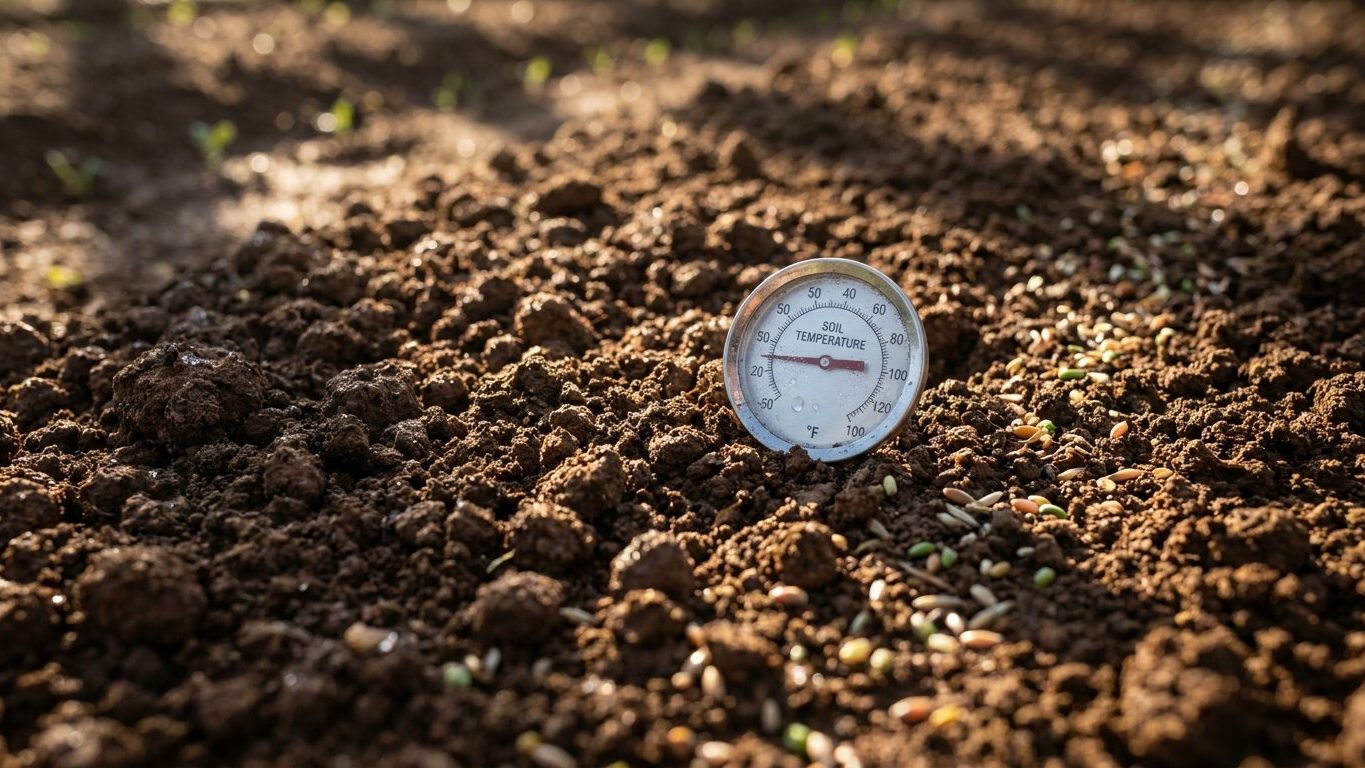
Frost dates matter to cover crop growers only as a rough stand-in for something else: soil temperature. Air can warm up on a sunny afternoon days before the ground underneath does the same. Cover crop seed doesn’t germinate on air temperature. It germinates once the soil itself has held steady warmth for several days running, which on the Island typically trails the frost-free date by a week or two, longer in low-lying or poorly drained plots where cold, wet clay hangs onto winter far longer than a garden on a sandy slope nearby.
That gap explains why two gardeners ten miles apart can plant the same species on different days and both be right. A community garden bed near the coast, buffered by the Northumberland Strait, often warms faster than a field tucked into an inland valley that pools cold air overnight. The frost date is one station’s number. Your own soil, worked with a hand or a soil thermometer, is the better source.
What decides the actual seeding rate
How much seed goes down per bed depends on the species chosen, the seeding method (broadcast versus drilled), soil fertility, and whether the crop is meant to smother weeds fast or simply hold ground over winter. Broadcasting always needs more seed than a drilled row to get the same stand, and a legume grown for its root system wants a different density than a grass grown purely for biomass. Because a wrong rate either wastes seed or leaves gaps for weeds, the right move is checking current guidance from the Prince Edward Island Department of Agriculture before buying seed, rather than guessing from a number printed for a different climate.
Termination on this site is handled the same way everywhere: mechanically. Mowing, crimping, cutting at flowering, or simply letting a hard frost do the work. No herbicide step belongs in this conversation, and none is needed if the crop is timed to die back or get cut before it sets seed.
How long the season lasts here
Subtract the two Charlottetown A normals and the frost-free window runs from May 16 to October 17, which is 154 days, a little over five months. That’s the span most PEI gardeners have to work with for anything that needs to be sown, grown, and terminated before hard cold sets in.
A window that size isn’t long enough to treat cover cropping as a background project squeezed in whenever convenient, but it isn’t so short that it locks a gardener into a single planting either. It’s enough time to run a fast-maturing summer cover crop after an early vegetable comes out in June or July, then follow with a fall-seeded species in late August or September timed to overwinter or winterkill on its own. What it doesn’t leave much room for is a third round, or for slow-maturing species that need a long stretch of warmth from start to finish.
This is also where the transplanting-versus-direct-seeding decision gets real. With roughly five months total, and cover crops typically wanting six to ten weeks of their own growing time before termination, a gardener stacking a cover crop between two vegetable plantings has to check the root systems already in the ground. Pulling a cover crop’s roots too early, before they’ve built the structure they were sown for, undercuts the whole point of growing one. The succession sowing guide on this site walks through how to sequence a fast cover crop between two cash crops without shortchanging either one.
The practical read for PEI: one solid cover crop cycle is the safe bet for most home gardens here. A second, shorter cycle is possible if the first crop clears the bed by mid-July and the chosen species matures in under two months. Anything slower than that runs into the same fall frost that ends the season for everything else.
Heat and water in Prince Edward Island
Here’s the honest answer for anyone expecting a paragraph about scorching afternoons and irrigation schedules: that paragraph doesn’t belong on this page. Prince Edward Island sits in the Gulf of St. Lawrence, and its maritime position keeps summer heat mild by North American standards. Days that climb into the 90s are rare on this island, and the FACTS behind this page don’t record a meaningful count of them at the reference station, because there isn’t much of one to record.
What a cool, damp maritime summer brings instead is a different set of headaches: slower ripening for anything that wants real heat to finish, and a longer window each week where leaves stay wet after fog or rain rolls in off the strait. For cover crops, thick stands of grasses or legumes sown too densely in a humid summer can hold moisture at the base of the plants long enough to invite mildew, particularly in a season with a wet August. Airflow between plants matters more here than heat tolerance ever will.
The number that actually drives cover crop selection on PEI isn’t a summer figure at all. It’s the coldest month’s mean daily minimum, which sits at 10.3°F according to the ECCC 1981-2010 normals for Charlottetown. That number, paired with the Canadian hardiness zone rating of 5b for Charlottetown (from Natural Resources Canada’s Plant Hardiness site, 1991-2020 normals), is the line that separates species that shrug off an Island winter from species that simply die where they stand once real cold arrives.
That’s not a downside. It’s the mechanism a lot of PEI gardeners lean on. A species that reliably winterkills at 10°F does the termination work for free, leaving a mulch mat by March that needs nothing more than raking aside before spring planting. Grow that same species somewhere with a milder coldest month and it survives the winter instead, turning into a weed that needs mowing or tilling under come spring. Cold here is a tool, not just a limit.
Which cover crops suit Prince Edward Island
Three facts about this island point toward the same kind of answer, without needing a single brand or variety name to make the case.
The 154-day frost-free window favors species that mature or build meaningful biomass quickly rather than ones that need a long, slow season to earn their keep. A cover crop sown in July has to accomplish something before October 17 shows up, so fast growers within a chosen species group get the practical edge over slower ones.
The coldest month’s 10.3°F minimum and the zone 5b rating together decide the overwintering question outright. Species that reliably die back at that temperature work as a self-terminating fall cover, leaving residue on the surface without any mowing or crimping required. Species bred to tolerate colder zones than 5b will often survive the winter here instead, which shifts the job to spring mowing or crimping before they set seed. Neither choice is wrong. They just call for different follow-up work, and a gardener should know going in which category their choice falls into.
The damp maritime summer makes disease resistance, and simple spacing for airflow, the first practical filter within any species being considered, ahead of yield or biomass claims that were likely measured somewhere drier.
What this page won’t do is hand over a cultivar name. Seed trialled and recommended for the Maritimes changes as breeders release new lines and as the PEI Department of Agriculture updates its own local trial results, and a variety that performed well three provinces away carries no guarantee here. The extension service listed above is the only source positioned to say which specific seed lot is doing well on Island soil this particular season, and that’s exactly the kind of current, local answer a general guide like this one can’t responsibly fake.