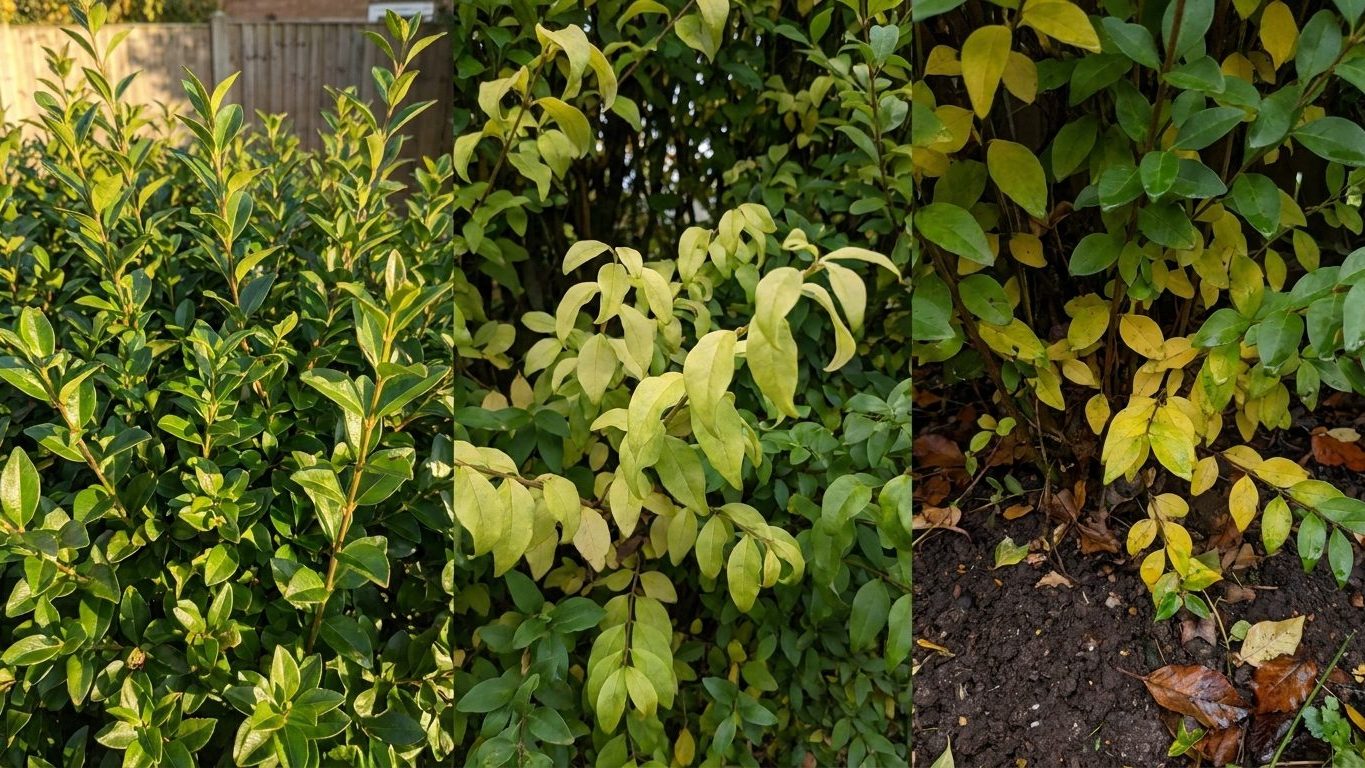

Privet turning yellow almost never means the shrub is dying. In the vast majority of cases the cause is waterlogged roots or nitrogen depletion from years of hard shearing without feeding, not disease or pests. The plant tolerates neglect that would kill most hedge species, and it regrows from bare wood once the cause is removed. Diagnosis, not panic, is what fixes it.
Telling apart what makes privet yellowing
Where the yellow leaves sit on the shrub tells you more than the color itself. A hedge yellowing uniformly from top to bottom, on both old growth and new, points toward nitrogen shortage built up over a season of clipping without feeding. A hedge yellowing only at the base and in the shaded interior, with leaves that drop while still soft, points toward waterlogged roots sitting in poor drainage. A hedge yellowing in one section or on one side only, with a sharp line between green and dead tissue rather than a gradual fade, points toward root damage or dieback, often from construction disturbance, drought stress, or a girdled root.
The pattern that separates the three
| Cause | Where it shows first | When it shows | Leaf pattern |
|---|---|---|---|
| Waterlogged roots | Bottom and interior of the hedge | After extended rain or in a spot with poor drainage | Leaves yellow then drop, still soft, roots smell sour when dug up |
| Nitrogen shortage | Uniform across the whole hedge | Builds over a season, worse by late summer | Pale, even yellow-green on old and new growth alike |
| Root or dieback damage | One section or one side only | Any time, often following drought or nearby digging | A hard line between healthy green and yellow-to-brown, no gradual transition |
The test that separates the first two causes takes five minutes and needs no tools beyond a trowel. Dig a 6-inch hole near the yellowing section a day after rain and feel the soil. Soggy, cool, and slow to crumble means drainage is the problem. Dry and loose at that depth, on a hedge that has been sheared hard every year, points to a feeding gap instead. The two causes call for opposite fixes, so guessing wrong wastes a season.
Timing adds a second clue. Yellowing that shows up within a week or two of a heavy rain event is almost always water-related. Yellowing that has crept in gradually over months, on a hedge that gets clipped twice a year but never fed, is almost always nutritional. Yellowing that appeared abruptly on one side after nearby trenching, grading, or a dry spell is a root problem, and root problems behave differently from the other two once you get to the recovery question.
Will it come back?
Yes, in almost every case the yellowed and even browned-out sections of a privet hedge regrow, provided the underlying cause gets removed first. Privet carries dormant buds along the length of its stems, under the bark, not just at the branch tips. Cut a stem back to bare brown wood and those buds break and push new growth, something a conifer hedge simply cannot do. That is the mechanism behind the one fact that makes privet forgiving where arborvitae or Leyland cypress are not: a privet hedge cut back hard to renovate it still regrows at 2 to 3 feet a year once conditions are corrected.
The order matters more than the cutting itself. A hedge yellowed by waterlogged roots that gets cut back before the drainage problem is fixed will push new growth, then yellow again the following season, because the roots are still sitting in standing water. A hedge yellowed by nitrogen shortage that gets fed but never pruned will green up without ever filling back in, because the old wood stays where it is. Diagnose first, remove the cause second, cut back third. Skip a step and the fix does not hold.
Where the answer changes is root damage. If the yellowing traces to a root system that has been severed, compacted, or girdled, cutting back the top growth does nothing for tissue that has already died below ground, and that section will not refill no matter how many times it gets pruned. The distinction is not cosmetic. Leaving the true cause unaddressed for another growing season costs the plant more than one bad-looking hedge, because roots that stay waterlogged or damaged through a second year of dormancy often do not recover at all, and by then the fix is removal rather than renovation.
Stopping the cause
Privet responds well to cultural correction because the yellowing is almost always cultural in the first place. Improving drainage, correcting a feeding schedule, and timing the cuts right will resolve the two most common causes on their own, no chemical intervention required.
Drainage comes first where the pattern points to waterlogging. That can mean regrading so water does not pool at the hedge base, adding a French drain along a low run, or simply cutting back on irrigation aimed at that bed if it is being watered on a schedule set for lawn or flower beds nearby. Feeding comes next where the pattern points to nitrogen depletion, since a hedge sheared twice a year is having a large share of its leaf tissue, and the nitrogen stored in it, hauled away with every clipping. A modest, balanced feeding after the spring cut replaces what the shears remove.
Pruning timing matters on its own. Privet takes its two cuts a season in spring and again in midsummer, never on a fixed calendar date, because the right window shifts by weeks depending on the local frost dates. Cutting too late in the season pushes soft new growth that has no time to harden before cold weather, which shows up the following spring looking a lot like nutritional yellowing but is really cold damage on tender wood. A local Cooperative Extension Service office can confirm the pruning window for a given area and, more importantly, can identify a hedge problem in person when the pattern does not match anything described here, since scale insects, fungal leaf spot, and root rot can all mimic parts of this picture and need lab or in-person confirmation rather than a guess from a description.
What does not respond to any of these fixes is dead tissue from root damage, or a hedge that is simply the wrong plant for a wet site to begin with. Sanitation helps at the margins, clearing fallen clipped debris that mats around the base and holds moisture against the crown, but it will not reverse damage that has already happened below ground.
What to do with what is left
Once the cause is stopped, four honest paths exist, and they are not equally good fits for every hedge.
| Option | What it involves | Time cost |
|---|---|---|
| Live with it | A few interior yellow leaves with no spreading pattern, monitor only | None, ongoing observation |
| Renovate | Cut affected wood back hard to sound tissue after the cause is fixed | One to two growing seasons to refill at 2 to 3 feet a year |
| Interplant | Add new stock in gaps while the cut-back sections recover | A couple of seasons before the hedge line looks even |
| Replace | Remove the hedge where root damage is extensive or the species is locally restricted | A full season to establish a new hedge |
Living with a light case costs nothing but attention, and most hedges that get corrected early never need more than that. Renovation is where privet earns its reputation, since a section cut back to brown wood after the drainage or feeding problem is solved will fill back in on its own timeline without replanting. Interplanting works when only part of a long hedge run is affected and a uniform look matters sooner than the renovation timeline allows.
Replacement is the honest answer in two situations, and both deserve to be said plainly rather than dressed up as a last resort. Where root damage has killed a section outright, no amount of cutting brings back tissue that is already gone. And several privet species are listed as invasive and are banned or discouraged in a number of states, which means a yellowing hedge that would otherwise be worth renovating may be worth replacing with a non-restricted species instead, regardless of how well it would recover.
Common questions
Why are my privet leaves turning yellow and dropping in fall?
Leaf drop concentrated at the base and interior in fall, after a wet season, points to waterlogged roots rather than normal seasonal change. Privet is semi-evergreen to evergreen depending on climate, so heavy interior leaf drop is a drainage signal, not a fall color cue.
Can overwatering alone cause privet to yellow?
Yes. Waterlogged roots are one of the two dominant causes on this species, and they show up as yellowing at the base and interior of the hedge, with leaves that stay soft as they drop, distinct from the drier, curled yellowing tied to nitrogen shortage.
How long does it take privet to recover after hard pruning?
At 2 to 3 feet of growth a year, a hard cut-back section typically fills back in over one to two growing seasons, provided the cause of the original yellowing was removed before the cut was made.
Is yellowing privet a sign it’s dying?
Rarely, on this species. Privet tolerates conditions that would kill most hedge plants, and yellowing is almost always a fixable cultural issue rather than a terminal one. The exception is a hedge with extensive root damage, where the yellowed section will not recover even after the cause is addressed.