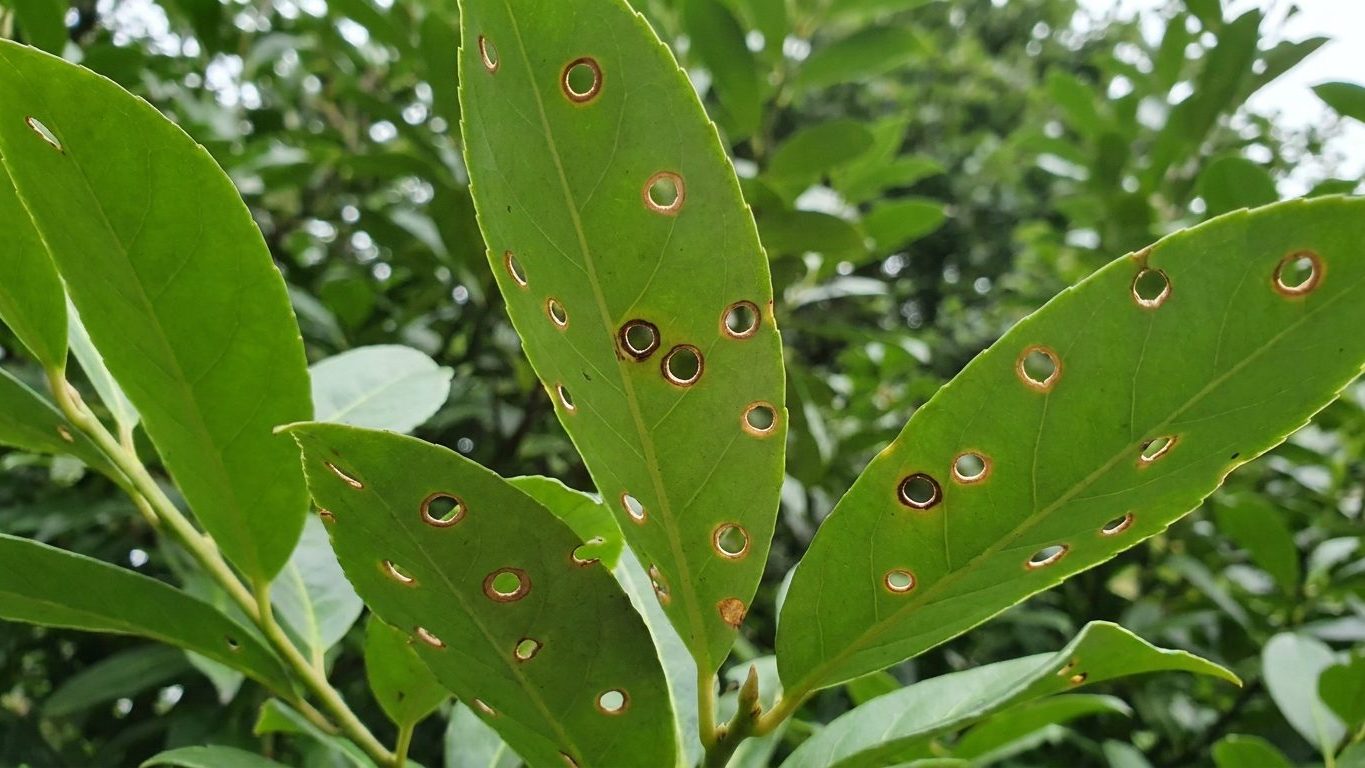

Round holes with tan or brown rims scattered over cherry laurel leaves point to a fungal or bacterial leaf spot, not chewing insects. The dead patch of tissue dries out and drops away on its own, leaving a clean, punched hole with a defined edge. Chewing insects leave ragged, uneven margins that usually start at the leaf edge and work inward. The shrub can recover from shot hole. Root rot in soggy soil is the condition that actually kills cherry laurel.
Telling apart what makes cherry laurel shot hole
Start with where the damage shows up, not with what to spray. Shot hole disease appears first on older, interior leaves, the ones sitting lowest on the plant where air barely moves and moisture lingers after rain. The spot begins as a small, water-soaked or purplish-brown blemish on the leaf surface. Within days the center of that spot dries out completely and drops, leaving a round hole rimmed with a darker, slightly raised edge, almost as if someone punched the leaf with a hole punch.
The pattern matters as much as the shape. Shot hole marks scatter across the whole blade, not just along the margins, and they stay fairly uniform in size and roundness from leaf to leaf. Insect feeding tells a different story: notches carved inward from the leaf edge, torn sections that connect into larger ragged patches, sometimes visible chew marks or frass left behind. Insects rarely leave a tidy, round hole in the middle of an otherwise intact leaf.
Timing separates the two causes just as clearly. Shot hole flares up after stretches of cool, wet spring weather, when fungal or bacterial spores splash from leaf to leaf during rain and stay active on damp foliage overnight. Insect damage tracks with pest activity instead, showing up in warmer weather and often repeating several times across the growing season rather than arriving all at once after a wet spell.
Hold a damaged leaf up to the light and look at the rim of the hole. A defined, slightly darker ring around a clean round opening points to shot hole. A torn, uneven edge with no ring points to insects.
| Clue | Shot hole (fungal/bacterial) | Insect feeding |
|---|---|---|
| Location on plant | Interior and lower leaves first | Anywhere, often outer canopy |
| Hole shape | Round, uniform, defined rim | Ragged, irregular, no rim |
| Where it starts | Middle of the leaf blade | Leaf edge, working inward |
| Weather link | Follows cool, wet spring stretches | Tracks pest activity, warmer months |
Will it come back?
Yes, cherry laurel recovers from shot hole. The fungus or bacteria damages leaves, not the wood underneath, and the shrub carries dormant buds tucked under its bark along every stem. Those buds don’t need light or an existing leaf to wake up. Cut a stem back to bare, brown wood and the dormant buds along that stem break open and push new growth, something a conifer hedge simply cannot do because conifers have no such reserve of buds hiding under the bark.
That’s the mechanism worth remembering for any cherry laurel, not just the one in front of you. A hedge riddled with shot hole this spring can drop every affected leaf, look thin and disappointing through summer, and still refill from the inside out because the wood underneath stays alive. Growth resumes at the plant’s normal pace of 1 to 2 feet a year once conditions dry out and new leaves push through.
Root rot is the different story, and the one that doesn’t end well. Cherry laurel planted in heavy, wet soil that never drains can lose its root system entirely, and no amount of dormant buds under the bark helps a plant with no roots feeding it. Leaves that yellow, wilt, and drop from the whole plant rather than showing scattered round holes signal root rot, not shot hole, and that distinction changes the entire plan from here.
Shot hole alone rarely threatens the plant’s survival. It costs a season of thin, spotty foliage while the fungus or bacteria runs its course in wet weather, then eases once drier conditions return and new leaves come in clean.
Stopping the cause
Diagnose first, remove the cause second, prune last. Cutting back a shot hole hedge before dealing with the moisture that’s feeding the fungus just gives the same organism fresh, damp leaves to infect all over again.
Cherry laurel responds to three changes more than any other:
- Watering at the soil line instead of overhead, so leaves stay dry between rains
- Wider spacing between plants, opening room for air to move through the hedge and dry leaf surfaces faster
- Sanitation: raking up and removing fallen, infected leaves rather than leaving them to reinfect the plant each rain
The plant does not respond to fertilizer boosts or general feeding schedules aimed at pushing new growth through the problem. More nitrogen produces more soft, disease-prone leaves, not resistance. Pruning cuts matter for airflow, though: thinning out crowded interior branches, rather than just shearing the outer surface, opens the canopy so leaves dry faster after rain. Do that thinning in late spring, after flowering, since cutting into the plant’s bloom period sacrifices flowers for no gain in disease control. Exact timing shifts by region, so check the pruning window against your own last frost date rather than a fixed date on a calendar.
Identification is the one step worth getting a second opinion on before treating anything. A state cooperative extension service can confirm whether a specific case is fungal, bacterial, or something else entirely, and can advise on any treatment decision for a plant sample sent in or photographed. That call costs nothing and prevents guessing at a cause from a distance.
What to do with what is left
Four honest options exist, in order of how much they ask of you.
Living with it costs the least. If the hedge still blocks the view or wind it’s planted for, and the damage is cosmetic thinning rather than bare gaps, waiting out a wet spring and letting the plant refill on its own is a reasonable call.
Renovating asks for patience rather than money. Because cherry laurel regrows from old wood, cutting damaged sections back hard, even to bare brown stems, works within its USDA zones 6 to 8 range. Recovery runs on the plant’s normal 1 to 2 foot yearly growth rate, so a hedge cut back hard to rebuild a 6 to 15 foot screen can take several full seasons to look complete again.
Interplanting fills a gap without renovating the whole hedge. A young cherry laurel, or a different species better suited to that particular spot’s drainage, tucked into a thin section can fill in over a couple of seasons while the rest of the hedge continues as is.
Replacement is the realistic answer only where root rot, not shot hole, has taken hold. Once roots have died back in waterlogged soil, no pruning technique or dormant bud brings that section back. Regrading the spot for drainage and replacing with a species that tolerates wet feet better is the honest move there, rather than replanting the same species into the same soil problem.
Common questions
Is shot hole contagious to other plants nearby?
The fungi and bacteria behind shot hole tend to be specific to certain plant families, though wet, crowded conditions that favor it on cherry laurel can also favor similar leaf spots on other susceptible shrubs planted close by. Spacing and dry foliage help across the whole planting bed, not just one hedge.
Can shot hole spread through pruning tools?
Wet, infected leaf tissue on blades can carry spores or bacteria from one cut to the next during active infection. Cleaning tools between plants during any pruning session lowers that risk, particularly during the wet spring window when the disease is most active.
Does shot hole affect flowering the following spring?
Leaf damage alone doesn’t typically stop cherry laurel from setting the flower buds it produces after its bloom period. A plant weakened by repeated years of heavy infection and poor recovery, though, may flower more sparsely as it puts energy into rebuilding leaf cover instead.
How long does it take to know if a hedge will recover from shot hole versus root rot?
New leaf growth appearing along previously bare or thinned stems within one growing season points to shot hole and a plant on the mend. No new growth, combined with widespread yellowing or wilting across the whole plant rather than just spotted leaves, points toward root rot and a root system in decline.