
Cover crops grow reliably in Quebec gardens, but the calendar here runs on a shorter, colder script than most guides assume. The frost window brackets a season of roughly five months, and what decides success isn’t the calendar so much as the winter that follows planting: which species die back into mulch, and which need cutting by hand come spring.
When the soil is warm enough in Quebec
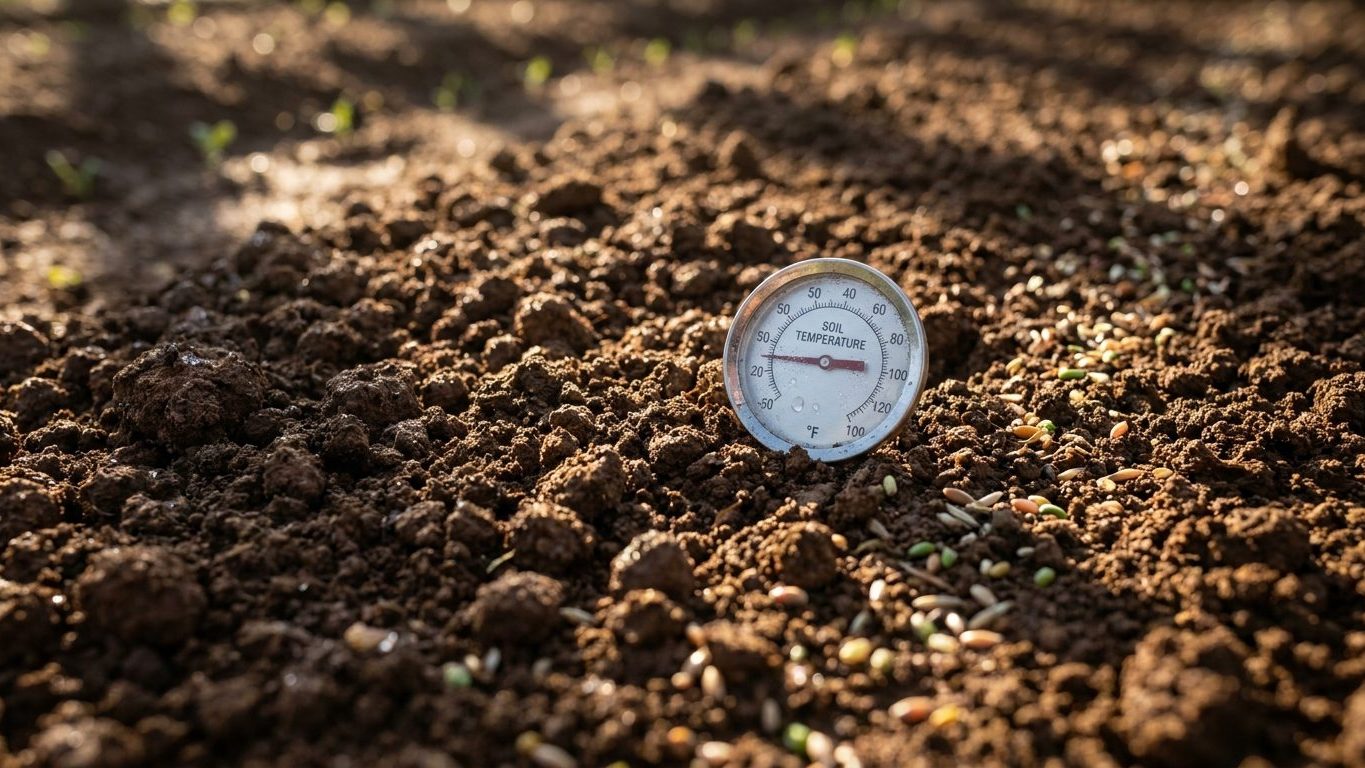
The average last spring frost at the Montreal/St-Hubert A station, per Environment and Climate Change Canada’s 1981-2010 Climate Normals, falls on May 6. That date is useful, but it’s not a green light by itself. Frost is a proxy for something else entirely: soil temperature. Cover crop seed germinates on soil warmth, not on the absence of frost, and soil lags behind air temperature by days, sometimes weeks, depending on how wet and how shaded the bed has been over winter.
There’s a second thing worth saying plainly about that May 6 figure: it’s a mean, not a safe bet. Environment and Climate Change Canada builds it from three decades of data, which means in roughly half of those years, the last frost landed later than May 6. Treat it as the middle of a window, not a promise the ground is clear. Gardeners in the Laurentians, the Gaspé, or anywhere upland and north of the St. Lawrence corridor should push that date back further still, since the reference station sits in the milder Montreal basin and a province this size is not one climate.
Once the soil has actually warmed, the choice of species narrows the timing question further. Cool-season options like oats, field peas, and annual ryegrass tolerate a cooler seedbed and can go in close to that mean date without much risk. Warm-season species such as buckwheat or sorghum-sudangrass want the soil noticeably warmer still, which in a zone 5b garden often pushes their sowing into late May or even early June, well after that averaged frost date has passed.
What governs how much seed goes into that soil is a different question than when. Rate depends on the species itself, on whether it’s broadcast or drilled, and on the seed source’s own germination figures, and getting it wrong either starves the stand or wastes a season’s worth of seed. That’s a calculation for Quebec’s agricultural extension network, not a generic number pulled from a national chart. The Ministère de l’Agriculture, des Pêcheries et de l’Alimentation du Québec, at mapaq.gouv.qc.ca, publishes regional guidance built for this soil and this climate specifically.
Termination follows the same mechanical logic throughout this territory. No herbicide is required to end a cover crop stand: mowing, crimping, or simply letting a hard fall frost do the work all get the job done, and which method fits depends on the species chosen and what’s planted after it.
How long the season lasts here
Bracket the two mean frost dates and Quebec’s frost-free window runs from May 6 to October 5, a span of roughly 152 days. That’s the same figures cited above, both from the Montreal/St-Hubert A station’s 1981-2010 normals, and neither one should be treated as a hard boundary rather than an average midpoint.
A five-month window changes the math on what’s actually possible in a single season. It’s long enough to fit a spring-sown cover crop, terminate it, grow a summer vegetable crop behind it, and still slot in a second cover crop planting before the fall frost risk climbs again in September. That kind of double-cropping is routine further south, where the frost-free window can run seven or eight months. Here, it’s tighter, and the sequencing has to be planned rather than improvised.
Where the window gets genuinely short, the practical question shifts. Instead of asking whether to plant a fall cover crop after harvest, many Quebec gardeners are really asking whether there’s enough calendar left to even attempt it, or whether the first sowing of the year was the only real opportunity. That changes how much energy goes into checking root development before pulling a summer crop early to make room, since every week matters more in a 152-day window than in a 220-day one.
Succession planning in a compressed season isn’t a cover-crop-specific skill. It overlaps heavily with vegetable succession sowing generally, where the same frost-window arithmetic decides how many rounds of lettuce or peas fit before the season closes. This site’s succession sowing guide works through that timing logic in more depth, and it applies just as much to a cover crop rotation as it does to a vegetable bed.
One detail worth flagging for anyone gardening north of the reference station: that 152-day figure shrinks the further from the St. Lawrence lowlands a garden sits. A window that’s already tight in the Montreal basin gets tighter in the Saguenay or the Abitibi, where local frost dates run later in spring and earlier in fall than what the reference station shows.
Heat and water in Quebec
For most vegetable crops, summer heat and rainfall drive the conversation. For cover crops in this territory, the more useful question runs the other direction: winter is what actually decides the outcome here, not the days of July heat.
The mean daily minimum of the coldest month at the reference station sits at 6.7°F, and Natural Resources Canada places the reference city in Canadian hardiness zone 5b. That zone figure comes from a seven-variable Canadian system, not the single-variable USDA scale used elsewhere on this site, and the two don’t convert cleanly. NRCan says as much itself: a single Canadian zone can span nine different USDA zones. So treat 5b as a description of this specific reference city’s climate, not a number to cross-reference against American charts.
That 6.7°F figure is the number that actually sorts cover crop species into two piles. Oats, for instance, reliably winterkill well north of Quebec’s mildest pockets, collapsing into a flat, easy-to-manage mulch once temperatures drop hard enough. In a genuinely mild territory, that same species can limp through winter and turn into an unwanted weed the following spring. Here, with a coldest-month minimum near 7°F, oats behave exactly the way most Quebec gardeners want them to: they die on schedule and leave a manageable residue.
Species with better cold tolerance, cereal rye chief among them, survive that same winter and need a different kind of ending: mowing, crimping, or hand-cutting once spring growth resumes. That’s not a drawback so much as a different management commitment, and which path a gardener wants (an automatic winterkill versus a spring termination job) is one of the more useful questions to settle before seed goes down in fall.
No verified figures for summer heat days or growing-season rainfall are available for this reference station, so this page won’t guess at them. What’s documented and reliable is the winter side of the equation, and for cover crops specifically, that’s the side that matters most anyway. A cool, damp summer common to this latitude brings its own complications for standing biomass, mildew pressure on dense stands being the most common one gardeners report, but the species choice itself is set by that coldest-month figure far more than by anything happening in July.
Which cover crops suit Quebec
A 152-day window and a 6.7°F coldest-month minimum together point toward earlier-maturing, cold-tolerant types over anything bred for a long, hot growing season. Cool-season grasses and legumes fit this territory’s rhythm more naturally than warm-season options that need a longer runway to build meaningful biomass before frost shuts things down.
Species that winterkill cleanly, oats among the most reliable examples in a zone 5b winter, suit gardeners who want a fall-sown cover crop that requires no spring intervention at all. Species that overwinter and resume growth, cereal rye being the standard example, suit gardeners willing to manage a mechanical termination (mowing, crimping, or cutting) once the ground thaws. Legumes like field peas or hairy vetch add a nitrogen-fixing role to the mix, though how much nitrogen becomes available to the next crop depends on the legume’s biomass and exactly when it gets terminated, not on any fixed number worth quoting here.
This page won’t name a specific cultivar, and that’s a deliberate choice rather than an oversight. Variety trials run by regional agricultural services test performance against local disease pressure, local frost timing, and local soil conditions in a way no general guide can replicate. Quebec’s own trials, run through the Ministère de l’Agriculture, des Pêcheries et de l’Alimentation, at mapaq.gouv.qc.ca, reflect exactly this reference station’s conditions and the province’s broader growing regions. That’s the recommendation that actually means something for a specific garden; a cultivar name pulled from a national gardening guide often isn’t tested anywhere near a zone 5b winter at all.
Seeding rate follows the same logic as species choice: it depends on whether seed goes down by broadcast or by drill, on the specific species selected, and on the seed lot’s own germination rate, all of which the extension service can size correctly for a given plot. Termination, whatever the species, stays mechanical throughout this territory: a mower, a crimper, a pair of shears, or simply a hard enough frost to finish the job without any chemical involved.