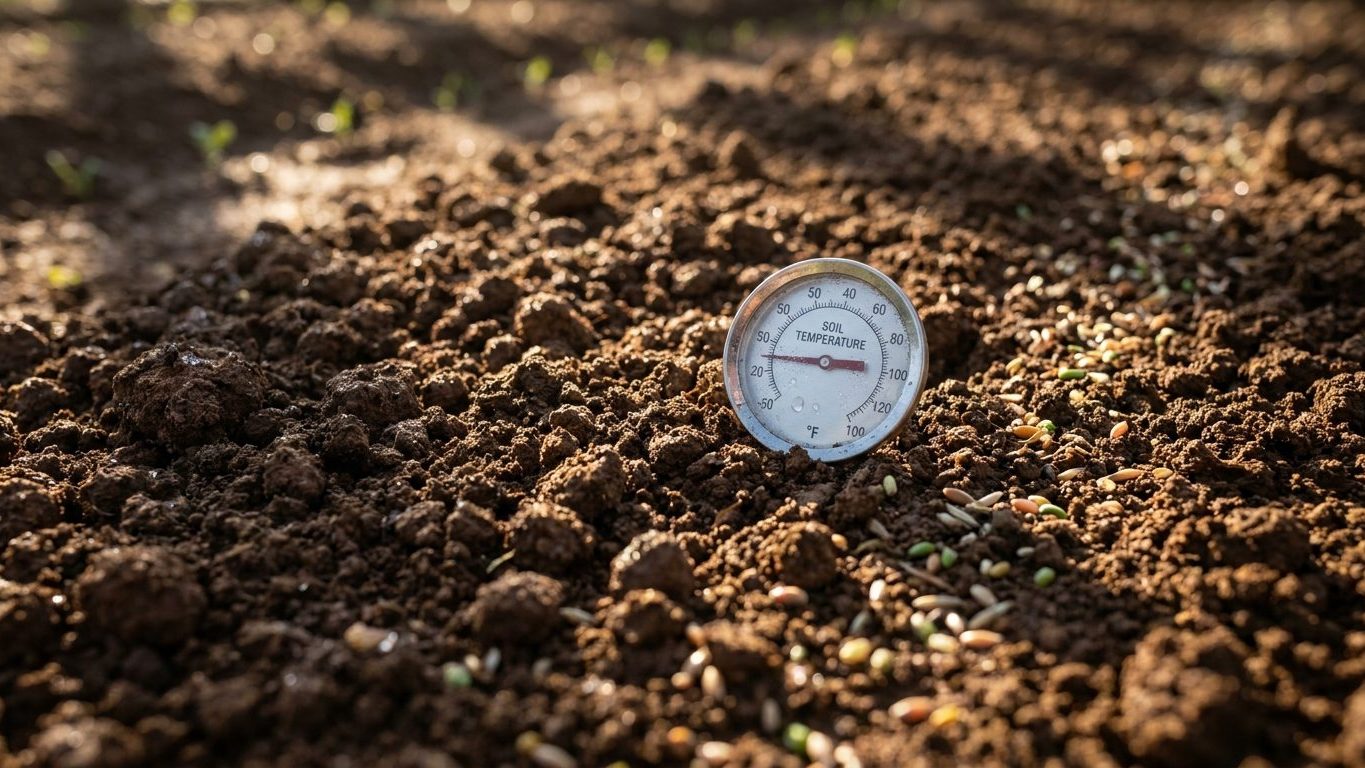

Cover crops in Rhode Island go into the ground once the soil itself has warmed, not on a fixed calendar date, and that usually means mid-to-late April through early May for spring seedings, with a second window opening after summer crops come out in August or September. The soil lag behind frost risk is the detail most planting calendars skip, and it’s the one that decides germination.
When the soil is warm enough in Rhode Island
The NOAA reference station near Providence puts the last spring frost between April 7 and April 17 (NOAA NCEI U.S. Climate Normals 1991-2020, 32°F freeze probabilities). That’s a 30-70% probability band, not a guarantee: some years the last freeze lands earlier, some years later, and gardens outside the immediate Providence area, especially inland and at higher elevation, often see frost linger a week or two past that date.
Here’s the part that trips people up. Frost date tells you when the air stops threatening tender growth. It says almost nothing about the soil. Cover crop seed, whether it’s a grass or a legume, germinates on soil temperature, and soil in coastal Rhode Island clay or loam can sit ten to fifteen degrees cooler than the air for weeks after that last frost passes. A grower who drills seed the same week the frost risk clears is often working ground that’s still too cold for even a quick germinator to break dormancy reliably.
Practically, that pushes a realistic spring sowing window to late April into May for most of the state, once the top few inches of soil have had sustained warmth, not just a few sunny afternoons. Species matter here too: some grasses tolerate cooler soil than most legumes, which tend to want more consistent warmth before nodulation gets going.
Seeding rate is the other place shortcuts backfire. Rate depends on the species itself, whether you’re broadcasting or drilling, seed size, germination percentage on the bag, and how much residue is already on the ground. A rate that works for a grass broadcast onto bare soil is wrong for a legume drilled into stubble, and guessing wastes a season’s worth of biomass and cost. The University of Rhode Island Cooperative Extension publishes current guidance tuned to the state’s soils and can walk through the math for your specific planting.
- Species chosen (grass, legume, or brassica)
- Seeding method (broadcast versus drilled)
- Seed source and germination rate on the label
- Existing residue or cover on the soil surface
Termination follows the same logic as timing: no herbicide step here. Mowing, crimping, or simply letting a hard frost do the work are the standard mechanical routes, and which one fits depends on the species and how much biomass built up before you cut it down.
How long the season lasts here
Running the two NOAA windows together gives a frost-free stretch. Using the latest likely spring frost (April 17) against the earliest likely fall frost (October 24) yields a conservative window of roughly 190 days. Pairing the earliest spring frost (April 7) with the latest fall frost (November 3) stretches that to about 210 days. Somewhere in that 190-to-210-day range is what most Rhode Island gardens actually get, and the true number for any one year depends on how that year’s weather lines up with the averages.
That’s a long enough window to matter. Six-plus months of frost-free ground means a single cover crop sowing isn’t the only option for most of the state. A spring-sown cover can be terminated in time for a summer vegetable planting, and there’s often still enough season left after that crop finishes to get a second cover crop established before the fall frost risk climbs. Whether that second sowing makes sense depends on what came out of the ground, how much daylight is left, and which species you’re considering, since a slow-establishing type needs more of that shrinking window than a fast one.
Where the season runs short, usually in the earlier-frost pockets or at elevation, that math changes. A short window can turn a two-crop rotation into a single planting, and it raises the stakes on the transplant question: setting out starts instead of direct-seeding buys back time at the front end of a squeezed season, which matters more when the back end is also getting squeezed by an early fall frost.
The mechanics of stacking two cover crop sowings into one growing year, including how to judge whether there’s enough calendar left for a second pass, are covered in more detail in our guide to succession sowing. That guide is worth reading before committing to a second planting, since the margin for error shrinks the later in the season you’re starting.
Heat and water in Rhode Island
Rhode Island doesn’t run hot by national standards, and there isn’t a high count of 90°F-plus days built into its coastal, marine-moderated summers the way there is inland. That matters less for cover crops than it does for tomatoes or peppers, because for cover crops the season that actually decides success is winter, not summer.
The mean daily minimum in the coldest month sits at 22.1°F at the Providence reference station (NOAA NCEI Climate Normals 1991-2020). That single figure is the one that sorts species into two camps: those that survive Rhode Island’s winter standing in the field, and those that don’t. Rhode Island’s hardiness range runs 6a to 7b on the USDA Plant Hardiness Zone Map (2023 edition, built on 1991-2020 normals), a range wide enough that a planting choice that works near the coast can behave differently inland or at elevation.
The practical split shows up clearly with two common cover crop grasses. Oats winterkill reliably once temperatures drop into that mid-20s range and below, collapsing into a mulch mat on the soil surface by midwinter with no mowing or crimping needed. Cereal rye does the opposite: it shrugs off Rhode Island’s coldest month and comes back green in spring, which means it has to be terminated by hand, mechanically, before it heads out and turns from a cover crop into a weed problem in whatever gets planted next. In a warmer region oats might survive and rye might barely slow down; here, the cold month does real sorting work for you.
Where Rhode Island’s climate does complicate things is humidity, not heat. Coastal moisture and cool, damp stretches in early summer favor foliar disease in dense stands, particularly in legumes and brassicas planted thick without airflow. That’s less a heat-and-drought story than a mildew-and-slow-drying one, and it’s the reason spacing and stand density matter more here than in a drier inland climate, even without extreme summer temperatures driving the conversation.
Which cover crops suit Rhode Island
Type, not cultivar, is what this territory’s numbers actually support choosing. A roughly six-to-seven-month frost-free window, a firmly cold winter minimum, and a humid coastal summer point toward a short list of reasonable categories rather than a single best answer.
| Type | Winter behavior in RI | Main consideration here |
|---|---|---|
| Cool-season grasses (oats, cereal rye) | Oats typically winterkill; rye typically overwinters | Choose based on whether you want a spring mulch or a crop needing mechanical termination |
| Legumes (clovers, vetch) | Varies by species; some overwinter in 6a-7b | Needs consistent soil warmth to establish before winter; dense stands are prone to mildew in humid stretches |
| Brassicas (mustards, forage radish) | Typically winterkill in Rhode Island’s coldest month | Fast fall establishment window; benefits from spacing to limit disease pressure |
The season length worked out earlier, that 190-to-210-day frost-free stretch, supports the earliest-maturing types when a grower is trying to fit a cover crop after a summer harvest and still get real biomass before the fall frost risk climbs. The humidity noted above pushes disease resistance and airflow to the top of the priority list for anything sown dense, ahead of yield or growth speed. And the coldest-month figure of 22.1°F is the detail that ultimately decides whether a given species needs mechanical termination in spring or does that job on its own.
What this page won’t do is name a specific variety within any of those types. Variety trials run by land-grant universities test named cultivars against local soils, local disease pressure, and local weather in ways a general guide simply can’t replicate, and a recommendation made without that local trial data is a guess dressed up as advice. The University of Rhode Island Cooperative Extension maintains that trial data and can point to varieties actually tested under Rhode Island conditions, which is the only kind of cultivar recommendation worth following. The same office is the right first call on seeding rates too, since rate depends on the species and method chosen above, not on a number that would apply evenly across the whole state.