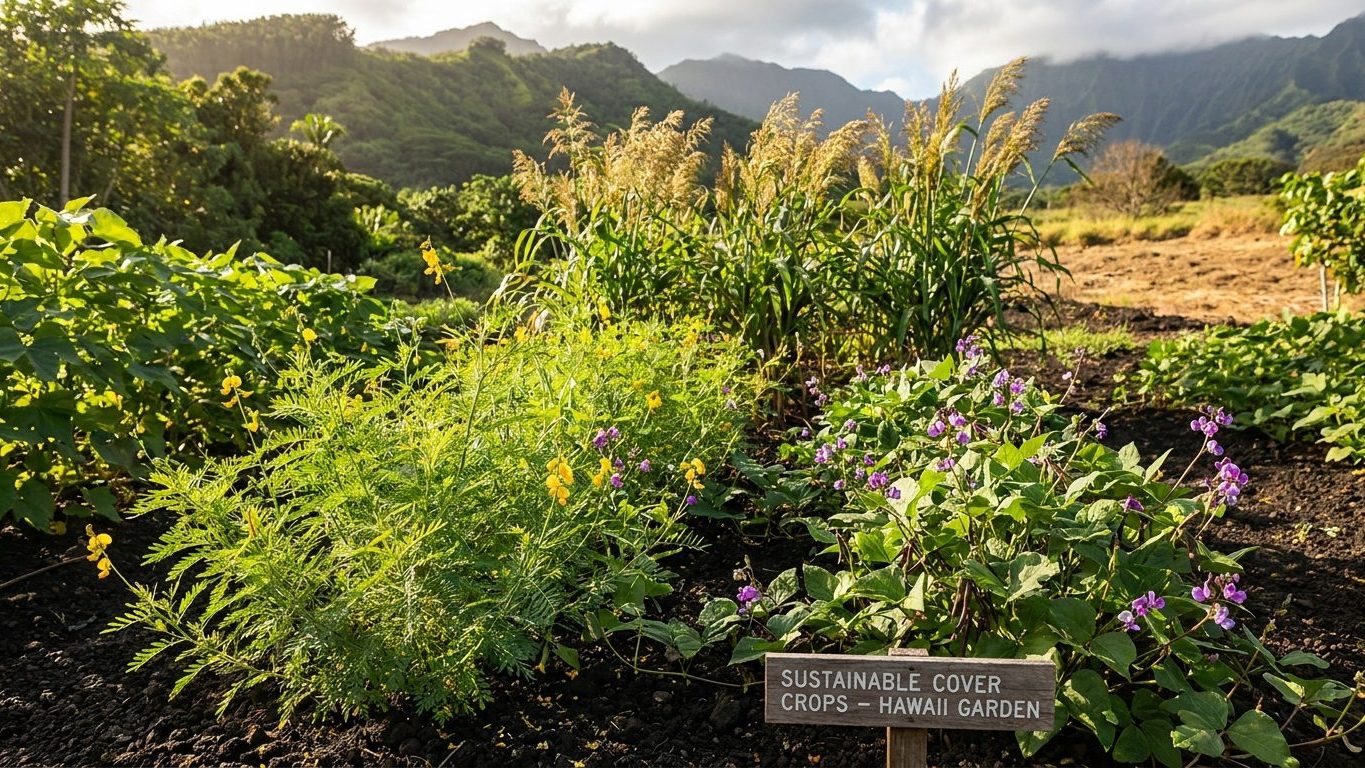

For most of Mississippi, the winning cover crop lineup pairs a fast summer legume like cowpea or sunn hemp with a fall-sown mix of cereal rye, crimson clover, and hairy vetch. The state’s long frost-free window, roughly March into November across most counties, and mild average winter lows near 37°F make this one of the easier Southeastern states to keep cover crops working nearly year-round, provided you match the crop to your side of the zone 7b-9a divide.
The short answer for Mississippi
Start with the numbers that actually drive the decision. NOAA’s 1991-2020 climate normals put the last spring frost at the Jackson reference station somewhere between March 6 and March 22, and the first fall frost between November 7 and November 22. That’s a frost-free stretch of nearly eight months in a typical year, which is long enough to run a full summer cover crop and a full winter one on the same bed without rushing either.
The mean daily minimum for the coldest month sits at 36.6°F. That’s not the record low, it’s the average low across January, and it tells you something important: winters here rarely punish a cover crop stand the way they do further north. Legumes that need reliable winter survival, hairy vetch, crimson clover, Austrian winter peas, all handle that kind of mild cold without trouble.
By type
Legumes are the strongest performers statewide. Cowpea (also sold as southern pea) and sunn hemp thrive in the long, hot summer window and fix nitrogen fast, often producing usable biomass in six to eight weeks. For the cool season, crimson clover and hairy vetch both tolerate the mild winter lows and keep growing through most of the year instead of going fully dormant.
Grasses do well too, but timing matters more. Cereal rye is the most forgiving cool-season grass here because it germinates in cool soil and keeps growing through winter without needing a hard freeze to trigger anything. Sorghum-sudangrass and pearl millet are the summer grass options, both suited to the heat but needing the full frost-free window to reach useful biomass.
Brassicas, tillage radish in particular, work as a fall-planted soil-loosener, but their role shifts depending on where in the state you garden, which the next section covers in more detail.
What will not work here
Mississippi’s problem isn’t a short season, it’s the combination of heat, humidity, and a winter that’s often too mild to do the job some cover crops are counting on.
Tillage radish is the clearest example. Many growers plant it expecting a hard freeze to kill it off cleanly by January, leaving a loose, weed-free bed in spring. That works reliably in colder states. In the milder pockets of Mississippi, especially toward the Gulf Coast where winter lows rarely dip far below that 36.6°F coldest-month average, radish can survive into spring, bolt, and reseed as a weed instead of dying back. If you’re relying on winterkill as your management plan, don’t assume it in southern counties.
Buckwheat is the opposite problem. It’s a fast, cheap summer cover crop, but its six-to-eight-week cycle was built for cooler climates. Planted into the peak of a Mississippi summer, it struggles with heat stress and fungal pressure well before it reaches full flower, and the state’s humidity accelerates disease in a crop that’s already thin-leaved and vulnerable. Use it only as a quick gap-filler between spring and fall plantings, not as a season-long stand.
Dense seeding of crimson clover or hairy vetch is another trap. Both crops handle the mild winter fine on their own, but packed too tightly in the humid Delta or coastal counties, they trap moisture at the canopy level and invite fungal disease before they ever reach full nitrogen-fixing potential. Extension trial data across the Southeast consistently shows wider row spacing and lower seeding rates outperform crowded stands in humid regions, even when the crowded stand looks lush early on.
Finally, oats are a coin flip depending on where you are. In the cooler, northern hill counties near zone 7b, oats reliably winterkill, which some gardeners actually want. In the milder zone 8b-9a stretch toward the coast, they can persist through winter, which changes your spring termination plan entirely. Don’t plant oats assuming they’ll die back just because that’s what they do further north.
What changes across Mississippi
Mississippi isn’t one garden, and its hardiness zone range of 7b-9a proves it. That’s a real spread, not a rounding error: it covers the colder hill country in the north down to the warm, humid strip along the Gulf Coast, and the difference shows up directly in how cover crops behave.
In the northern zone 7b counties, winters run cold enough that cool-season crops like oats and even some radish varieties reliably winterkill, giving you a predictable spring reset without extra termination work. Frost dates there also tend to run earlier in fall and later in spring than the Jackson reference figures used above, since those figures come from a single airport station and don’t capture every county’s local conditions.
Move south toward zone 9a along the coast, and the picture flips. Winters are mild enough that some crops meant to die back on their own simply won’t, and the frost-free window stretches noticeably longer, giving warm-season legumes like cowpea and sunn hemp extra weeks to build biomass before the first fall frost arrives. That extra length also means summer grasses like sorghum-sudangrass can be planted a bit later and still finish strong.
There’s no single hardiness zone answer for the whole state, and there’s no single frost date either. A reader in the Delta, the hill country, or the coastal counties is working with a meaningfully different calendar, even though all three are technically “Mississippi.” The right move isn’t to guess which zone you fall into based on this article, it’s to check the USDA Plant Hardiness Zone Map directly for your county before locking in a planting date, especially for anything you’re counting on to winterkill or overwinter reliably.
Where to check this for your own county
This page gives you the state-level picture, built from one reference station’s climate normals. Your county is not that station. Mississippi State University Extension is where the state-specific and county-specific numbers actually live, and it’s worth going there before you finalize a planting date, especially for a cover crop you’re counting on to winterkill or overwinter through a mild spell.
Two things are worth looking for specifically once you’re there. First, the local planting calendar for your region of the state, since Mississippi’s counties split fairly cleanly between the cooler hill country, the Delta, and the coastal plain, and extension guidance is usually broken out that way rather than given as one blanket date for the whole state. Second, look for variety trial results for your area. Extension programs regularly test cover crop varieties, cowpea lines, cereal rye cultivars, clover types, under local soil and humidity conditions, and those trial results tell you a lot more about what actually performs in your county than a statewide average ever could.
A county recommendation beats a state one every time. This page exists to explain the mechanics, the frost dates, the zone spread, the reasons certain crops fail here, but it’s not a substitute for the county-level detail your local extension office has on file. If you garden near a zone boundary, or at any elevation above the surrounding area, that gap between state and county numbers is exactly where things go wrong, usually in the form of a cover crop that either winterkills when you needed it to overwinter, or the reverse.
Checking this against your own garden
Every date on this page is a probability built from decades of averages at one weather station. Your own garden will tell you more than any calendar, and it does it for free.
Start with soil warmth by feel. Push a finger a couple of inches into the bed where you’re planning to seed a summer legume like cowpea. If the soil feels cool and slightly damp rather than warm to the touch, even after a few sunny days, it’s telling you the ground hasn’t caught up to the air temperature yet, and seed sown now will sit and sulk rather than germinate quickly.
Watch for the first true leaves on whatever you’ve already got in the ground. The first set of leaves after the seedling’s initial pair are the plant’s real working leaves, and how fast they show up is a direct read on how favorable your specific microclimate is right now, regardless of what the calendar says the average frost date should be.
If you’re running a cool-season legume like crimson clover, keep an eye on how it handles the first real cold snap of the year. A stand that shrugs off a cold night without browning is confirming that your spot runs milder than the state’s coldest-month average of 36.6°F suggests, useful information if you’re deciding whether to count on winterkill for a companion crop like radish. A stand that browns back hard is telling you the opposite, and that’s worth trusting over any regional map.