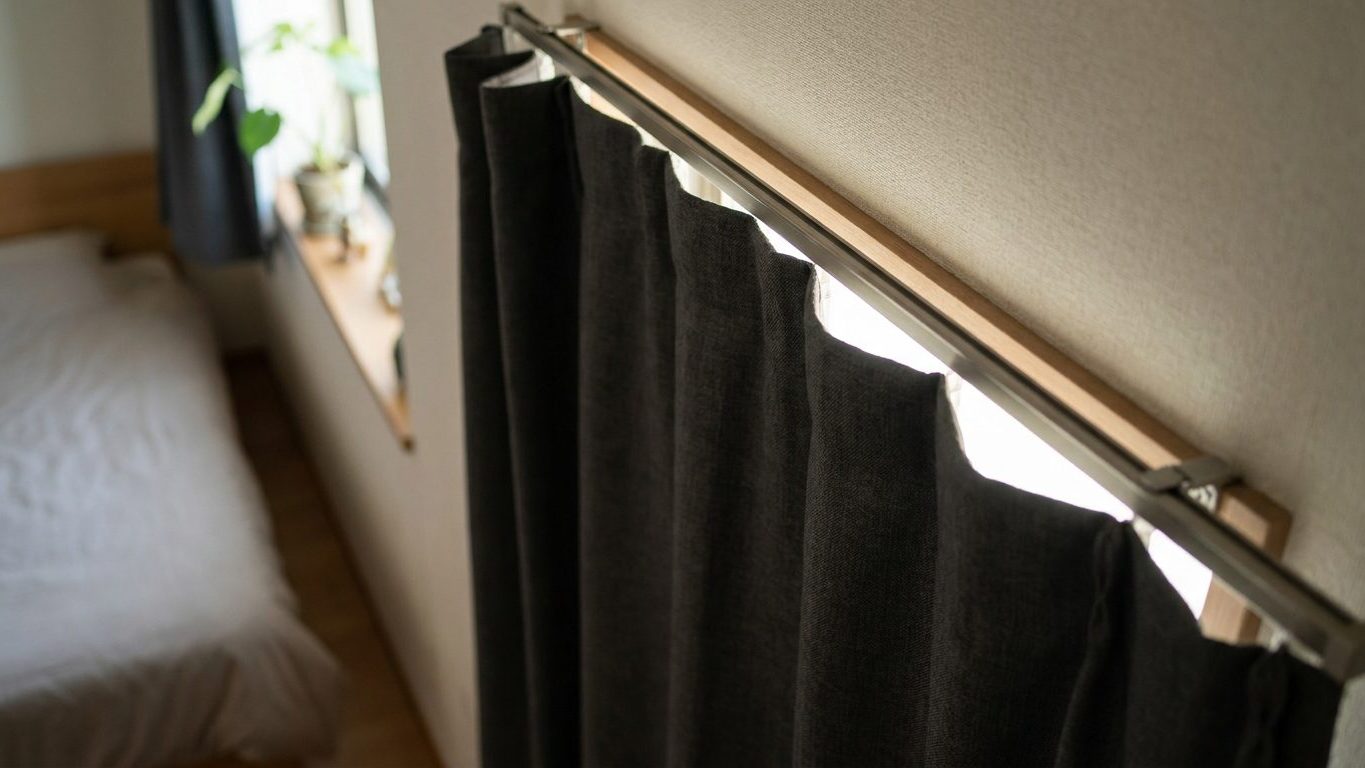

Light gets in at the sides, the top and the bottom of the panel, not through the weave of the fabric itself. A blackout panel needs to run 8 to 12 inches past the window opening on each side to close the gap where light bends around the edge of the cloth. Measure that overlap at your own window before you decide the curtain is the problem.
Why the fabric is not the problem

The number that actually governs a dark room is 8 to 12 inches of overlap on each side of the window opening, a dimension the window-treatment trade plans around rather than a building code requirement. It is a convention, not a law: no inspector checks it, no manual cites a section number for it. It measures the distance from the edge of the window opening, meaning the frame or the trim, out to the edge of the hung panel.
Blackout fabric is rated for how much light passes straight through the weave when the panel is flat and fully covering something. That part of the job, most blackout linings do well. Triple-weave and foam-backed linings block the direct path of light through the cloth almost completely, and that is the number printed on the product tag or the swing sample at the store.
What the fabric rating does not cover
None of that rating touches the edges. The fabric note that matters here is simple: blackout lining stops light through the cloth, and it does nothing about the perimeter. A curtain can be rated to block better than 99 percent of direct light and still leave a room streaked with daylight at six in the morning, because the light is not going through the fabric. It is going around it, at the sides where the panel meets the wall, at the top where it meets the rod, and at the bottom where it meets the floor or the sill.
This is why buying a heavier or more expensive blackout panel rarely fixes a room that still gets light. The weave was never the leak. The install was.
The four gaps a straight rod leaves open
A standard curtain rod, mounted directly above the window frame and cut to the width of the window, creates four separate gaps, and each one has a reason. Light does not need a hole to get through. It needs an unobstructed line from outside to the room, and a straight rod hung tight to the window opening gives it four of those lines: one at each side, one across the top, one across the bottom.
The side gaps exist because a panel sized to the window, rather than beyond it, leaves the vertical edge of the window opening exposed. This is the same logic behind the 8 to 12 inch overlap figure from the previous section. Light entering at a low morning or evening angle does not travel straight through the window. It comes in at a slant, and a panel that stops exactly at the frame gives that slanted light a straight path past the edge of the fabric and into the room.
The top gap comes from mounting the rod too close to the window, so the finial and the header of the curtain sit right against the frame with nothing behind them but a thin strip of wall. The bottom gap comes from a panel that is cut to end at the sill instead of running to the floor, leaving a lit strip below the hem that shows up as a line of light across the floor at dawn.
Why this matters more in some rooms than others
None of these four gaps are new numbers. They are the same overlap and mounting figures already in play, just applied to four edges instead of one. A room facing a streetlight or a neighbor’s porch light shows the side gaps first, because that light comes in horizontally and finds the vertical seam. A room facing east or west shows the top and bottom gaps first, because the sun angle in early morning or late afternoon comes in low and finds the horizontal seam. A nursery or a shift worker’s bedroom tends to show all four gaps at once, because any amount of leak reads as a failure when the goal is full dark at any hour.
Returns, tracks and the wall-mounted alternative
A straight rod with the panel hanging in front of it always leaves a side gap, because the fabric sits several inches off the wall and light finds the space behind the edge of the panel. A return to the wall, or a wrap-around track, closes that gap by turning the panel back against the wall itself instead of letting it hang flat and open at the side. This is trade practice, not a code requirement, and it varies by the hardware you buy: some rods include a return bracket, some tracks wrap by design, and a plain tension rod usually has neither.
Where a room has a corner window, an angled dormer, or a curtain that has to clear a radiator or a window seat, a wrap-around track is often easier to fit than trying to bend a rigid rod into a return. This comes up constantly in Can an Attic Be a Bedroom? The Half-the-Floor Rule, where slanted ceilings and dormer windows make a standard straight-rod install awkward at best.
None of this is inspected or enforced by anyone. It is worth saying plainly because it is easy to assume there is a rule somewhere setting a minimum return depth, and there is not. The trade plans around returns deep enough to meet the wall cleanly, but the exact depth depends on the rod, the bracket, and how far the rod projects from the wall in the first place. If you are unsure what your hardware allows, check the specifications from the rod or track manufacturer rather than guessing at a number.
Measuring the opening plus the overlap

The measurement that actually predicts whether a room goes fully dark starts at the window opening itself, not at the existing rod or the existing curtain. Measure the width of the window opening first, then add the 8 to 12 inches on each side to get the minimum rod length. Measure the height from where the new rod will sit down to the floor, since a blackout panel should run to the floor rather than stop at the sill.
The measurement people skip
The mistake that shows up most often is measuring the current rod instead of the window. If the existing setup already leaks light, its width and height are not a starting point, they are the problem being measured. Measure from the edge of the window opening outward, not from the edge of the current hardware.
- Window opening width: measure frame edge to frame edge
- Rod length needed: window width plus 8 to 12 inches on each side
- Rod height: 4 to 6 inches above the top of the frame
- Panel length: rod height down to the floor, not to the sill
Rod placement itself is its own decision, covered in more detail in Where to Put a Curtain Rod, Above and Beyond the Frame, since the height above the frame changes how much fabric is needed and how the return sits against the wall. Getting the width and the height numbers down on paper before buying hardware avoids the common outcome of ordering a rod that turns out to be a few inches short on each side once it is on the wall.
The expensive blackout curtain in a bright room
When the overlap and return are skipped, the result shows up at the exact times it matters most: early morning in summer, streetlight glow in winter, or any night a car turns into the driveway and sweeps headlights across the wall. The panel does its job through the weave and still fails at the job it was bought for, because the light was never going through the fabric.
In a nursery or a shift worker’s bedroom, this failure is not cosmetic. A gap at the top or sides can mean the difference between a room that stays dark through a summer sunrise and one that starts brightening at first light regardless of how heavy the curtain is. Buying a second, heavier panel on top of the first does not fix a return that is too shallow or a rod that is too short. The gap is still there, just behind two layers of fabric instead of one.
If a room still leaks light after checking the overlap, the return, and the rod height, the next step is checking the hardware specifications against the actual wall measurements, since brackets, tracks and returns are not universal across manufacturers. For a full renovation involving structural changes to a window opening or wall, that question moves beyond curtain hardware and belongs with a contractor or the local building department instead.
Common questions
Do I really need to go past the window on both sides?
Yes, on both sides, not just the side facing the street or the strongest light source. Light angles change through the day, and a gap left open on one side will show up at a different hour than a gap on the other.
Can I just clip the curtain to the wall instead of buying a return bracket?
Command hooks or magnetic clips at the edge of the panel can close a side gap in a pinch, and plenty of people use them as a permanent fix. They will not hold up as well as a proper return bracket or wrap-around track under regular opening and closing.
Why does my curtain still let light in even though it’s rated blackout?
Because the rating covers light passing through the woven fabric, not light traveling around the edges of the panel. Check the overlap at the sides, the rod height above the frame, and whether the panel reaches the floor before assuming the fabric itself is the issue.
Does a valance or cornice help with the top gap?
A valance or cornice board can block light that would otherwise sneak over the top of the rod, since it extends the covered area above and in front of the hardware. It does not replace mounting the rod 4 to 6 inches above the frame, it works alongside that placement.