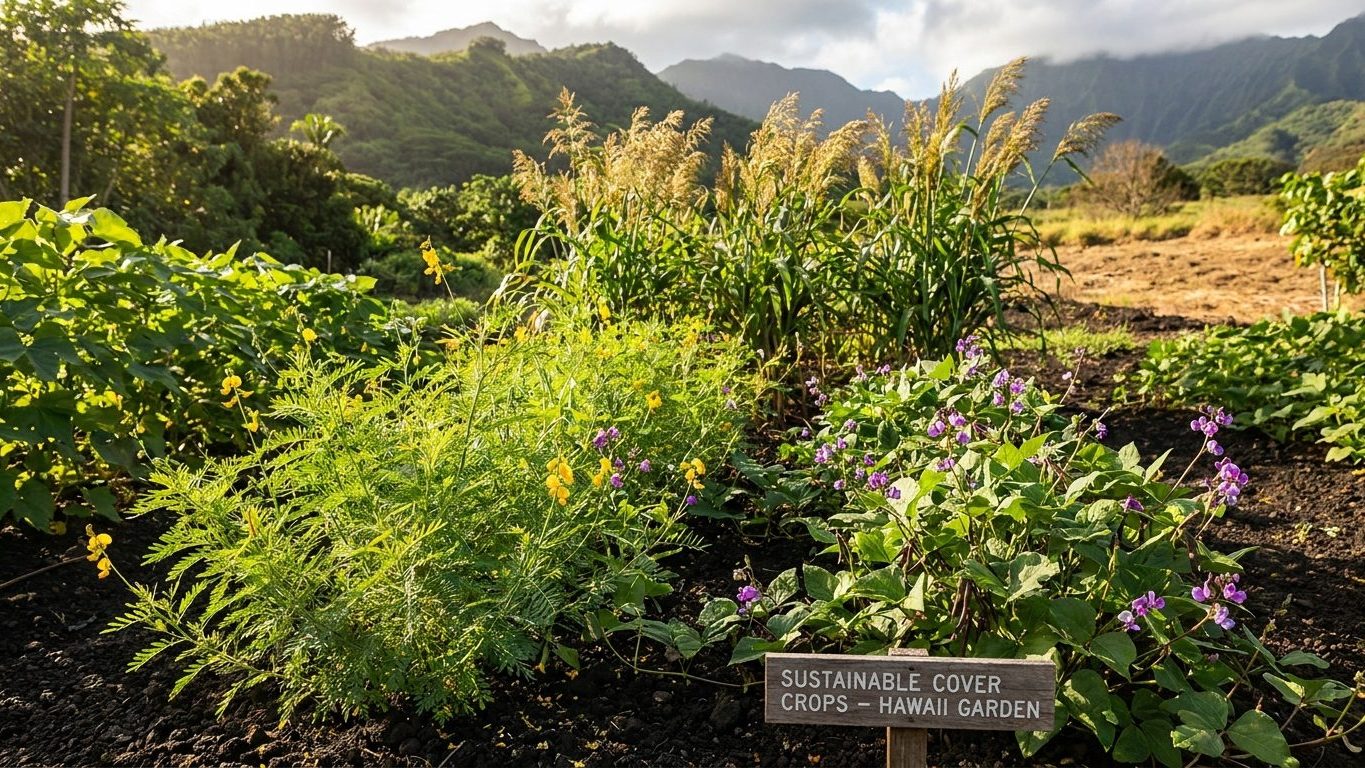

The best Cover Crops for Montana are winterkill annuals like spring oats, field peas, forage radish, and mustard, plus fast summer covers like buckwheat and sudangrass grown within the state’s roughly 150-day frost-free window. Overwintering options such as winter rye, hairy vetch, and crimson clover work only in the state’s milder valleys, not statewide. The right pick depends on which part of Montana you’re farming or gardening.
The short answer for Montana
Montana’s growing season, measured at the Billings reference station, runs from a last spring frost between April 29 and May 10 to a first fall frost between October 1 and October 14. That’s a frost-free stretch of roughly 145 to 165 days, depending on the year. It’s enough time to grow one solid cover crop cycle, but not enough to gamble on anything slow to establish or slow to terminate.
That season length pushes the decision toward two categories. The first is winterkill annuals: spring oats, field peas, forage radish, and mustard. Seeded in later summer after a cash crop or garden bed is cleared, these grow fast, build biomass through fall, then die outright once temperatures drop hard enough. Killed on their own schedule, they need no herbicide pass and no spring tillage before the next planting. The second category is quick summer covers like buckwheat and sudangrass, which fit neatly inside the frost-free window and are done and terminated before the first fall frost arrives.
Overwintering species, winter rye, hairy vetch, crimson clover, sit in a different bucket. They depend on surviving winter cold, and Montana’s winter cold is severe and uneven. At the Billings reference station, the coldest month has a mean daily minimum of 17.9°F, which is the number that actually decides whether a plant makes it through winter, not the record low and not a monthly average. That’s Billings, one of the state’s milder valleys. Statewide, the USDA Plant Hardiness Zone Map (2023, built on 1991-2020 averages) puts Montana anywhere from zone 3a to zone 6a, a spread wide enough that a species surviving winter in one county can be wiped out sixty miles away.
So the honest short answer is: lean on winterkill and quick summer species for a consistent result anywhere in the state, and treat fall-seeded overwintering legumes and cereals as a bonus option only where local winters run milder, not as a default statewide plan.
What will not work here
Slow, heat-loving cover crops are the first casualty of Montana’s season length. Sunn hemp and cowpea, both marketed as warm-season biomass builders, typically need 60 to 90 days of consistent heat to do their job, and they want that heat to start after the soil has already warmed well past the last frost date. With a frost-free window that opens around late April to early May at best and closes by mid-October, there simply isn’t enough margin left for these species to establish, flower, and build meaningful biomass before cold shuts them down. Sorghum-sudangrass hybrids run into the same wall in the state’s higher, cooler valleys, where summer heat units never accumulate the way they do farther south.
Fall-seeded legumes and cereals fail for a different reason: winter itself. Crimson clover and hairy vetch are commonly recommended in warmer regions as reliable overwintering covers, but planted on an exposed, high-elevation Montana field, they’re gambling against a coldest-month mean minimum that can sit well below the 17.9°F figure recorded at Billings once you move into the state’s colder zones. A plant rated for milder winter minimums doesn’t just get set back by that kind of cold, it dies outright, and the grower is left with a bare, eroding field going into spring instead of the protective mat they were counting on.
Irrigation-dependent establishment is the third trap. Montana’s growing-season precipitation is thin and unevenly distributed, and species that need consistent moisture through germination and early growth, fine-seeded clovers seeded into a dry August stubble field, for instance, will often germinate unevenly or not at all without supplemental water the grower may not have budgeted for. Buckwheat and mustard, by contrast, germinate and establish fast enough to get ahead of a dry spell, which is part of why they show up so often on winterkill recommendation lists for the northern Plains and Rocky Mountain states.
Close row spacing borrowed from wetter regions is a smaller but real problem too. Tight spacing that works fine in humid states here concentrates competition for a shallow, unreliable moisture supply, thinning stands right when biomass is supposed to be building.
What changes across Montana
Montana is not one climate, and the hardiness zone range makes that concrete. A statewide spread of USDA zone 3a to zone 6a means the coldest parts of the state and the mildest parts differ by a full three zones, which in practical terms is the difference between a plant that reliably overwinters and one that reliably dies. There is no single cover crop answer for “Montana.” There’s an answer for the milder valleys and a different, more conservative answer for the colder high plains and mountain valleys.
In the milder zones, closer to the 6a end of that range, a reader has more room to experiment with fall-seeded winter rye or hairy vetch as an overwintering cover, because winter minimums there are less punishing. Even in those areas, though, the 17.9°F coldest-month figure recorded at Billings is a reminder that “milder” in Montana is still cold by national standards, and a rough winter can still take out a marginal stand.
In the colder zones, toward 3a, the safer default is to skip overwintering species altogether and build the whole plan around winterkill annuals and quick summer covers instead. A grower there should also expect the practical frost-free window to run shorter than the Billings dates quoted above, since Billings sits in one of the state’s warmer valleys. That means shifting seeding dates earlier when the goal is a summer cover, and shifting fall-seeding dates earlier too, so a winterkill species has enough weeks to build real biomass before the first hard freeze arrives.
At higher elevations, the caution embedded in the frost-date data applies directly: mountain valleys can see frost in any month, which rules out anything that needs an uninterrupted stretch of warm weeks to succeed. This page can describe the range. It can’t tell an individual reader which zone their own field sits in, that call belongs to the map, not to a general article.
Where to check this for your own county
The Montana State University Extension system is the next stop, and it matters more than anything on this page. This article is a state-level overview built from statewide averages and a single reference station. A county extension office works from local trial plots, local frost records, and local soil conditions, which makes a county recommendation more reliable than a state one every time they disagree.
Once there, two things are worth tracking down specifically. First, a local planting calendar for cover crops, if the county office publishes or references one, since it will reflect actual local frost timing rather than the Billings-based dates used here. Second, any record of cover crop species trialled in that specific county, because Montana State’s extension network and affiliated researchers have run field trials on winterkill and cover crop performance across different parts of the state, and a county agent can usually point to what performed well nearby, not just what performed well somewhere in Montana.
It’s also worth asking directly whether the office has data on winter survival for legumes and cereals in that county specifically. Given how wide the state’s hardiness zone range runs, a phone call or an email to a local agent answering “does hairy vetch reliably overwinter here” is worth more than any general guidance, including this article’s. State-level pages like this one are built to frame the decision and flag what to check locally, not to replace the answer a county office can give from its own soil and its own weather station.
Checking this against your own garden
None of the dates above beat what’s happening in the actual field. Frost tables are probabilities built from decades of averages, not a forecast for this particular year, and a grower’s own observations will catch a shift the calendar can’t.
Soil warmth by feel is the first check. Before seeding a summer cover like buckwheat, pushing a hand into the top few inches of soil should feel comfortably warm, not just frost-free air temperature but warm soil, since seeds sitting in cold, wet ground germinate slowly and unevenly no matter what the calendar says.
The second check is watching for the first true leaves on whatever’s already growing nearby, a garden crop, a volunteer weed patch, a neighboring field. True leaves showing up earlier or later than expected against the stated frost window is a direct signal about that specific spot’s microclimate, low ground that pools cold air, a south-facing slope that warms early, a windbreak that shelters a bed from the worst of a late frost.
The third is simply tracking how a fall-seeded cover behaves going into winter: how much biomass it built before growth stalled, whether it still looks alive after the first hard freeze, and how it looks coming out of winter dormancy. A stand that limps through one winter and dies the next is telling the grower something about that year’s cold, not necessarily about the species choice itself, and it’s worth noting both outcomes before deciding a variety failed for good.