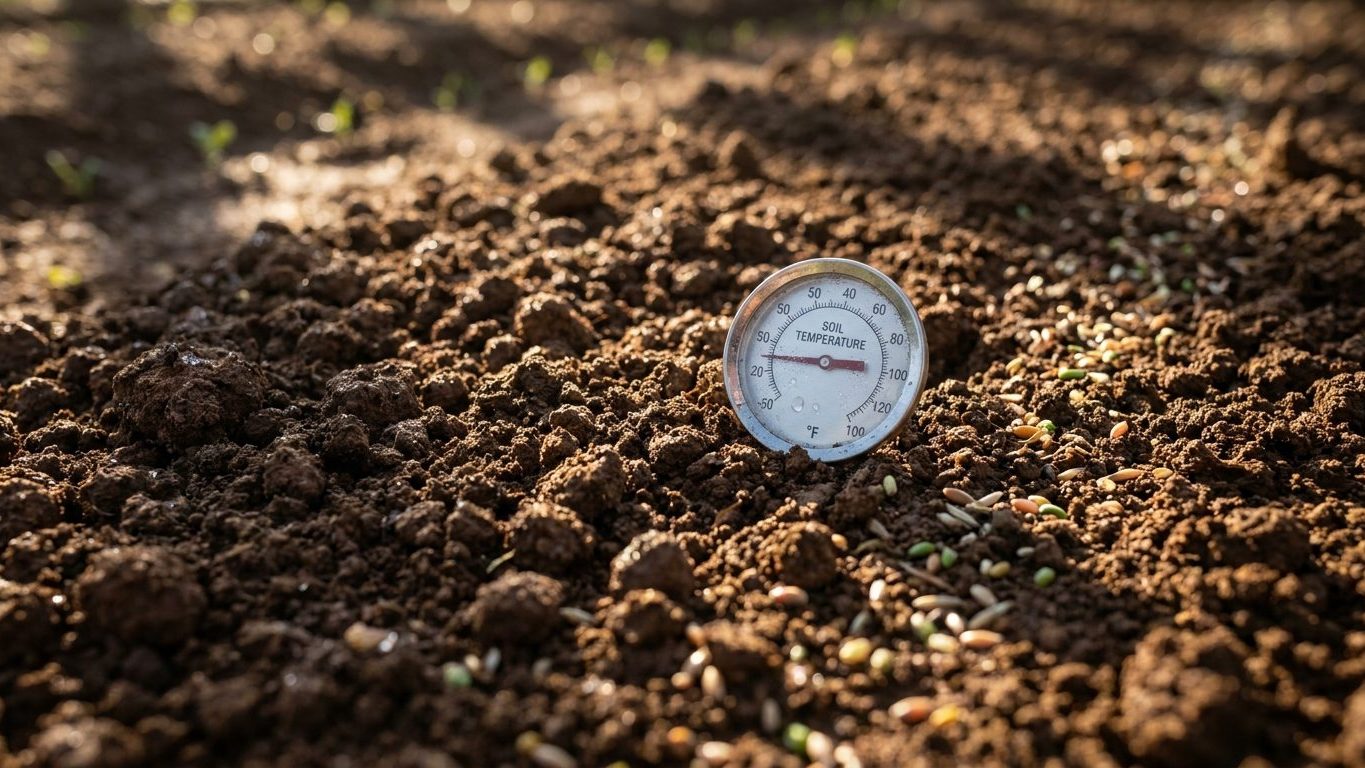

Cover crops go in Virginia once the soil itself holds steady warmth, not the day the calendar says frost is over. The frost-free window runs roughly seven to eight months depending on where you garden in the state, and Virginia’s mild coastal winters mean several popular species won’t die back on their own, so the plan for killing them matters as much as the plan for planting them.
When the soil is warm enough in Virginia
The question every gardener asks first is simple: when can I put seed in the ground? At the NOAA reference station for coastal Virginia, USW00013769 (NAS Oceana), the 1991-2020 Climate Normals put the last spring freeze between March 20 and April 3. That’s the window where the 32-degree freeze probability sits between 30 and 70 percent, meaning it’s a coin-flip stretch, not a guaranteed cutoff on either end.
Treat that date as a proxy, not a green light. Frost risk ending and soil warming enough for germination are two different events, and the second one lags behind the first by days to a couple of weeks depending on how much sun the bed gets and how heavy the soil drains. A raised bed in full sun in Virginia Beach might be workable within days of that early-April mark. A shaded, clay-heavy plot inland could sit cold and slow to wake up well past it.
That gap matters more the farther you move from the coast. The Blue Ridge and southwest Virginia run weeks later in spring than the Oceana station, so anyone gardening in Roanoke, Blacksburg, or the Shenandoah Valley should treat the coastal date as an early marker, not their own. The elevation and cold-air drainage in the mountains push both the frost date and the true soil-warming date back substantially.
Once the soil is ready, the crop you choose and how densely you scatter it depends on the species, the seeding method, and the source of your seed, three variables no single number can cover responsibly. Virginia Cooperative Extension keeps current rate tables for the state at ext.vt.edu, and that’s the right place to confirm rates before you buy seed, not a generic chart.
Termination deserves the same caution. This site works from mechanical methods only, mowing a stand down before it sets seed, crimping it flat to kill it while leaving the residue as mulch, cutting it back by hand in a small bed, or simply letting a hard frost finish an already-tender species. Skipping the chemical route isn’t a compromise here; it’s the whole approach, and it works fine at garden scale where a mower or a pair of shears can do in an afternoon what a sprayer would do on a farm.
How long the season lasts here
Stretch the two frost dates from the same NOAA station across the calendar and you get the outer edges of the frost-free season: as early as March 20 on the spring side, as late as November 24 on the fall side. That’s a window of roughly seven to eight months, depending on which end of each range applies to your particular spring and fall.
What that length actually buys a gardener is the more useful question. Seven to eight frost-free months is enough room for a first cover crop planted after a spring harvest, a summer break, and a second cover crop planted ahead of fall, provided the first stand is terminated with enough lead time for the second to establish before growth slows. That’s a real advantage over shorter-season territories farther north, where growers often get exactly one shot.
| Territory reference | Typical frost pattern | Practical effect |
|---|---|---|
| Coastal Virginia (Virginia Beach / Oceana station) | Last frost March 20-April 3; first fall frost Nov 10-24 | Longest window in the state; room for two cover crop sowings in most years |
| Blue Ridge / southwest Virginia | Weeks later in spring, weeks earlier in fall (per NOAA caution) | Shorter window; often only one reliable sowing per season |
Where the window narrows, the first sowing tends to be the only one that counts, and that changes a second decision most people don’t think about: whether it’s worth transplanting a rooted cover crop start versus direct-seeding. A shorter season makes direct seeding the more forgiving choice in most cases, since it removes one more delay from an already tight calendar. If you’re weighing a second planting or want the mechanics of timing one cover crop right behind another, the succession sowing guide on this site walks through how much lead time each termination method needs before the next seed goes in.
Gardeners near the coast who skip the second sowing aren’t wasting the extra weeks; that time is exactly what lets a summer legume build enough biomass before a fall grass takes over the same bed, something a shorter inland season simply doesn’t allow.
Heat and water in Virginia
For a cover crop, summer heat matters less than what happens after it. The two figures that actually govern success here are the first fall frost and the coldest month’s typical low, and both point toward a state where winter is doing most of the deciding, not the July thermometer.
The reference station’s data doesn’t tabulate a summer heat count or a rainfall total in the normals used for this page, so no number belongs here for either one. What the data does give is the coldest month’s mean daily minimum: 31.6 degrees Fahrenheit at the Virginia Beach reference station. That’s barely below freezing on an average night in the coldest stretch of winter, which is a mild figure by national standards and sits inside the USDA’s 5a-8b hardiness range recorded for the state (USDA Plant Hardiness Zone Map, 2023 normals).
That mild coldest-month minimum changes the whole calculus for a gardener choosing between species. In a territory where winter regularly drops well below zero, a tender cover crop like oats freezes into a dead mat on its own, doing the termination work for you. In coastal Virginia, with nights only occasionally dipping meaningfully below freezing, that same tender species can survive mild winters more often than not, turning what’s supposed to be a self-terminating crop into something that overwinters and behaves like an early-spring weed instead.
The first fall frost date, November 10 to November 24 at the reference station, sets the other half of the equation: the last date a cover crop can realistically be sown and still establish before growth slows for winter. Sow too close to that date and a crop that’s supposed to build a thick winter mat instead goes into the cold half-grown, leaving the soil less protected than if nothing had been planted at all.
None of this changes drastically farther inland, but it does shift. The Blue Ridge and southwest Virginia see both a colder coldest-month minimum, generally, and an earlier fall frost, which tips the balance back toward species that reliably winter-kill rather than ones that need a mower in spring. A gardener there is choosing crops for a genuinely colder winter, not the mild one coastal Virginia experiences.
Which cover crops suit Virginia
The honest answer to which cover crop works best here is: it depends on which part of the state, and this page won’t pretend otherwise by naming a variety. What it can do is reason through the types, and let Virginia Cooperative Extension fill in the cultivar names that have actually been trialed in your county.
Season length is the first filter. In the seven-to-eight-month coastal window, there’s room for a warm-season legume followed by a cool-season grass, a rotation the shorter inland windows can’t always fit twice.
Winter behavior is the second filter, and it’s the one this state complicates. Because the coldest-month minimum sits close to freezing rather than well below it near the coast, species that are supposed to winter-kill on their own sometimes don’t, which means:
- Grass types chosen for reliable winter die-back near the coast may need mechanical termination anyway in a mild year
- Legume types that overwinter successfully build more biomass, and more of the nitrogen contribution that comes from that biomass breaking down after mowing or crimping, the more of the season they get to grow
- Broadleaf types grown for weed suppression need airflow in humid stretches, since dense summer humidity favors mildew on a thick canopy more than it favors the plant itself
Humidity is the third filter, and it argues for disease resistance as a real criterion, not an afterthought. A cover crop that shrugs off dry heat can still struggle in a wet, sticky Virginia summer if it’s prone to fungal trouble in dense stands.
None of that adds up to a single named recommendation, and that’s deliberate. The specific varieties that have actually performed well in trials around Richmond, the Shenandoah Valley, or Hampton Roads are the only recommendation that means anything on the ground, and those trial results live with Virginia Cooperative Extension at ext.vt.edu, not on a general page like this one. Reasoning through type gets a gardener most of the way there; the local office fills in the rest with numbers this page was never going to have.