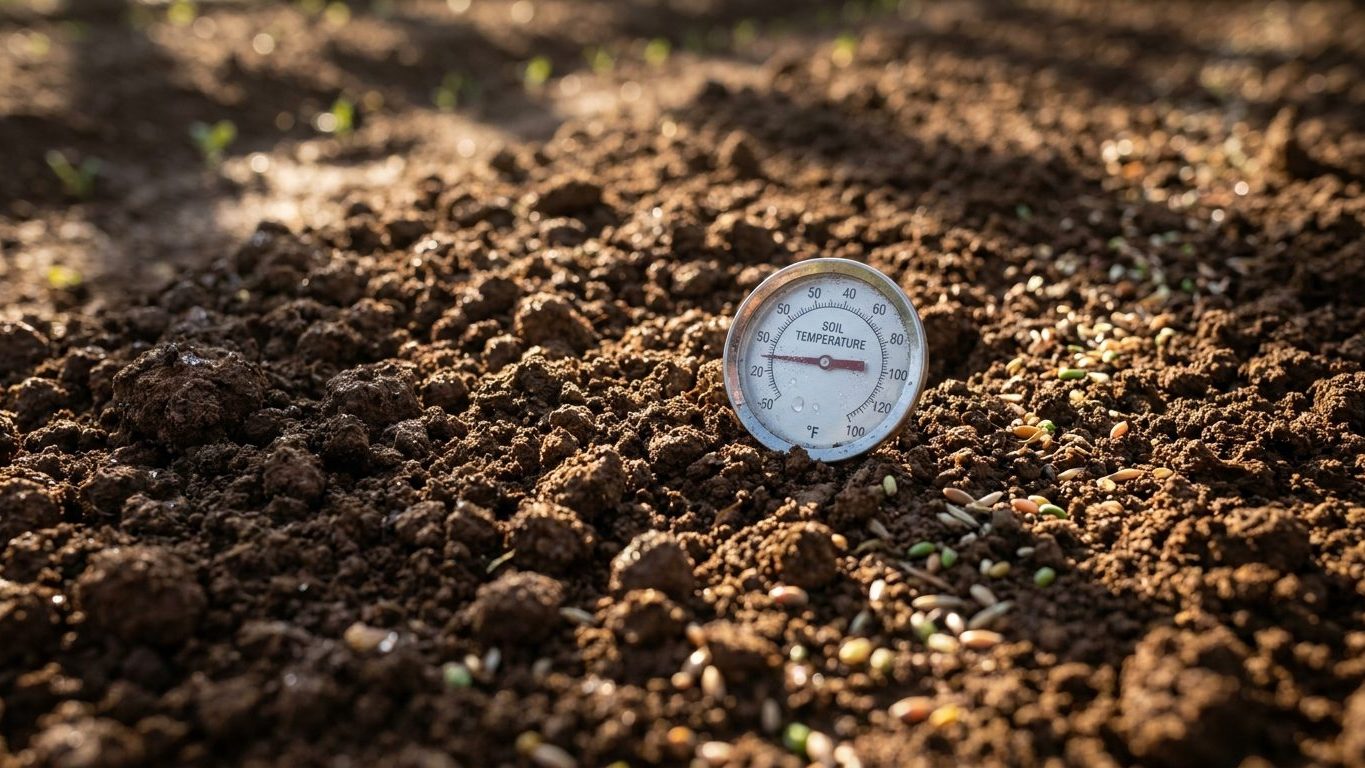

Cover crops go into Washington ground once the soil itself warms, not on the day frost risk officially ends. In the maritime lowlands around Seattle, cold, waterlogged soil holds seeds back for weeks after the last freeze; east of the Cascades, a high-desert climate runs on an entirely different calendar. The mild winter that defines much of this territory, averaging 37.1°F in its coldest month, decides which species survive to spring and which need cutting by hand. WSU Extension holds the county-level trial data that fills in the rest.
When the soil is warm enough in Washington
Ask when to seed a cover crop here and the calendar gives a tidy-looking answer: the last spring frost at station USW00024233, the Seattle-area reference point used in NOAA’s 1991-2020 Climate Normals, falls somewhere between February 27 and March 18. That’s a 30-70% freeze probability window, not a promise, so treat it as the point where frost risk starts thinning out rather than a green light.
The date matters less than what it’s standing in for. Frost is a proxy. What actually determines when a cover crop germinates is soil temperature, and in western Washington that number lags well behind the air. Rain-soaked clay and silt loams common on this side of the Cascades hold onto winter cold for weeks past the last freeze date, and the region’s flat gray light in early spring doesn’t help the soil catch up. A grower who drills seed the week after the “last frost” often finds it sitting dormant in cold mud rather than sprouting.
Grasses move first, legumes wait
Cool-season cereal grains and grasses, such as cereal rye or oats, tolerate colder soil and get moving before most legumes will. Vetches and clovers generally want the soil to warm further, which in this territory can mean a real gap between when the grass goes in and when the legume follows, even in the same bed. That staggered timing is one reason mixed plantings here often lean on species chosen for compatible germination windows rather than a single sowing date for everything.
None of this changes with a bag of seed and a rule of thumb, because the right rate depends on the species, whether it’s broadcast or drilled, seed size, and germination percentage on the label. WSU Extension (extension.wsu.edu) publishes rate tables built for this state’s conditions, and that’s the source to check before buying seed, not a generic per-acre figure that assumes a different climate.
Termination here stays mechanical. A cover crop that’s up and growing by late spring gets managed by mowing before it sets seed, by crimping to lay it down as mulch, or simply by cutting it back at the base once it’s done its job. Frost itself terminates the tender species that don’t survive winter at all, which turns out to be the more useful conversation for a territory this mild.
The frost dates above describe western Washington only. East of the Cascades, the climate turns to high desert, with a shorter, drier growing season and its own frost timing that doesn’t track the Seattle numbers at all. A grower in Spokane or the Yakima Valley working from the western window would be planting on the wrong clock entirely.
How long the season lasts here
Subtract the two frost dates from NOAA’s Climate Normals for station USW00024233 and western Washington’s frost-free window runs roughly 257 to 259 days, depending on where in the probability band you land: from a last spring frost as early as February 27 to a first fall frost as late as November 30, or from March 18 to November 13 at the tighter end. Either way, that’s close to eight and a half months without a freeze, one of the longer windows a temperate gardener will find in the country.
A window that long changes the whole conversation around cover cropping. In a short-season climate, the first sowing is usually the only one, and everything hinges on getting it right the first time. Here, there’s room to sow a spring cover crop, terminate it, grow a summer crop or leave a bed fallow, and still have enough season left to put in a fall cover crop before the November frost closes things down. That second window is where succession sowing earns its keep, timing a fall-seeded crop to establish before the cold sets in and then carry a living root system through winter.
What the long window does and doesn’t buy
It doesn’t mean everything germinates faster. Soil temperature and low spring light still hold early plantings back regardless of how many frost-free days sit on the calendar. What the length does buy is flexibility: a grower who misses the ideal spring window by two or three weeks isn’t out of options the way someone gardening in a 120-day climate would be. There’s also more slack to decide whether transplanting seedlings versus direct-seeding makes sense for a given cover crop, since a longer season tolerates the extra weeks a transplant needs to establish roots before doing real work in the soil.
For the mechanics of timing a second or third planting to fit inside a window like this one, the site’s succession sowing guide walks through how to stagger sowings against a known frost calendar without guessing.
Heat and water in Washington
For a cover crop, the defining question in this territory isn’t summer heat. It’s winter. The coldest month here averages a daily minimum of 37.1°F at the Seattle reference station, per NOAA’s 1991-2020 Climate Normals, a figure that sits just above freezing on an average day rather than describing an occasional cold snap. That single number does more to shape which species belong in a Washington cover crop plan than any summer statistic would.
A mild coldest-month minimum like this means many species that would die back cleanly in a colder climate simply keep growing here, or at least survive to limp through winter and resume growth in a thaw. Oats, for instance, reliably winterkill in much of the country and leave a tidy mulch behind by spring. In a territory where the coldest month barely dips below 37°F, oats can survive a mild winter instead of dying on schedule, turning what’s supposed to be a self-terminating cover crop into something that needs mowing or cutting by hand come spring. That’s not a flaw in the plant. It’s a mismatch between the crop’s expected behavior and the actual winter it’s given here.
The fall frost sets the deadline
The first fall frost, arriving between November 13 and November 30 at station USW00024233, marks the last realistic date for sowing a cover crop meant to establish before winter. Miss that window and a fall-seeded crop goes into cold, wet ground with too little daylight left to root properly before growth slows for the season.
This page doesn’t have verified figures for summer heat or rainfall totals in this territory, and rather than guess at numbers, it’s worth naming what the maritime climate is known for instead: a cool, often damp growing season on the western side of the state. That combination brings its own headaches for a cover crop stand, foliar mildew on dense plantings, slower ripening for any seed set, and disease pressure that thrives in humidity rather than in heat. A hardiness zone range of 4a-9a across the state (USDA Plant Hardiness Zone Map, 2023) reflects just how differently the coastal lowlands and the interior behave, and a recommendation built around Seattle’s numbers won’t necessarily hold for a garden two hundred miles east.
Which cover crops suit Washington
Reasoning from this territory’s own numbers narrows the field without naming a single variety. The long frost-free window, roughly 257 to 259 days around Seattle, means there’s room to be patient with slower-establishing legumes rather than rushing to the fastest grass available. The mild coldest-month minimum of 37.1°F pushes the choice toward species that either winterkill reliably even in a soft winter or are genuinely meant to overwinter and get terminated by hand, rather than something caught in between that survives when it shouldn’t.
The damp, humid character of the maritime side of the state makes disease resistance a real criterion, not an afterthought, since mildew and fungal pressure build fast in dense, wet foliage. A grower choosing between cover crop species here is choosing largely by type, cool-season grass, winter legume, or a broadleaf cover, rather than by heat tolerance, since summer heat isn’t the limiting factor this territory hands a gardener.
What this page won’t do is name a specific cultivar. Seed companies and university trials run variety comparisons every season, and the ones that hold up in a given county’s soil and microclimate change as new trials come in. WSU Extension (extension.wsu.edu) runs exactly those local trials and keeps current variety recommendations, seeding rate tables built for this state’s soils, and guidance on legume species and their nitrogen contribution, which depends on biomass and termination timing rather than a fixed number per acre. That’s the only recommendation that means anything for a specific yard, and it’s not something a general reference page can responsibly guess at.
Termination, wherever the choice lands, stays mechanical: mowing a grass before it sets seed, crimping a taller stand to lay it flat as mulch, or letting a tender legume die back on its own once a hard enough frost arrives. In a territory this mild, that last option is less reliable than it sounds, which is exactly why the coldest-month figure matters more here than almost anywhere else in the cover crop conversation.