
Cover crops go in the ground in Wisconsin once the soil has shed its spring chill, typically from mid-April through early May depending on where you garden, and they come out again by mid-to-late October before hard frost locks the ground. The window between those two dates, not the calendar month, is what decides your planting plan.
When the soil is warm enough in Wisconsin
Everyone wants a date. NOAA’s 1991-2020 Climate Normals, drawn from station USW00014839, put Wisconsin’s last spring frost (the 32°F freeze probability band) between April 16 and April 29. That’s a real number, sourced, and not something to round off to “late April” or push to a tidier Mother’s Day weekend planting.
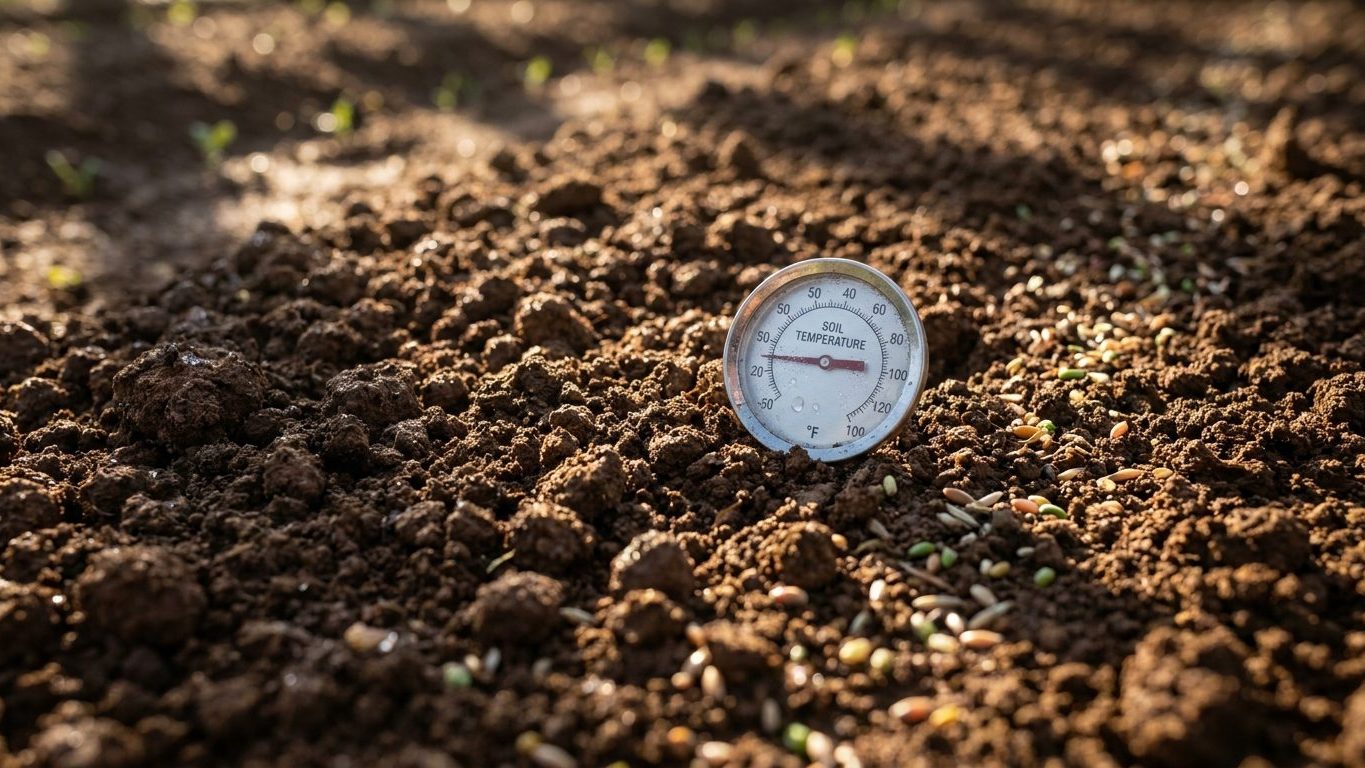
But frost is a proxy, not the actual trigger. Cover crops don’t care what the thermometer said the night before last; they care whether the soil itself has warmed enough for seed to germinate and roots to push out without rotting in cold, wet ground. Soil lags behind air temperature by days, sometimes weeks, especially in clay-heavy plots that hold winter’s chill longer than sandy loam. So the frost date is useful as a backstop, a marker that says danger has likely passed, not a green light by itself. Push a spade in. If the top few inches crumble and feel like they’ve lost that raw, cold-storage dampness, you’re closer to ready than the calendar alone would suggest.
And remember: that April 16 to April 29 window is a probability band, not a promise. Some years the last frost arrives early in that stretch, some years it lingers past it. Treat it as a planning tool, not a guarantee.
Once soil temperature cooperates, species selection matters more than any specific date. Oats, field peas, and other frost-tolerant options can go in earlier than warm-season legumes like cowpeas, which want soil solidly on the warm side. Seeding rate isn’t something to guess at here, either. It shifts based on species, whether you’re broadcasting or drilling, and the source of your seed, so a number pulled from a random source is more likely to waste a season than help it. That’s exactly the kind of question University of Wisconsin-Madison Extension answers with current, regionally tested guidance.
Termination, when the time comes, is mechanical on this site: mowing, crimping, cutting at the right growth stage, or simply letting a hard frost do the work on tender species. No herbicide shortcuts here, and none needed if timing is right.
How long the season lasts here
Subtract April 16 from October 17, and again April 29 from October 29, and you get a growing window that runs roughly five and a half to six months, depending on where in that probability band your particular spring and fall land. That’s a meaningful stretch, long enough that a single cover crop planting doesn’t have to be the only move of the year.
What that length actually allows is the interesting part. A six-month window means gardeners can often work in a spring-planted cover crop, terminate it in time for a summer vegetable crop, and still have enough season left after harvest to get a fall cover crop established before the first hard frost shuts things down. That’s a rotation, not a one-shot deal. Compare that to territories with a four-month window, where the first sowing is often the only sowing, and every week of delay chips away at what’s left for the crop to do its job (building organic matter, suppressing weeds, holding soil against winter erosion) before frost ends the conversation.
The length of the window also changes how you think about transplants versus direct seeding. In a shorter season, gardeners sometimes reach for transplants to buy a few extra weeks. With Wisconsin’s six-month spread, direct seeding cover crops is rarely a race against time the way it might be farther north, though it’s still worth checking root development before committing to a second planting late in the season. A cover crop with shallow, underdeveloped roots going into a cold snap won’t perform the way a well-rooted stand will.
Gardeners planning a spring-then-fall rotation, or wondering whether a mid-summer sowing makes sense after an early vegetable harvest, will find the mechanics of that timing laid out in more detail in the site’s succession sowing guide, which walks through how to stack multiple plantings into one growing year without one crop stepping on the next.
Heat and water in Wisconsin
Reference-station data doesn’t hand Wisconsin a big number for days above 90°F, and that absence is itself the fact worth noting. This isn’t a territory where cover crop selection has to account for scorching, plant-stressing heat stretches the way it does farther south. Summers here run warm, sometimes humid, but the extreme-heat pressure that pushes gardeners elsewhere toward heat-tolerant, shade-seeking root systems just isn’t the dominant story in Wisconsin.
The real story for cover crops in this territory is winter, and it starts with that first fall frost. October 17 to October 29 (again from the NOAA normals at station USW00014839) is the marker that sets the last useful sowing date for anything you want established before cold shuts growth down. Miss that window with a warm-season species and you’re planting something that won’t have time to build the biomass it needs before frost stops it cold.
Then there’s the coldest month’s mean daily minimum: 17.2°F at the Milwaukee reference station. That single figure does more work than almost any other number on this page, because it decides which species survive Wisconsin’s winter and which don’t. Something rated hardy only to zones 7 or 8 has no realistic chance here; the region’s hardiness zone range of 3b to 6a (per the USDA Plant Hardiness Zone Map) confirms it. A species that shrugs off 17°F lows can overwinter and get killed by hand come spring, cut down mechanically once new growth resumes. A species that can’t take that cold dies back on its own, turning into a protective mulch over winter, no mowing required.
That distinction flips depending on where you garden. In a mild coastal territory, an oat crop might survive winter and turn into a stubborn weed the following spring, something that has to be fought rather than simply left to decompose. In Wisconsin, that same 17.2°F minimum makes oats one of the easiest cover crop choices available, precisely because winter kills them outright and leaves a clean mulch behind. Cold, in this case, does the termination job for free.
Rainfall figures for a typical Wisconsin summer don’t put this territory in drought-stress territory either, but cover crop growers here should watch for the flip side of adequate moisture: cool, damp stretches that favor mildew, slow ripening on anything grown for seed, and general disease pressure rather than heat stress. That’s a different management problem than watering anxiety, and it changes which cover crop traits matter most.
Which cover crops suit Wisconsin
Given a season that runs roughly five and a half to six months, a winter that reliably kills back tender species, and summers that lean cool and damp rather than blazing, the type of cover crop that fits Wisconsin points toward frost-sensitive, quick-establishing species for anyone who wants a self-terminating mulch, and toward genuinely cold-hardy legumes or grasses for anyone who wants a stand that survives to spring and needs mechanical termination, mowing or crimping, once soil work resumes.
Disease resistance deserves real weight in the decision here, more than it might in a drier climate. Cool, humid stretches during the growing season create conditions where fungal pressure builds faster than in a hot, dry environment, so species and growth habits that allow better airflow through the canopy tend to hold up better against the kind of leaf and stem diseases that thrive in damp air.
This page will not name a specific cultivar, and that’s a deliberate choice rather than an oversight. Variety trials run by land-grant universities test named cultivars against local disease pressures, local frost timing, and local soil types, generation after generation, in ways a general reference page simply cannot replicate. A cultivar that performs well in one part of the state’s 3b to 6a hardiness range may underperform in another, and only regionally specific trial data can sort that out reliably. University of Wisconsin-Madison Extension maintains that kind of current, locally tested guidance, and it’s the only source worth trusting for a named variety recommendation.
The same caution applies to seeding rates and nitrogen contribution from legume cover crops. Both depend on species, on how much biomass actually gets produced before termination, and on the timing of that termination, none of which a general guide can specify without guessing. What’s certain is the mechanism: legumes fix nitrogen through root nodules while alive, and release it to the soil as that root and shoot material breaks down after mowing, crimping, or winterkill, not while the plant is still standing.
Termination on this site stays mechanical across every recommendation: a mower for a stand that’s gotten ahead of itself, a roller-crimper for a mature grass or grain crop timed at flowering, hand-cutting for a small garden bed, or simply Wisconsin’s own winter cold doing the work on anything not built to survive a 17.2°F month.