
For carrots grown in Louisiana, the honest answer starts with a gap: the sourced material behind this page does not carry a state-specific, named list of insect pests for this crop here. What it does carry is verified information about the region’s representative soil and the carrot’s own biology, and that combination already explains most of what gardeners mistake for pest damage before an actual insect ever shows up.
Which pests attack carrot in Louisiana
No sourced, documented list of insect species feeding on carrots in this state is part of the verified material behind this page. That is worth saying plainly rather than filling the gap with names that sound plausible. What follows instead is what the record does support: the soil this crop is planted into, and how that soil behaves.
Louisiana’s representative soil, the one the USDA NRCS State Soils program lists for this state, is the Ruston series, an Ultisol. That means it is old, heavily weathered, and leached of nutrients over a long span. The surface horizon runs 65 percent sand, 11 percent clay, and 24 percent silt, with organic matter around 1.8 percent and a surface pH near 5.5, slightly acid. It drains well. That sandy, well-drained profile happens to be close to what a carrot wants: Utah State University Extension describes the crop’s ideal bed as deep, sandy, well-drained, and rich in organic matter, warning that heavy or rocky ground makes the root fork instead of running straight.
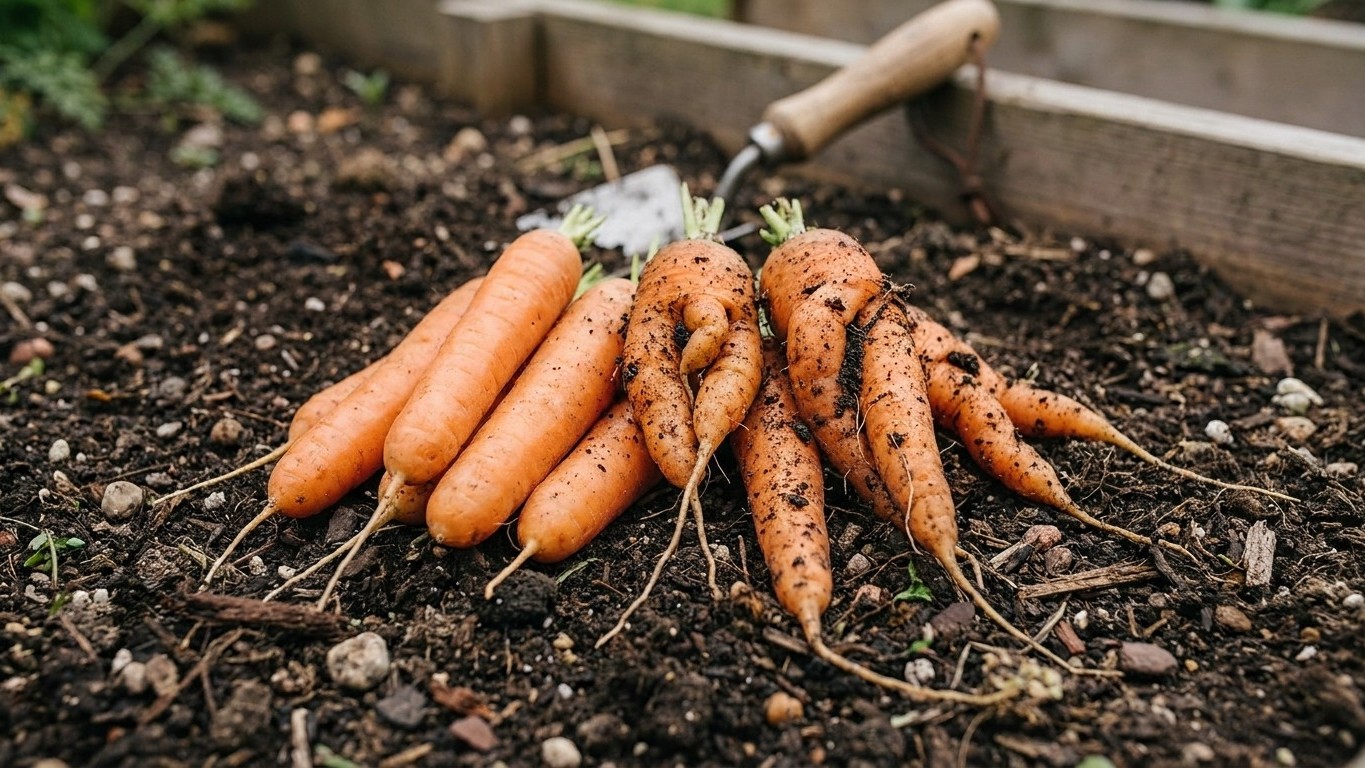
That overlap matters here because it removes one common false alarm. A gardener whose carrots come up twisted, split, or stubby is not necessarily looking at a wireworm or a root maggot. On ground that resembles the state’s own representative soil, more of that damage traces back to compaction, rocks, or a clay pocket than to a chewing or tunneling insect. That is not a claim that no insect ever bothers a Louisiana carrot bed. It is a caution against reaching for a pest name before ruling out the soil itself, which is the one thing this page can actually document.
The one caveat that matters more than any pest name: the Ruston series is what USDA maps as representative of the state as a whole, not a measurement of any one backyard bed. A worked garden plot that has been amended, tilled, or built up over past seasons will not match those percentages, and river-bottom ground, hill country, or anywhere a builder has scraped and filled will differ completely. Anyone chasing a pest problem should start with an actual soil test on their own bed, not the state average.
When each one shows up, and what it does first
Without a sourced, state-specific pest calendar, the timeline that holds up is the crop’s own. Carrots are sown directly in the ground; there is no transplanting step to count from. Utah State University Extension’s guidance frames the crop on a maturity window of 70 to 100 days from seeding, and that window is the one clock this page can use with confidence.
Three stages inside that window carry different risks, and they matter regardless of what species eventually shows up in a given bed. Right after seeding, through emergence, a thin stand of seedlings is the most exposed point in the whole season: this is when chewed cotyledons or a stand that simply never fills in gets noticed first, and it is also the stage most easily confused with a poor germination rate or a crusted-over seedbed rather than an insect. Once true leaves are established and the root starts bulking, feeding on foliage tends to show up as ragged or skeletonized leaf tissue, something a gardener spots from above ground well before ever pulling a root to check it. Closer to the harvest window, in the final weeks before that 70-to-100-day mark, damage shifts underground, and the first sign is often not visible at all until a root is lifted and shows tunneling, scarring, or a chewed tip.
That staged pattern, exposed seedling, damaged foliage, hidden root damage, is a useful mental map even without a named insect attached to it, because it tells a gardener where to look and when. Checking the stand in the first couple of weeks after seeding catches the most vulnerable stage while there is still time to reseed a gap. Watching the foliage through the middle of the season catches feeding before it reaches the root. Pulling a test root or two as the maturity window closes catches the kind of damage that never shows above ground until it is too late to save that root, though not too late to protect the rest of the bed for the next planting.
Telling the damage apart from everything else
Most of what gets blamed on insects in a carrot bed is something else entirely, and the sourced facts here point to three specific look-alikes worth ruling out first.
- Forked or stubby roots: Utah State University Extension attributes this directly to heavy or rocky soil, not to feeding damage. The fix is compost and double digging, not a spray.
- Stunted, pale growth: on ground resembling the state’s representative Ruston profile, acidity near pH 5.5 and organic matter around 1.8 percent both point toward a nutrient-poor bed rather than a pest. A soil test settles this, since the state figure is a starting point, not a diagnosis of any one garden.
- Wilted or limp tops after harvest: Clemson Cooperative Extension’s Home & Garden Information Center notes that bunched carrots, meaning roots pulled with their tops still on, keep only 10 to 14 days because the leaves keep drawing moisture out of the root. That wilting is a storage effect, not evidence of anything that happened in the field.
What none of these look-alikes explain is actual chewing on foliage, tunneling through a root, or holes bored into the taproot itself. Those signs point to an insect, and that is exactly the point where this page runs out of sourced information and a parish extension office needs to take over, ideally with the damaged plant or root in hand rather than a description of it.
What actually works here, and what is a waste of time
Given a short list of verified facts, the actions that hold up are the ones tied directly to soil and timing rather than to any product.
On the soil side, working compost into a bed and double digging before seeding is the documented fix for forking, and it is a one-time investment that pays off for every root pulled from that bed afterward, not a repeated treatment. Spraying anything in response to a forked root is wasted effort, because the damage happened as the root grew around an obstruction weeks earlier; there is nothing left to treat.
On the timing side, the 70-to-100-day maturity window and Clemson’s harvest guidance of roughly 65 to 75 days after planting both argue for pulling roots on schedule rather than leaving them in the ground past that point hoping they’ll size up further. A root left too long is a root exposed to underground feeding for longer, whatever the cause.
After harvest, the storage instructions are specific enough to act on directly: cut the tops off before storing, since it is the tops drawing moisture out of the root that shortens shelf life, and hold trimmed roots at 33°F with high humidity. Storing bunched, untrimmed carrots at room temperature and expecting them to hold is the single most common waste of a good harvest; at that temperature, sprouting and softening show up in a fraction of the 10-to-14-day window Clemson documents for properly bunched storage.
Where to check this for your own county
Louisiana organizes its local government by parish rather than county, and that distinction matters for anyone trying to find local guidance: the office to call is the parish extension office of the LSU AgCenter, the state’s land-grant extension service. That office is where an actual, documented pest list for carrots in a given parish would come from, along with a diagnosis based on a sample or photo rather than a description over the phone.
The state soil figures cited on this page describe the Ruston series as USDA maps it across the state, and pest pressure varies at least as much as soil does from one parish to the next, often from one side of a farm to the other. What is documented at the state level says nothing definite about what is happening in a single backyard bed. That gap is exactly what a parish extension agent is positioned to close.
The next concrete step is not another search: pull a damaged root or a chewed leaf, bag it, and take it (or a clear photo) to the parish extension office before guessing at a name or a treatment. A soil test through the same office answers the pH and fertility question just as directly, and settles far more of the “why do my carrots look like this” question than any general list ever could.
Common questions
Do carrots need to be transplanted in Louisiana?
No. Carrots are sown directly in the bed where they will grow. The 70-to-100-day maturity window counts from the seeding date, not from a transplant date, because there is no transplanting step with this crop.
Is the state soil pH the same as the pH in my garden?
Not necessarily. The pH near 5.5 comes from USDA’s representative figures for the Ruston series mapped across the state, not from a measurement of any single yard. A worked, amended garden bed can differ substantially. A soil test through the parish extension office gives the actual number for a specific bed.
Why do my harvested carrots go soft so fast?
Most often it’s storage temperature and untrimmed tops, not anything that happened in the field. Clemson Cooperative Extension notes that bunched carrots (tops still attached) keep only 10 to 14 days because the leaves continue pulling moisture from the root; trimmed roots held at 33°F with high humidity last considerably longer.
What should I bring to my parish extension office for a pest diagnosis?
Bring the actual damaged plant material, root or leaf, or a clear, well-lit photo showing the damage. A verbal description rarely allows for a confident identification, and a sample lets the office rule out soil-related causes like forking or nutrient deficiency before looking at insect damage.