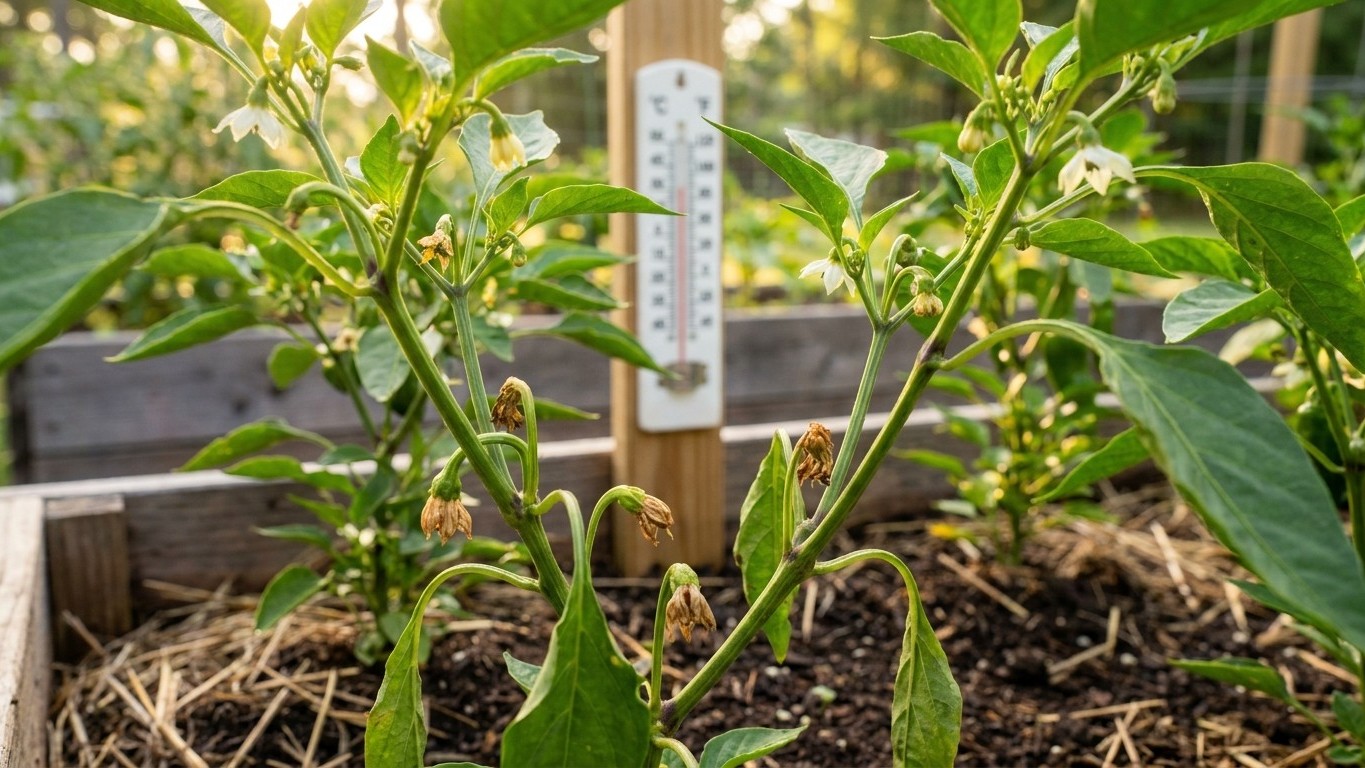

In central Iowa, expect 18.4 days a year at 90°F or hotter, per NOAA’s 1991-2020 Climate Normals for the Des Moines reference station. That heat load is enough to stall pepper flowers if it lands during bloom. Fruit set also fails on the cold end, below 55°F at night, but this site doesn’t track summer night minima. You’ll need to watch your own thermometer on that side.
The short answer
Peppers set fruit inside a narrow window. Utah State University Extension puts the failure points at both ends: nights under 55°F and days over 90°F. Des Moines averages 18.4 days a year at or above 90°F, and that number matters more than most gardeners realize. It’s not the average summer temperature, and it’s not a single scorching afternoon. It’s the count of days each season when flowers can drop before they ever become a pepper.
Eighteen days doesn’t sound like much spread across a whole growing season, but peppers don’t average their stress. A run of five or six 90°F-plus days in mid-July, right when a plant is loaded with blooms, can wipe out that flush entirely. The plant survives. The flowers it was carrying don’t. New buds form later, and the harvest simply shifts back a couple of weeks, assuming the plant has enough season left to recover.
The cold end works the same way but flips the math. A night that drops into the low 50s, even for a few hours before dawn, can abort blossoms just as effectively as a heat spike. Iowa’s early growing season, especially late April and May transplant windows, carries exactly that risk. Here’s where this site draws a hard line: it carries days above 90°F for Iowa, sourced from NOAA’s climate normals, but it does not carry summer night minima. There’s no reliable substitute figure to hand you. Latitude doesn’t tell you what a specific yard does on a clear, dry night in a low spot, and neither does the coldest month of the year. Those numbers describe winter, not a June overnight low.
The practical move is to keep your own log. A basic outdoor thermometer, checked at dawn a few times a week during May and early June, will tell you more about your microclimate than any regional average. Low-lying yards, north-facing beds, and spots near open fields tend to run several degrees cooler overnight than a paved suburban lot a mile away. If you’ve had blossom drop in past seasons without an obvious heat spike to blame, a cool night is the more likely culprit, and it’s one you can only catch by watching your own site.
When to start seed here
Timing pepper seed in Iowa comes down to counting backward from two fixed points: when frost is reliably gone, and when the soil itself has warmed enough to support a transplant. Here’s how the arithmetic works, step by step, so you can redo it for your own county.
- Start with your last spring frost window. NOAA’s 1991-2020 Climate Normals put the 32°F freeze probability window for the Des Moines-area reference station at April 12 to April 24. Iowa State University Extension’s county-level figures, drawn from 1950-2021 records, tend to run about 4 days later in spring than that airport station. Treat April 12-24 as the optimistic end of the range, not the safe bet for every county.
- Don’t transplant on the frost date alone. Utah State University Extension is clear that peppers go in the ground after frost has passed and once the soil itself reaches 60°F. Air temperature and soil temperature don’t move together in spring; a soil probe a few inches down will tell you more than a calendar ever will. Cold soil stalls root growth even if the air feels warm enough for a T-shirt.
- Count back 8 to 10 weeks from your realistic transplant date. If you’re aiming to move plants outside in the last week of April, that puts indoor seed starting around the last week of February to the first week of March. If your county’s frost risk pushes transplanting closer to mid-May, the same 8-to-10-week window shifts seed starting to roughly mid-to-late March.
- Build in slack for a slow soil warm-up. Since frost date and 60°F soil don’t always arrive together, many Iowa gardeners find it safer to plan for a transplant date a week or two after their county’s last frost, then start seed 8 to 10 weeks before that adjusted date rather than the frost date itself.
Run those four steps with your own county’s frost data, not the airport figure alone, and you’ll land on a seed-starting date that fits your actual yard rather than a regional average.
What goes wrong here
- Blossom drop from a heat spell. With 18.4 days a year at 90°F or above in central Iowa, a hot stretch during bloom is close to a certainty most seasons. Flowers open, then drop without setting fruit. There’s no fix once it happens beyond waiting for the next flush; the useful move is timing your transplant so peak bloom doesn’t line up with Iowa’s hottest stretch, typically mid- to late July, and keeping plants consistently watered so heat stress doesn’t compound with drought stress.
- Blossom drop from a cool night. This site doesn’t carry Iowa’s summer night minima, so the only way to catch this failure is your own thermometer. If flowers are dropping with no heat wave in sight, check your overnight lows for a run of nights near or below 55°F. Row cover pulled over plants on a forecast cool night can hold enough heat to prevent the drop.
- Sunscald on exposed fruit. Iowa’s open, high-sun summer days can scald peppers that lose their leaf cover, whether from pruning, wind damage, or early leaf drop from disease. Scalded fruit shows a pale, papery patch that eventually softens. Leaving foliage intact rather than pruning heavily, and avoiding cages or stakes that pull leaves away from developing fruit, keeps peppers shaded by their own plant.
- Blossom-end rot. This shows up as a sunken, dark patch on the bottom of the fruit, usually tied to inconsistent watering rather than a soil nutrient shortage outright. Uneven moisture, a dry week followed by a heavy soak, interrupts calcium uptake to the fruit even when the soil itself has enough calcium. Even, regular watering on a schedule rather than reactive watering after the soil has already dried out is the more reliable fix.
Common questions
How many days after transplanting until peppers are ready to pick?
Clemson Cooperative Extension puts harvest at about 70 to 85 days after transplanting, depending on the pepper. Count from your transplant date, not your seed-starting date, to estimate harvest timing.
What’s the right way to store peppers after harvest?
Clemson recommends 45 to 50°F with 80 to 90 percent relative humidity, which can hold peppers for two to three weeks under optimal conditions. That’s warmer than a standard refrigerator. A home fridge typically runs colder than 45°F, and peppers held below that threshold develop pitting and soften from chilling injury. A cool room, an unheated porch in early fall, or a fridge’s warmest drawer set well above freezer-adjacent shelves works better than the main compartment.
Can a single hot week during bloom really ruin the whole harvest?
Not the whole harvest, but that flush of flowers. Utah State University Extension identifies days above 90°F as one of the two thresholds that stall fruit set. Des Moines sees an average of 18.4 such days a year, so at least one hot stretch during bloom season is likely. Plants generally recover and produce a later flush once temperatures moderate, so the season isn’t lost, just delayed.
Does variety choice matter for Iowa’s climate?
Utah State University Extension names several pepper varieties in its guidance but doesn’t attach heat tolerance ratings, days-to-maturity figures, or size data to any of them. Rather than picking based on a specific number that isn’t published, focus on the timing steps above, since matching seed-starting and transplant dates to your county’s frost window matters more for a successful Iowa harvest than variety selection alone.