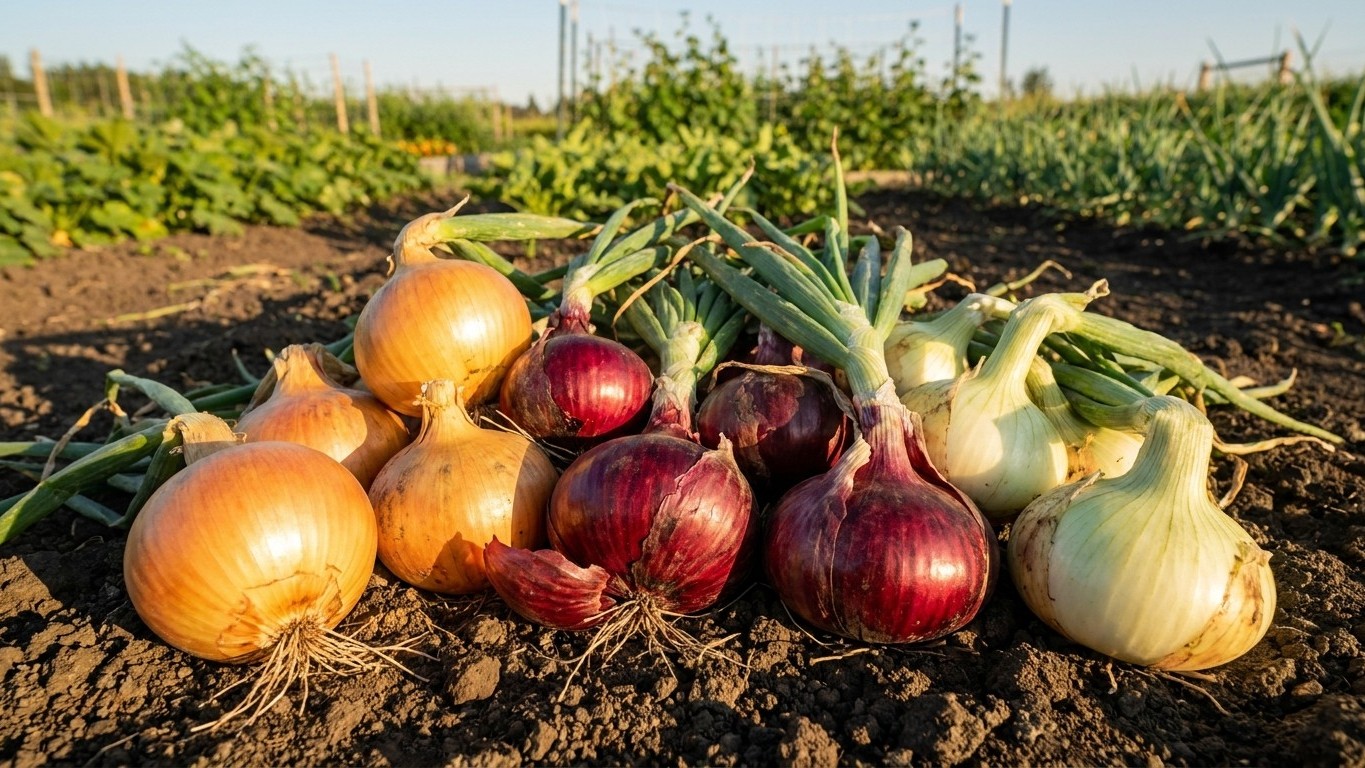

Nebraska Extension (UNL) tracks ten garden pests statewide, but onion foliage only interests two of them: blister beetles and grasshoppers. Both show up once bulbs are actively filling out, later in the season than most vegetable pests, and both arrive in waves tied to weather and nearby field activity rather than a fixed date. Knowing which damage is theirs, and which is just dry weather or a nutrient gap, decides whether you treat the row or leave it alone.
Which pests attack onion in Nebraska
Nebraska Extension (UNL) documents ten pests across home garden crops: Bean leaf beetle, Blister beetles, Cucumber beetles, Grasshoppers, Green June beetle, Imported cabbageworm, Japanese beetle, Squash bug, Squash vine borer, and Tomato hornworm. That list covers a lot of ground, but most of it has nothing to do with an onion bed. Only two of those ten, blister beetles and grasshoppers, are actually known to feed on onion foliage in this state.
The rest are specialists that stay loyal to other crops. Bean leaf beetle sticks to bean foliage and pods, and rarely wanders past the edge of a bean row. Cucumber beetles, squash bugs, and squash vine borer are cucurbit feeders through and through, built to find and stay on cucumber, squash, melon, and pumpkin vines. Imported cabbageworm is a caterpillar that hatches from eggs laid almost exclusively on brassicas, cabbage, broccoli, kale, and their relatives. Tomato hornworm needs nightshade-family leaves, tomato, pepper, potato, eggplant, and an onion leaf offers it nothing it can use. Green June beetle grubs chew turf roots underground while the adults go after ripening soft fruit on the surface, and Japanese beetle, though it will eat almost anything with soft tissue, consistently passes over onion in favor of roses, grapes, and linden leaves.
That leaves a short list on purpose. Blister beetles feed directly on onion leaves, sometimes in tight clusters that can strip a patch of foliage fast once they settle in. Grasshoppers are generalists, and when their numbers build, onion is simply one more green thing standing in a dry field. Neither pest is unique to onion, but both will use it when the opportunity is there, which is why they’re the two worth watching.
When each one shows up, and what it does first
Onion foliage matters most in the stretch when bulbs are actually forming, because every leaf lost during that window is one less leaf feeding the bulb underneath. Bulbing itself is triggered by day length rather than temperature, and Lincoln, Nebraska’s reference station logs 14 hours and 59 minutes of daylight on the year’s longest day, which puts the bulking season squarely around the summer solstice for long-day varieties. That’s the stretch when leaf damage does the most harm, whichever pest is doing it.
Blister beetles tend to arrive later than other summer feeders, and often in a sudden wave rather than a gradual buildup. They’re known to move into a garden after nearby alfalfa or clover fields get cut, since mowing pushes them out of their usual habitat and onto the next green thing standing, which can be a vegetable row. The first sign isn’t a single chewed leaf here and there; it’s a cluster of beetles working the same few leaves at once, leaving ragged, ribbon-like strips where the tissue between the veins has been eaten away.
Grasshoppers build more gradually, and their numbers track the weather more than any calendar date. In a dry stretch, populations climb because the grasses and weeds they’d normally prefer dry out and thin, and a green, well-watered onion row becomes one of the few tender options left standing. Their damage starts small: notches cut in from the leaf tip, working inward, usually worse on the outer rows closest to a dry ditch, fence line, or pasture edge. Unlike blister beetles, grasshoppers rarely cluster, so the first clue is often the pattern of the damage rather than the sight of the insect itself.
Telling the damage apart from everything else
Chewed onion leaves get blamed on insects more often than they deserve. Nebraska summers bring enough heat stress, uneven watering, and hail on their own to mimic a pest problem, and the fix for each is completely different. The single most useful habit here is checking timing: damage that shows up within a day of a storm is almost always mechanical, not insect, since hail and wind bruise and tear tissue instantly, while beetle and grasshopper feeding accumulates over days.
| Symptom | Likely cause | What distinguishes it |
|---|---|---|
| Ragged strips of missing tissue, beetles clustered nearby | Blister beetles | Insects visible in groups on the leaf surface, often near recently mowed hay or clover |
| Notches cut from the tip inward, worse at field edges | Grasshoppers | No insects visible during the heat of the day; hopping activity noticeable at dawn or dusk |
| Tips yellowing or browning, tissue looks bleached rather than torn | Water stress or nutrient shortfall | No chewed edges or holes; often uniform across the whole row |
| Water-soaked or streaked lesions that spread | Foliar disease | Pattern ignores leaf edges and spreads regardless of insect presence |
| Clean tears or bent, broken leaves across whole rows | Hail or mechanical injury | Appears suddenly, right after a storm or after cultivation equipment passed through |
None of this replaces a look at the actual plant. A photo and a description of when the damage appeared are the two most useful things to bring to a local extension office, since insect feeding, drought stress, and disease can produce leaf symptoms that look nearly identical from across the row.
What actually works here, and what is a waste of time
Timing beats almost everything else with these two pests, because both arrive in short, intense waves rather than settling in for the whole season. A lightweight row cover put on before blister beetles move in from a mowed hayfield next door does more good than any reaction after the fact, since once a cluster settles onto an exposed row, the leaves they’ve already stripped don’t grow back. Wear gloves when handling blister beetles directly, since they release a compound that can blister bare skin on contact, a detail worth knowing before anyone reaches in to pick them off by hand.
For grasshoppers, reducing the dry, weedy edges around a garden, mowing ditches and fence lines before they turn brown, cuts down on the egg-laying habitat that feeds next year’s population. That’s slower to pay off than a row cover, but it’s the closest thing to a long-term fix available to a home gardener.
What tends to waste effort is a single, late response after damage is already obvious. Both pests move in waves tied to outside conditions, a hayfield getting cut, a dry spell pushing insects out of pasture, so a one-time treatment after the fact often misses the next wave entirely. Because product choices and what’s legally labeled for edible crops change from year to year, and vary by what’s actually approved for use in Nebraska, that decision belongs with a local extension office rather than a generic recommendation here.
Where to check this for your own county
Everything above comes from what Nebraska Extension (UNL) documents at the state level, and a state is a big area to generalize about. Pest pressure inside Nebraska isn’t uniform: a garden near a working hayfield in the southeast faces a different blister beetle risk than one in the drier western panhandle, and grasshopper buildup tracks local rainfall more than anything statewide. What’s documented for the state doesn’t say what’s actually in one particular backyard.
Call the county extension office before treating anything, and bring a photo of the damage along with a rough timeline of when it appeared. That’s the fastest way to get a local answer instead of a statewide guess, and it’s the same office that can confirm what’s currently labeled for use on onion in Nebraska if a physical barrier or habitat change isn’t enough on its own.