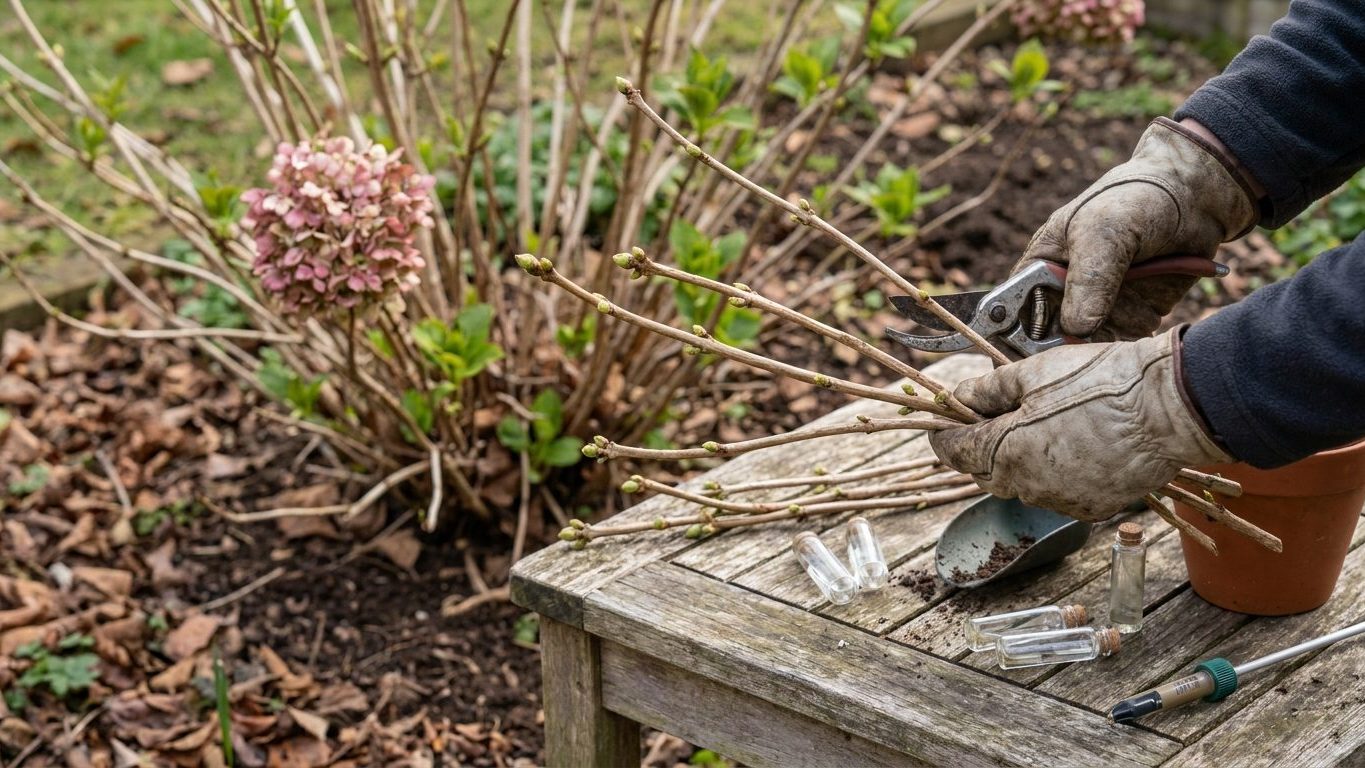

Hydrangeas rarely fail from one single cause. Most “problems” trace back to three things: pruning the wrong wood at the wrong time, guessing at soil chemistry instead of testing it, or applying the same fix to a plant type that doesn’t work that way. Get the type right first, and most mysteries solve themselves.
Why this matters
A hydrangea that “just won’t bloom” almost never has a disease. It has an owner who cut off next year’s flowers without knowing it. Bigleaf, oakleaf, mountain and climbing Hydrangeas set their buds on last year’s wood, meaning the flower is already formed inside the stem months before you see it open. Prune at the wrong moment, or lose those buds to a late frost, and the plant survives but skips its show entirely for a season.
Color complaints work the same way. Someone waters their pink hydrangea with a kitchen remedy expecting blue, gets nothing, and assumes the plant is unhealthy. It isn’t. The soil chemistry hasn’t moved enough to matter, or worse, the plant is a type that was never going to change color no matter what gets poured on it. Misreading the actual mechanism, wood age for blooms, aluminum availability for color, means every fix aimed at the wrong lever wastes a season and sometimes damages the plant further, as when high-phosphorus fertilizer locks up the very aluminum needed for blue flowers.
When to do it
Diagnosis has its own timing, tied to what the plant is doing rather than the calendar. The first checkpoint comes at bud break in spring: if last year’s stems show no swelling buds where flowers should form, that’s your signal to look back at pruning history or frost exposure from the prior season, not to start treating for disease.
The second checkpoint is the first flush of bloom. This is when color problems become visible on bigleaf and mountain types, and when you can compare flower shade against what the plant produced the year before. A shift from blue toward pink over a season, or the reverse, tells you the soil pH is drifting, information that’s useless once the blooms fade.
Watch foliage through the humid stretch of the growing season for leaf spot or powdery mildew, both of which show up as the plant’s canopy fills in and airflow drops. Wilting deserves its own watch point: if leaves droop in afternoon heat but recover by morning, that’s normal for a shallow-rooted plant like bigleaf or panicle hydrangea. If they stay droopy overnight, the problem is roots or drainage, not sun.
How to do it
Start every diagnosis by confirming the type. This one step prevents most of the wrong-cause, wrong-fix cycle described above.
| Type | Blooms on | USDA zones | Mature size | Color changes with pH? |
|---|---|---|---|---|
| Bigleaf / mop-head / lacecap (H. macrophylla) | Last year’s wood | 6a-11b | 3-6 ft | Yes |
| Panicle / peegee (H. paniculata) | Current season’s growth | 3a-8b | 8-25 ft | No |
| Smooth, e.g. Annabelle (H. arborescens) | New wood | hardiest of the genus | varies | No |
| Oakleaf (H. quercifolia) | Old wood | varies by cultivar | to about 5 ft | No |
| Mountain (H. serrata) | Old wood | varies by cultivar | varies | Yes |
| Climbing (H. petiolaris) | Old wood | varies by cultivar | 15 ft and more | No |
Once you know the type, work through the checks in order.
No flowers: for an old-wood type, ask whether pruning happened after buds had formed, or whether a late frost hit the plant after growth resumed. For panicle or smooth hydrangea, which bloom on new growth, absence of flowers points elsewhere, usually deep shade or a hard freeze that killed the whole plant back before it could push new stems.
Wrong or fading color: only relevant for bigleaf and mountain types. Test soil pH with a simple soil test rather than guessing. Below about pH 5.5 produces blue, above about pH 6.5 produces pink, and the range between gives purple or mixed tones. Aluminum sulfate acidifies soil toward blue; garden lime pushes it toward pink. Check your fertilizer, too: a high-phosphorus formula ties up the aluminum the plant needs, nudging blue flowers toward pink even if the pH itself hasn’t moved much.
Spotted or powdery leaves: compare against the short list of diseases actually documented for this genus, leaf spot, bacterial wilt and powdery mildew across all types, plus rust and bud blight specific to panicle hydrangea. Isolate affected stems and improve air circulation before reaching for a chemical treatment.
Chewed foliage or missing buds: aphids, scale, nematodes and mites are named as occasional pests but rarely a serious problem. Deer are the more common culprit, and they do browse Hydrangeas despite sometimes being listed as a plant the genus can tolerate. If buds disappear overnight in a rural or wooded lot, deer are the first suspect, not disease.
What goes wrong
The single most common mistake is pruning an old-wood hydrangea, bigleaf, oakleaf, mountain or climbing, on the same schedule as a new-wood type like panicle or smooth. Bigleaf hydrangea should be pruned before August 1 precisely because its buds for next year are already forming by then; cut later, thinking you’re tidying the plant for winter, and you remove the flowers before they ever open.
Reaching for coffee grounds or citrus peel to turn flowers blue looks like attentive care but rarely works. The pH shift these kitchen scraps produce is small, and what actually drives blue color is available aluminum in the soil, not acidity alone. Gardeners who rely on this method often conclude their plant “won’t turn blue” when the real issue is that nothing they’ve added moves the aluminum into a form the roots can use.
Overwatering a shallow-rooted type like bigleaf or panicle hydrangea, mistaking daytime wilt for thirst, is another frequent error. Both types will droop in afternoon sun as a normal response and recover by evening; adding more water on top of already-wet, poorly drained soil invites root problems instead of solving one.
Finally, treating every insect sighting as an infestation ignores what the record actually shows: aphids, scales, nematodes and mites are rarely a serious problem on this genus. Deer damage is the pest issue worth watching for.
Doing it differently
Container growing gives the most control over color problems, since a confined volume of soil responds to amendments faster and more evenly than an in-ground bed. If you’re chasing a specific blue or pink on a bigleaf or mountain hydrangea, a pot with a soil mix you control from the start beats guessing at an established garden bed.
Raised beds offer a middle path: enough soil volume for the plant to establish properly, while still letting you blend in a distinct pH-adjusted mix rather than fighting the native soil chemistry of the whole yard. This matters most where native soil runs strongly alkaline or acidic and you want a color the surrounding ground won’t naturally support.
For panicle hydrangea, the one type that tolerates full sun well, an open bed away from afternoon shade will outperform a container in growth rate and bloom size, since this type reaches its largest mature form, 8 to 25 feet, only with room to spread. Bigleaf and mountain types, by contrast, do better with the dappled or partial shade a container placed under high tree cover can provide, protecting them from harsh afternoon sun that stresses shallow roots.
Common questions
Why did my hydrangea not bloom this year?
For old-wood types (bigleaf, oakleaf, mountain, climbing), the likely cause is pruning after buds had formed the previous summer, or a late frost that killed already-formed buds. For new-wood types (panicle, smooth), check for deep shade or a hard freeze that killed stems back to the ground before new growth could form flowers.
Can I change the color of any hydrangea?
No. Color response to soil pH applies only to bigleaf and mountain hydrangeas. Panicle, smooth, oakleaf and climbing types stay white, cream, pink or green as they age regardless of soil chemistry, so acidifying the soil around one of these types won’t produce blue flowers.
Are hydrangeas toxic to pets?
Only bigleaf hydrangea is documented as toxic, and only if eaten in large quantities. Bark, flowers, leaves and stems contain cyanogenic compounds that can cause nausea, stomach pain, vomiting and sweating in people, and the same plant parts are a concern for cats, dogs and horses.
Do deer eat hydrangeas?
Yes. Despite hydrangeas sometimes being described as tolerant of common challenges, deer are named as a damage agent for the genus, and browsing is a realistic risk in areas with a resident deer population.