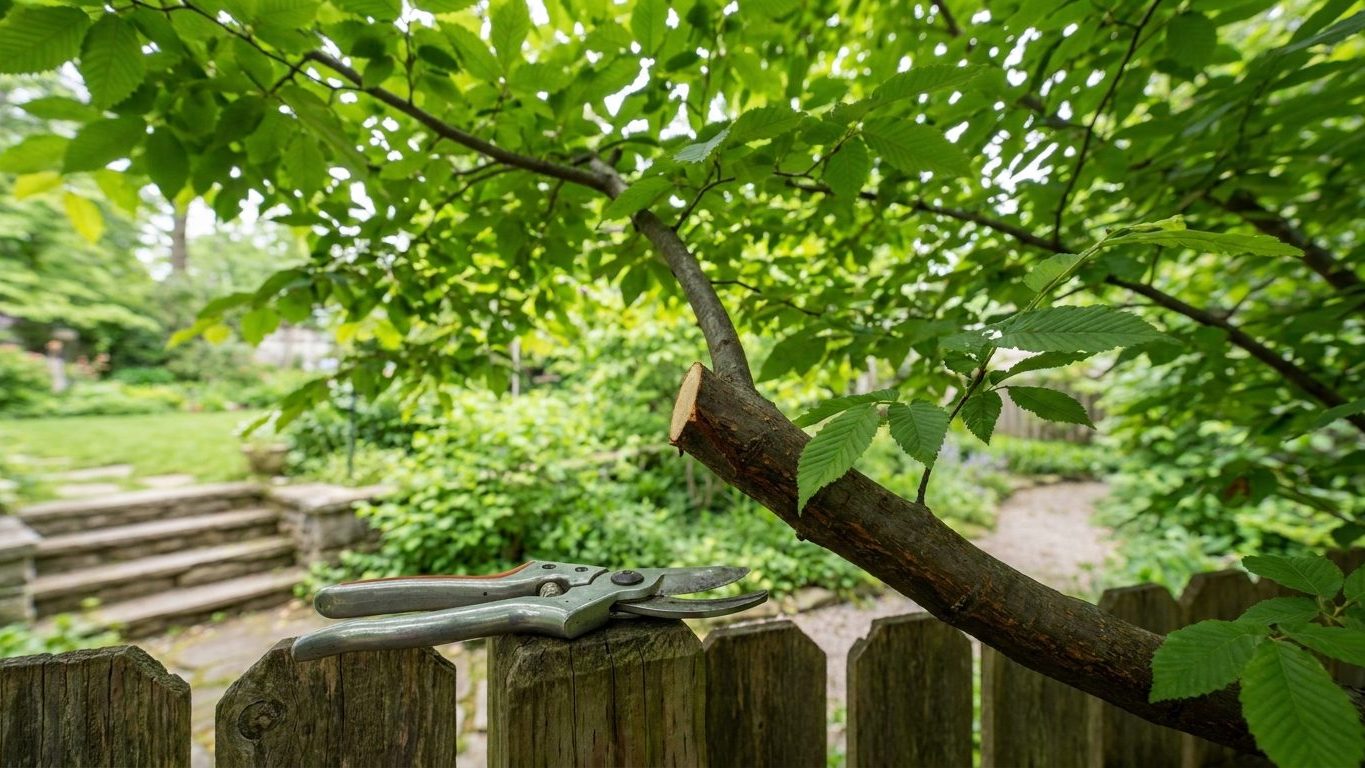

Prune American hornbeam in early summer, once the first flush of spring growth has hardened off and stopped stretching. That plant signal, not a date on the calendar, tells you the cut will get covered by fresh leaves before fall. The species tolerates a heavier hand than most homeowners expect, and that changes how you plan the whole job.
When to prune american hornbeam
The reason the timing matters comes down to what the plant is doing at that exact moment. Early in the season, American hornbeam is pushing new wood at a fast clip for a shade-tolerant tree, roughly 12 inches a year, and that flush is soft, green, and still expanding. Cut into it and the plant simply redirects that energy into buds just below the cut, filling in the gap within weeks. Wait until the flush has hardened (the wood stiffens, the bark color deepens) and you’re cutting into tissue that’s already done most of its stretching for the year, so the response is calmer and more predictable.
Cut in autumn instead and you get a different outcome entirely. The wound sits open all winter with no new growth to seal it, right as the plant is shutting down for dormancy. Hornbeam is not especially prone to winter dieback at the cut site, but there’s no upside to leaving a fresh wound exposed for five or six months when a midsummer cut heals under cover of leaves the same season.
Reading your own plant instead of a date
Frost dates shift by weeks from a Vermont yard to one in Georgia, so the safest approach is watching the hardening-off point rather than circling a day in July. New shoots go from bright yellow-green and floppy to a duller, firmer green with a bit of resistance when you bend them. That’s the window. It usually runs from late spring into midsummer depending on your zone, and American hornbeam covers a wide range of them, from USDA zones 3 to 9, so a reader in Minnesota and a reader in South Carolina are watching for the same plant behavior at very different points on the calendar.
One more thing shapes the timing decision: hedge height. Hornbeam hedges are typically kept anywhere from 6 to 15 feet, and a taller hedge holds more stored energy, so it tends to push its first flush a little earlier and harder than a low border planting. Watch the actual shoots on your hedge rather than assuming every hornbeam on the block is on the same schedule.
How hard you can cut it back
Most pruning advice floating around online was written with conifers in mind, and it says never cut into bare wood because the plant won’t push new growth from it. American hornbeam breaks that rule entirely. It carries dormant buds tucked under the bark along its older branches, which means it can take a hard renovation cut and come back from wood that looks completely leafless and gray. That single trait is what makes it the go-to answer for a hedge that’s outgrown its space, gotten leggy, or been neglected for a decade, situations where a boxwood or an arborvitae would simply die in the bare zone and never fill back in.
The renovation itself works best staged rather than done in one pass, even though the plant could technically survive a single severe cut. Spreading it out keeps the hedge looking like a hedge (not a row of stumps) while it rebuilds density.
| Season | Action | What happens next |
|---|---|---|
| Year 1, early summer | Cut one side back hard to within a few inches of the main trunks | Dormant buds break along the cut side through the rest of the season |
| Year 2, early summer | Cut the second side back the same way | New growth on side one has filled in; side two starts catching up |
| Year 3, early summer | Take the top down to the target height | Both sides are dense enough to support the reduced height without gaps |
Skipping the staged approach and taking everything down at once in a single season is the move that costs a hedge its screening value for a year or two longer than it needed to. The plant will still recover, but you’re looking at a bare, twiggy hedge with no privacy through an entire summer instead of one side at a time. For a hedge that’s just gotten a little wide or tall rather than fully overgrown, a single cut removing up to a third of the total mass in one visit is plenty, and that’s the number worth keeping in mind before you get out the loppers.
The shape that keeps the bottom alive
A hedge cut with straight vertical sides, or worse, sides that lean inward toward the top, ends up shading its own lower branches. Leaves near the base get less light every year than leaves near the top, and a plant doesn’t keep feeding branches that aren’t pulling their weight photosynthetically. The bottom thins out, then goes bare, and that bare strip at ground level is the single most common complaint about overgrown hedges of any species, hornbeam included.
The fix is a taper: cut so the hedge is noticeably wider at the base than at the top, roughly a 2- to 3-inch pullback in width for every foot of height as you move upward. Picture the profile as a gentle trapezoid rather than a rectangle or an upside-down one. That angle lets sunlight reach the lower branches even as the top canopy fills in, and it’s the difference between a hedge that stays green from the ground up and one that turns into a green lollipop on bare legs after ten years.
The taper matters more as the hedge matures, not less. A young hornbeam hedge can get away with straighter sides for a season or two because there’s not much canopy yet to cast shade downward. Once it’s established and pushing that full 12 inches of growth annually, an untapered top starts stealing light from the base within a couple of seasons, and that thinning is much harder to reverse than it is to prevent.
This taper works alongside the one-third rule mentioned in the renovation section, not against it. Removing more than a third of the plant’s total green material in a single cut pushes it to prioritize survival growth (fast, upward, often at the expense of lower branching) over the kind of dense, even fill that keeps a hedge looking good from top to bottom. Stay under that third, keep the taper, and the two rules reinforce each other instead of competing.
What actually kills american hornbeam
The honest answer is: very little. This is a tough, adaptable native tree, and extension horticulture programs consistently list it among the lower-maintenance hedge options precisely because it isn’t chasing away pests or diseases the way some ornamental hedge species do. It even holds its dead leaves through winter, a trait called marcescence, which means a hornbeam hedge is still screening a view when every other deciduous hedge on the property has gone bare and see-through.
What pruning changes isn’t the plant’s baseline toughness, it’s the conditions around each branch. A crowded, unthinned hedge traps humidity between its branches, and that damp, still air is exactly what fungal and bacterial problems need to get established on any woody plant. Opening the canopy up with routine thinning cuts, removing crossing branches and letting air move through, keeps the interior of the hedge closer to the drier, sunnier conditions on the outside. That’s not a hornbeam-specific trick, but it matters more for a hedge that’s dense enough to hold moisture the way this species can once it’s mature.
For a local read on pest pressure or an identification check if you’re not certain the hedge you’ve inherited is actually American hornbeam and not a look-alike, a state extension service is the right call rather than a garden center employee. Penn State Extension, Clemson Cooperative Extension, NC State Extension, and UMass Extension all publish horticulture guidance specific to Carpinus caroliniana, and checking with the one covering your state is the most reliable way to confirm both the plant’s identity and the exact pruning window your local frost dates set.
Common questions
Can I prune American hornbeam in winter without hurting it?
The plant will survive a dormant-season cut, since it’s not sensitive to winter pruning the way some flowering shrubs are. The tradeoff is a wound that sits open through the cold months with no leaf cover, and losing that dead-leaf winter screen a season early if you cut back hard.
For shaping cuts rather than renovation, early summer after the first flush hardens off still gives the cleanest result.
How fast will an overgrown hornbeam hedge recover after a hard cut?
Given the roughly 12-inch annual growth rate, a hedge that’s had one side renovated typically shows visible new shoots within a few weeks and meaningful density within that same growing season, with full fill-in on the cut side by the following year.
Does American hornbeam need fertilizer after a heavy pruning?
Most established hedges recover on stored energy and don’t need supplemental feeding to push new growth after a cut. A soil test through your local extension office is the better first step if a hedge seems slow to recover, rather than adding fertilizer as a guess.
Why does my hornbeam hedge look thin at the bottom even though I prune it every year?
This almost always traces back to shape rather than frequency. A hedge cut with straight or inward-leaning sides shades its own lower branches regardless of how often it’s trimmed, and the fix is widening the base relative to the top rather than pruning more or less often.