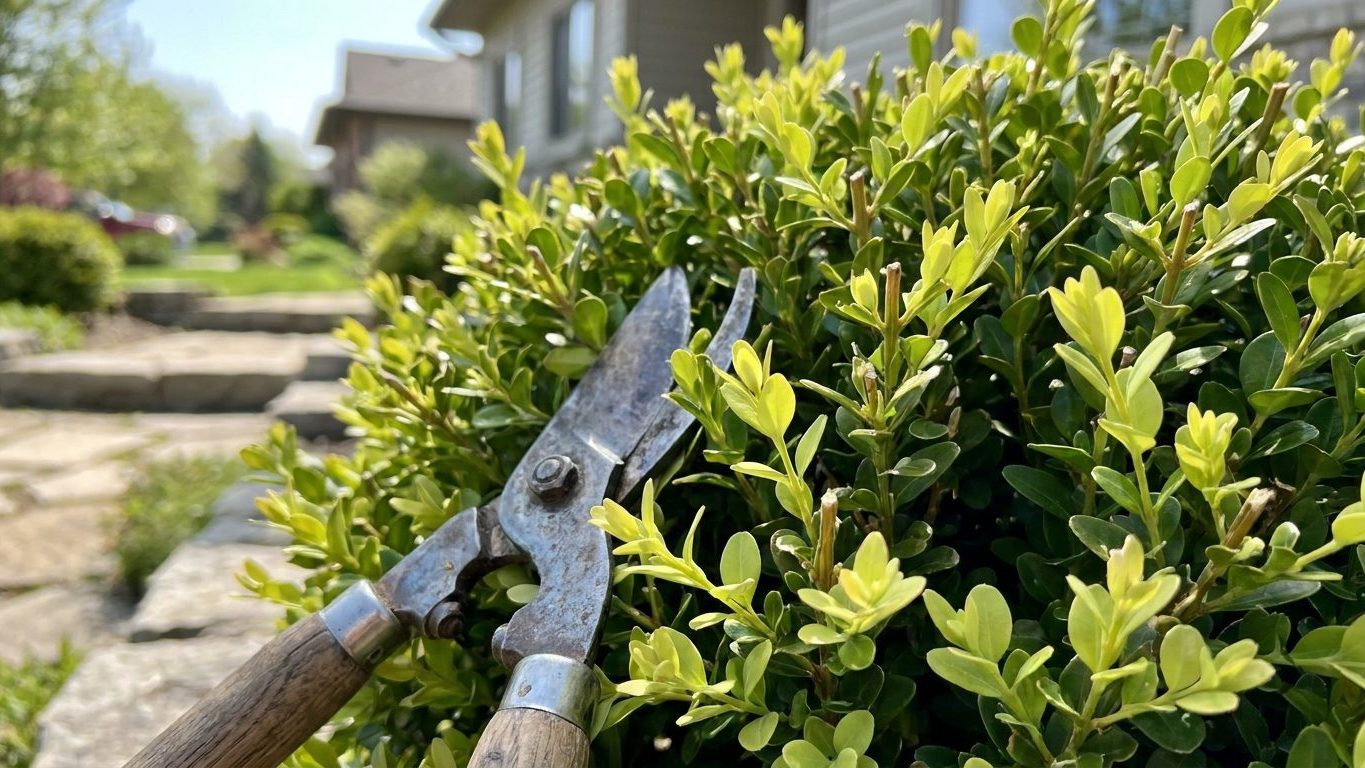

Boxwood is ready for its main pruning cut in late spring, right after the last frost in your area, once new growth starts to push out. That timing matters because the plant has an entire growing season ahead of it to cover the cut with fresh leaves. A cut made later, once growth has already slowed for the year, leaves an open wound exposed through winter instead of hidden under new foliage by fall.
When to prune boxwood
The signal to watch is new growth, not a date circled on a calendar. Once boxwood pushes out its first flush of small, pale green leaves after the last frost where you live, the shrub is ready for its main cut. That flush lines up with a **growth rate of 3 to 6 inches a year**, so the plant still has plenty of active growing weather left to cover any pruning cut with fresh stems before the season winds down.
Why the timing matters
A cut made just as growth starts gets absorbed into that flush almost right away. New shoots emerge along the cut line within a few weeks, and by midsummer the shear marks are buried under a fresh layer of leaves. The same cut made in early fall plays out differently. Growth has already slowed for the year, so the wound sits exposed through the coldest stretch, and the tissue around it is more prone to winter dieback or browning before spring growth arrives to cover it up.
A lighter trim, later in the season
Many gardeners follow the main spring cut with one light shearing in early summer to knock back that season’s new growth and keep the outline crisp. This second pass should stay light, closer to a touch-up than a real cut, and it needs to happen early enough that the plant can still push a bit of new leaf before growth naturally slows for the year. Cutting again close to the first hard frost, on the other hand, invites the same exposed-wound problem as a fall cut. Your regional extension office can confirm the exact frost-free window for your county, since it shifts by several weeks between northern and southern states.
How hard you can cut it back
Boxwood carries dormant buds tucked under its bark, all along the older wood, not just at the growing tips. That single fact changes what’s possible with a hedge that’s gotten out of hand. Most advice about needle evergreens warns against cutting past the green, because conifers like arborvitae or juniper have no buds hiding in that older wood and simply won’t regrow from a bare stump. Boxwood is built differently. It can take a hard renovation cut down into bare brown wood and still leaf out again from those hidden buds.
The staged renovation
Skipping a hard cut and just shearing the surface year after year is what hollows out a hedge from the inside: the outer shell stays green while the interior fills with dead twigs and light never reaches the center. **Cutting an overgrown hedge back hard, in stages, over two to three seasons**, works better than one drastic cut that removes everything at once, because it keeps the plant from losing too much of its leaf canopy in a single year.
| Season | What to cut | Result |
|---|---|---|
| Year one | Remove about one-third of total height and width, cutting into old wood on the most overgrown side | New shoots emerge from dormant buds along the cut surface |
| Year two | Cut back the remaining overgrown side by a similar amount, and shape the regrowth from year one | Hedge starts to regain a defined outline |
| Year three | Light shaping cuts only, refining the outline set in the first two years | Hedge returns to a maintainable size and density |
Time the heaviest cut of each stage for the same late-spring window used for regular pruning, right as new growth is starting. A renovation cut made then heals fastest, because the plant is entering its most active stretch of the year rather than heading into dormancy. A yard with a hedge halfway through this process looks a little rough for a season or two, but the alternative, leaving a hollow, overgrown hedge sheared thin on the surface, only gets harder to fix the longer it’s left alone.
The shape that keeps the bottom alive
A hedge sheared with straight vertical sides, or worse, sides that lean inward toward the top, shades its own lower branches all summer long. Without direct light reaching the base, those lower leaves thin out and drop, and the hedge slowly goes bare at the bottom while the top stays full and green. It’s the single most common reason a boxwood hedge ends up looking like a green wall on stilts.
The taper that fixes it
The fix is a simple taper: cut the hedge **slightly wider at the base than at the top**, sloping the sides in by a few inches from bottom to top over the height of the hedge. Shaped this way, light reaches all the way down to the lowest branches instead of stopping at the shoulders of the hedge. A hedge kept in this taper holds its lower leaves for years, while one with vertical or inward-leaning sides rarely grows that bottom foliage back once it’s gone thin.
How much to remove at once
The one-third rule sets the limit for any single pass of shears: removing no more than a third of the plant’s total leaf coverage in one cut keeps the shrub within a range it can recover from during that same season. Take off more than that at once, and the plant has to rebuild its energy reserves and its shape at the same time, which slows recovery and can leave thin, patchy spots that carry through to the following year. This is the same limit that applies whether you’re shaping a small foundation hedge or working through the staged renovation of an overgrown one.
What actually kills boxwood
Boxwood blight is the disease that worries growers most. It defoliates plants from the bottom up and survives in fallen leaves left on the ground, ready to reinfect the same spot the following year. Boxwood leafminer and volutella blight round out the main threats, with volutella taking hold specifically in **crowded, unthinned plants** where leaves stay damp and air can’t move through the canopy.
Why open plants fare better
Pruning changes the odds here more than any spray schedule. A boxwood sheared tight on the outside but never thinned on the inside holds moisture against its own stems long after rain or dew has dried off everything around it, and that damp, still air is exactly what volutella blight needs to take hold. Opening up the interior with occasional thinning cuts, removing a few whole stems back to the trunk rather than just shearing the surface, lets air move through the plant and dries it out between wet spells. Raking up and disposing of pruning debris and fallen leaves matters too, since that’s where boxwood blight overwinters and waits for the next wet season.
Check with your state’s extension service, such as Penn State Extension, Clemson Cooperative Extension, NC State Extension, or UMass Extension, for identification if you spot dieback or leaf spotting that doesn’t look like ordinary winter burn. These programs track boxwood blight outbreaks by region and can confirm whether a struggling hedge needs to come out entirely to protect other boxwood planted nearby.
Common questions
Can you prune boxwood in summer?
A light touch-up shearing works in early summer, but it should stay minor. Heavy cuts made in the heat of summer stress the plant and can scorch newly exposed foliage.
Can you prune boxwood in winter?
Winter cuts leave wounds exposed through the coldest weather with no growth to cover them, raising the risk of dieback. Late spring, after the last frost, remains the safer window.
How often should boxwood be pruned?
A hedge kept at a set size typically needs one main shaping cut in late spring, plus an optional light trim in early summer, each year.
Will boxwood grow back if cut to the ground?
Because it holds dormant buds under its bark, boxwood can regrow from a severe cut into old wood, though full recovery from an extreme renovation stretches across multiple growing seasons.