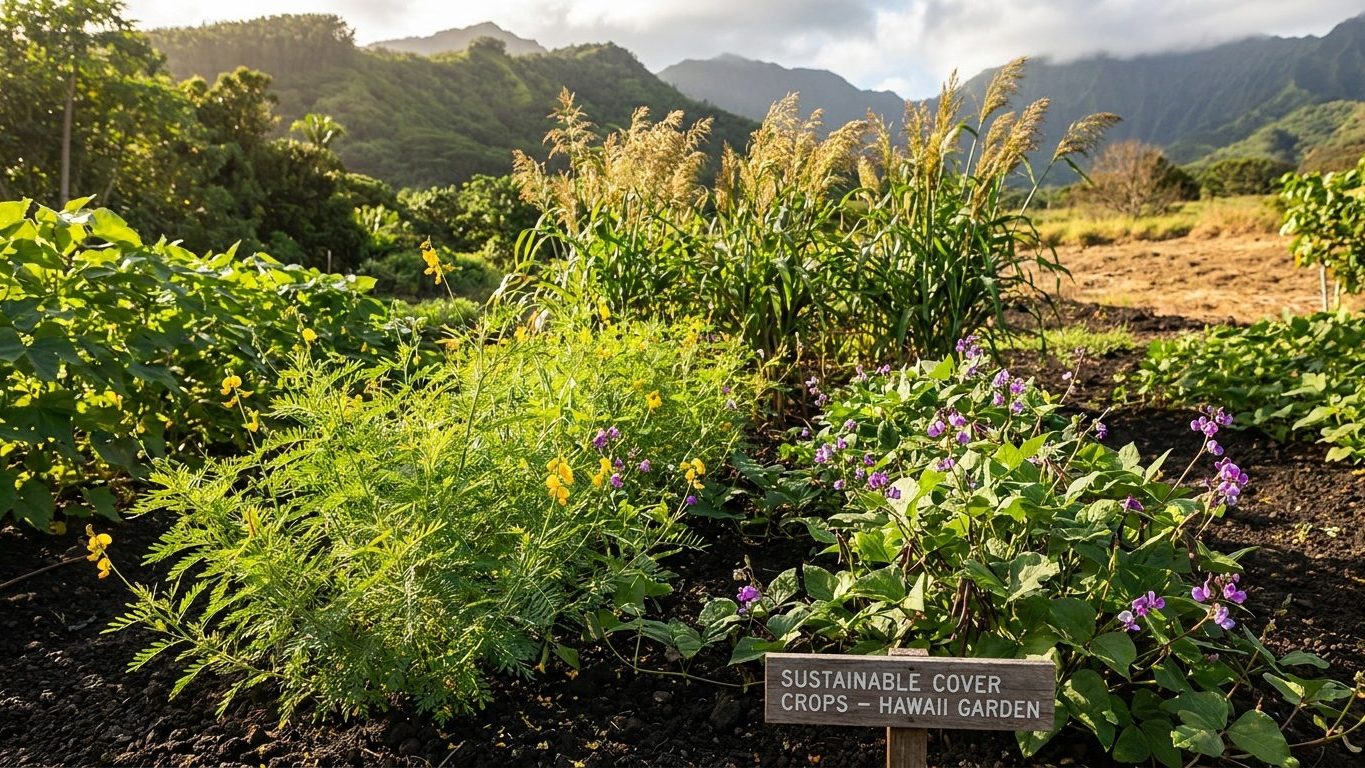

Cereal rye, crimson clover, and hairy vetch planted in fall carry an Oklahoma garden through winter almost anywhere in the state, while buckwheat and cowpeas fill the gap between a spring harvest and a fall planting. Which mix actually wins depends on where you sit inside the state’s frost calendar and how much winter cold your particular patch of ground sees.
The short answer for Oklahoma
Start with the numbers instead of a plant list. At the reference station used for these figures, the last spring frost falls somewhere between March 28 and April 10, and the first fall frost arrives between October 29 and November 8. Count from the later end of that spring window to the earlier end of the fall window and you get a frost-free stretch of roughly 200 days. That’s the window any cover crop has to work with if it’s going in as a summer cover between a spring vegetable crop and a fall one.
For a fall-to-spring cover, the number that matters more is the coldest month’s mean daily minimum: 27.0°F. That’s not a record low, it’s the average nightly floor during the coldest stretch of an Oklahoma winter at that reference point, and it’s the figure that tells you whether a cover crop survives the season at all rather than just tolerating one bad night. Cereal rye shrugs that off without a second thought. Crimson clover and hairy vetch handle it too, though they slow down hard once temperatures sit near that mark for weeks at a stretch. Winter peas do the same.
Split the decision by type rather than by variety name. Cool-season cereals and legumes (rye, wheat, oats, crimson clover, hairy vetch, winter peas) go in in the fall and hold soil through a winter that regularly dips to that 27°F nightly average. Warm-season fillers (buckwheat, cowpeas, sorghum-sudangrass) go in after the last frost risk has passed and need to finish their job well before the first fall frost shows up, because none of them tolerate freezing weather at all. Brassicas like tillage radish sit in between: plant them six to eight weeks before that first fall frost window and they’ll winterkill on schedule, which for many gardeners is exactly the point.
The hardiness zone range for the whole state, 6a to 8a on the USDA Plant Hardiness Zone Map, matters less for cover crop survival than that coldest-month figure does, since most cover crops used here are annuals killed by design or by frost rather than perennials that need to survive years of winter. Where the zone range does matter is covered below.
What will not work here
Slow, tropical-leaning legumes are the first casualty. Sunn hemp and some of the longer-season southern peas need consistently warm soil and a long run of frost-free nights to bulk up before they’re cut down; ask them to finish inside a 200-day window that closes as early as October 29 in a cool year, and they simply run out of time. The same problem hits any warm-season mix planted late. If a gardener waits until July to seed a summer cover expecting a full 90-day cycle, the earliest end of that fall frost window (October 29) can arrive before the crop has done its job.
On the cold side, cover crops rated only to zone 8 or 9 for winter survival are gambling against that 27.0°F coldest-month minimum. A crop that needs milder nights than that to stay alive through winter will thin out or die back across a normal Oklahoma winter, not just an unusually harsh one. That’s a real risk for gardeners borrowing a plant list built for a Gulf Coast garden, where winter minimums never come close to that mark.
Watering habits trip up cover crops too, in both directions. Buckwheat and cowpeas are picked precisely because they tolerate Oklahoma’s hot, dry summer stretches on minimal supplemental water; treat them like a thirsty vegetable crop needing daily attention and they’ll actually grow leggy and weak rather than thrive. Go the other direction, though, and clovers seeded too thickly in a humid, wet spring can mat down and rot at the base before they ever get a chance to fix nitrogen, since Oklahoma’s spring humidity plus close spacing is a recipe for fungal trouble regardless of how well the crop tolerates heat later in the season.
Annual ryegrass deserves a specific warning. It overwinters reliably in the milder parts of the state but can behave as a weak perennial in a mild winter, coming back the following spring when a gardener expected it to be gone, then competing with whatever was planted next. That’s less a cold-tolerance failure and more a timing trap worth knowing about before it happens.
What changes across Oklahoma
A hardiness zone range of 6a to 8a is not a rounding error, it’s most of the USDA scale’s midsection packed into one state. There is no single cold-tolerance answer for “Oklahoma” the way there might be for a smaller state sitting entirely in one zone. A cover crop that winters reliably in the state’s warmer 8a pockets can winterkill outright in a colder 6a stretch, and a crop chosen specifically because it’s supposed to winterkill on schedule (like a tillage radish planted for spring residue) might instead limp through a mild winter in the warmer part of the range and need to be terminated by hand.
The practical shift for a reader gardening in the colder end of that range is straightforward even without knowing an exact zone number: lean harder on the cover crops proven to shrug off hard freezes (cereal rye above all, since it’s rated hardy well below anything Oklahoma sees), and treat crimson clover or hairy vetch as needing a slightly earlier fall planting date so they’ve built enough root mass before the coldest nights arrive. A reader at the warmer end of the range gets more flexibility on planting date and can lean on crops like crimson clover that would struggle further north or at higher ground.
None of this tells an individual gardener which zone applies to their own yard, and it shouldn’t try to. The spread between 6a and 8a runs across real distance and real elevation change within the state, and a county-level or even neighborhood-level answer requires the actual USDA Plant Hardiness Zone Map, not a guess based on which part of the state sounds warmer.
Where to check this for your own county
Oklahoma State University’s Extension service is the source built for exactly this gap between a state-wide range and a single garden: Oklahoma State University Extension. This page has laid out the state’s frost windows and its zone range because that’s what a state-level page can responsibly claim. It cannot tell a reader in the panhandle whether their soil freezes harder than the coldest-month figure used here, and it shouldn’t pretend to.
What to actually look for once there: a county-specific planting calendar for cover crops, if the local extension office publishes one, and any notes on which cover crop varieties have been trialled in that county rather than just recommended statewide. Extension offices often carry results from local demonstration plots, field days, or county agent observations that flag a variety performing better or worse than its statewide reputation would suggest, and that kind of trial data beats a generic recommendation every time.
A county recommendation outranks a state one, plainly and without exception. This page is the state-level answer, built from a single reference station’s frost data and a statewide hardiness range. It’s useful for narrowing down which type of cover crop makes sense and roughly when to plant it, but the fine-tuning, the exact week to seed crimson clover in a specific county, the variety of cereal rye that’s done best three counties over, lives with the local extension office and nowhere else.
Checking this against your own garden
Every date on this page is a probability built from decades of averages at one weather station, and any gardener’s own observation of their own ground beats it. Three things worth watching, none requiring anything more than hands and eyes.
- Soil warmth by feel: push a finger a few inches into the bed before seeding a warm-season cover like buckwheat or cowpeas. Cold, damp soil that feels barely above the surface air temperature means the ground hasn’t caught up to the calendar yet, regardless of what the frost-date window suggests.
- The first flush of flowers on an already-growing cover: buckwheat flowering early and fast is a sign the season has turned warm quickly; a slow, delayed bloom on the same crop planted the same week in a different year points to a cooler microclimate than the reference station’s numbers assume.
- First true leaves on a fall-seeded legume: crimson clover or hairy vetch pushing true leaves within a week or two of seeding means the soil was still warm enough to work with; a long delay before those leaves appear is the ground’s way of saying fall arrived early in that particular spot, which matters more for planting next year’s cover than any date printed here.
None of that replaces the extension office’s local data, but it’s the fastest correction available, and it’s free.