
Cover crops go into Oklahoma ground once the soil itself has warmed, not on a calendar date, and once you know your own frost window the rest of the planning follows: how long the season runs, what the summer heat and winter cold demand of a plant, and which species families actually fit those constraints. Here’s how those pieces connect.
When the soil is warm enough in Oklahoma
At the Oklahoma City reference station, the last spring frost falls somewhere between March 28 and April 10, according to NOAA’s 1991-2020 Climate Normals freeze probability data. That’s a 30-70% band, meaning it’s a probability, not a promise. Your own county may run later, sometimes by a week or two, especially if you’re outside the metro or sitting at higher elevation.
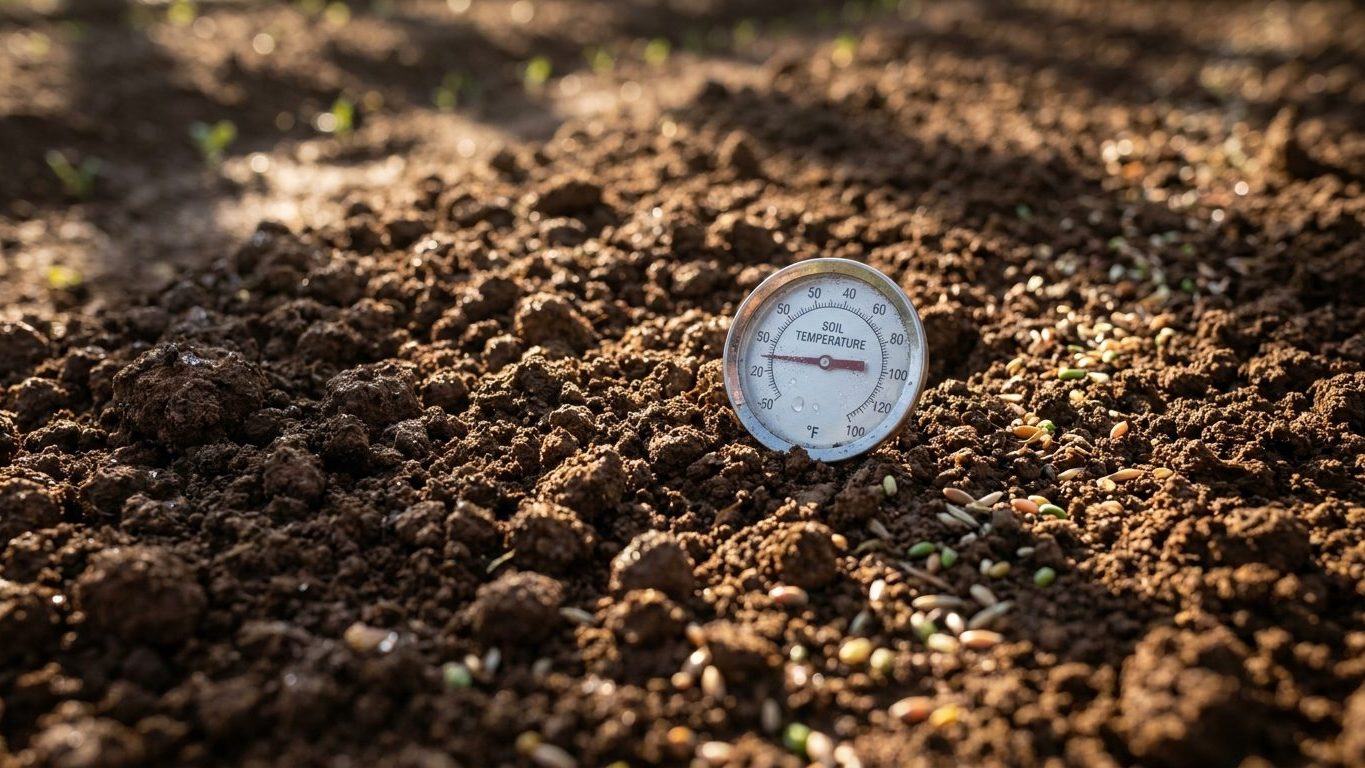
Frost is a useful marker, but it’s a proxy for something else: soil temperature. A warm-season cover crop like cowpea or sorghum-sudangrass doesn’t care what the air did last night. It cares whether the soil a few inches down has climbed into the 60s, which usually happens one to three weeks after the last frost risk has passed. Cool-season species (oats, cereal rye, crimson clover, hairy vetch) work the other way: they tolerate cold soil and even light frost, so they’re the ones you plant in early spring or, more commonly in Oklahoma, in fall for winter cover.
Why the seeding rate isn’t here
How much seed you put down depends on the species, whether you’re broadcasting or drilling, and the source of the seed itself. A rate that works for cereal rye drilled into a garden bed is meaningless for cowpea broadcast over a fallow patch. Rather than hand you a number that might waste a season, the better move is a call to your county office of the Oklahoma State University Extension service, which tailors rates to local conditions and current trial data.
Termination follows the same logic of restraint. This isn’t the place for a spray program. Cover crops here get cut, mowed, crimped, or simply left to a hard freeze that finishes the job for you. A crimped rye stand lying flat as mulch does the same weed-suppression work a herbicide would, just slower and without the chemical.
How long the season lasts here
Subtract the two frost windows and Oklahoma’s frost-free season runs from roughly early-to-mid April (spring frost ending March 28-April 10) to late October or early November (fall frost arriving October 29-November 8). That’s somewhere in the neighborhood of six and a half to seven months, depending on where in that band your particular year and county land.
That’s a long window by national standards, and it changes what’s practical. A gardener in a shorter-season state might get one cover crop cycle and call it done. Here, there’s often room for a second sowing: a spring legume or quick-growing grass ahead of summer vegetables, then a fall cover (oats, cereal rye, crimson clover) sown after the last harvest and left to overwinter. The length of the window is exactly why succession planning matters so much in this state, more than in places where the frost dates leave barely enough time to get one crop up and terminated.
A long season also raises the transplanting question. If you’re growing a summer vegetable that needs a head start indoors, a six-plus month frost-free window gives you the luxury of checking root development before you commit to the garden bed, rather than rushing a transplant out the door because the season is short and every week counts. Where the window is tight, growers often skip that check. Here, you don’t have to.
For the mechanics of timing a second sowing correctly, including how to read your own soil and calendar rather than someone else’s, the succession sowing guide on this site walks through the sequencing in more detail.
Heat and water in Oklahoma
For cover crops, the deciding factor isn’t really summer heat, it’s winter. Oklahoma’s coldest month averages a daily minimum of 27.0°F at the Oklahoma City reference station, per NOAA’s 1991-2020 Climate Normals. That number, not the record low and not a seasonal average, is what determines whether a given species survives the winter outright or gets killed back by cold.
That 27°F minimum sits right at a threshold. It’s cold enough to kill back tender annual covers like buckwheat and cowpea completely, turning them into a dead mulch on the surface by midwinter, which is often exactly what a gardener wants: no spring termination work required. But it’s not reliably cold enough to kill hardier grasses like cereal rye or oats outright. Rye shrugs off 27°F without blinking and keeps growing on any mild day, which means it has to be terminated by hand (mowing or crimping) before it sets seed and turns from a cover crop into a volunteer weed problem the following year.
That’s the real fork in the road for this territory. In a genuinely mild climate zone, oats might survive winter easily and demand active management every spring. In a colder pocket of the state, or at higher elevation where winter minimums run lower than the Oklahoma City average, oats die back on their own and turn into low-maintenance mulch without anyone lifting a hoe. Oklahoma’s hardiness range of 6a-8a, per the USDA Plant Hardiness Zone Map, spans exactly that gap: what dies back reliably in the colder end of the state may need mowing in the warmer end.
The state’s hot season matters less for cover crops than it does for vegetables, mainly because most cover crop work in Oklahoma clusters around spring and fall, not the peak of summer. Where high heat plays a role is in choosing summer-active species: sorghum-sudangrass and cowpea both handle heat and short dry spells better than cool-season grasses, which tend to go dormant or brown out once daytime temperatures climb consistently into the 90s.
Which cover crops suit Oklahoma
Given the frost windows, the long frost-free season, and that 27°F winter minimum, three broad categories fit this territory well.
- Cool-season grasses (oats, cereal rye) for fall sowing: reliable winter cover, but check whether your part of the state sees them die back naturally or needs mechanical termination in spring.
- Cool-season legumes (hairy vetch, crimson clover) for nitrogen-building ahead of spring vegetables, sown alongside or after the grasses.
- Warm-season covers (cowpea, sorghum-sudangrass, buckwheat) for the gap between spring and fall harvests, when heat and possible dry spells favor species built for both.
What this page won’t do is name a variety. That’s not an oversight, it’s the honest answer. Cultivar trials run county by county and year by year at Oklahoma State University’s research stations, and a name that performed well in one part of the state can underperform badly in another given differences in soil, elevation, and microclimate that a statewide article simply can’t account for. The seeding rate question runs into the same wall: it shifts with the species, the method (broadcast versus drilled), and the seed source, so a number printed here would be a guess dressed up as fact.
The one recommendation that actually means something is a call or visit to your county Extension office, where trial data reflects your specific conditions rather than a statewide average pulled from a single airport weather station. That’s not a brush-off, it’s the difference between a cover crop that earns its keep and one that becomes next year’s weed problem.