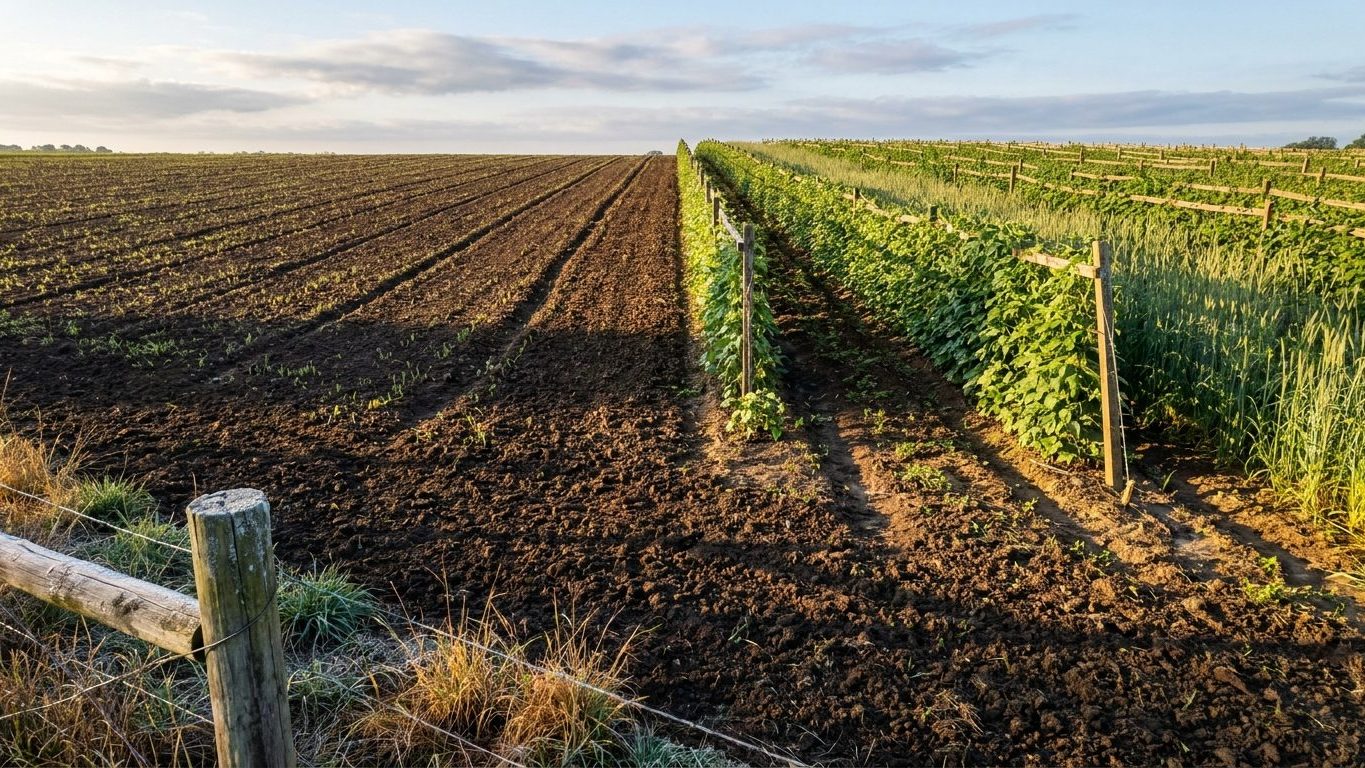

In most of Oklahoma, cover crops go in during two separate windows depending on the species: late summer through early fall for cool-season crops like cereal rye, crimson clover and hairy vetch, timed against a first fall frost that arrives October 29 to November 8, and mid-spring for warm-season crops like buckwheat and cowpeas, once the last frost risk clears between March 28 and April 10. The right window depends entirely on which crop you’re planting and why.
The short answer for Oklahoma
Cool-season cover crops need roughly four to six weeks of growth before a hard freeze locks up the soil. Working backward from a first fall frost of October 29 to November 8, that puts the seeding target for cereal rye, wheat, hairy vetch, crimson clover and forage brassicas at mid-September to early October. Miss that window and the plants go into winter as thin seedlings instead of an established stand, which means less erosion protection and less nitrogen fixed before the cold sets in.
Fall window: cool-season cover crops
Cereal rye is the most forgiving of the fall crops here. It germinates in cool soil, tolerates a late planting date better than clover or vetch, and will keep growing on mild winter days even after that mid-September to early October target has passed. Legumes like hairy vetch and crimson clover are less flexible: they need real top growth and a developed root system before winter to survive and to fix meaningful nitrogen come spring, so pushing them into late October is a gamble that often doesn’t pay off.
Spring window: warm-season cover crops
Buckwheat, cowpeas, sunn hemp and sorghum-sudangrass are frost-tender from the moment they emerge. The last spring frost band of March 28 to April 10 is the earliest realistic seeding point, and even then, waiting an extra week or two for the soil itself to warm up produces faster, more even germination than rushing the calendar date. These dates come from freeze-probability data at a single reference airport station, not a statewide guarantee, so treat them as a starting point rather than a locked-in schedule.
What will not work here
Slow-establishing cover crops sown too close to that fall frost window are the most common failure in Oklahoma gardens and fields. A brassica or clover planted in late October, right at the edge of the October 29 to November 8 frost band, simply doesn’t have time to build the root mass it needs, and a hard freeze at the early end of that window can wipe out a stand that’s only a few weeks old.
On the warm-season side, the mistake runs the other direction: seeding buckwheat or cowpeas before the last spring frost date has actually passed. These species have zero frost tolerance, and a single freeze event inside the March 28 to April 10 band can take out an entire planting, forcing a costly reseed just as the growing window is opening.
Winter survival is where the hardiness zone spread matters most. Oklahoma’s zone range runs from 6a to 8a, and the mean daily minimum temperature in the coldest month sits at 27°F at the reference station. That’s a mild average minimum, not a brutal one, so well-adapted winter covers like cereal rye and hairy vetch generally hold up fine through an average winter. But a cover crop chosen for its performance in the milder 8a pockets and then planted without adjustment in a colder 6a stretch of the state can still take unexpected winter damage, because that 27°F figure is a mean, not the coldest night the location will ever see. The safest approach is to choose winter-hardy species rated for at least zone 6 rather than pushing the limits with anything marginal.
What changes across Oklahoma
Oklahoma is not one climate, and its cover crop calendar shouldn’t be treated as one either. The state’s hardiness zones span 6a to 8a, meaning the average annual extreme minimum temperature swings by as much as 20 degrees Fahrenheit between the coldest corner of the state and the warmest. That’s a wide enough gap that a fall sowing date built around a single reference frost window won’t fit every county equally.
The frost dates cited above come from one airport weather station, and suburban and rural sites typically see their last spring frost arrive later, and their first fall frost arrive earlier, often by one to two weeks. Higher-elevation ground pushes that gap even further. In practice, that means a gardener toward the colder end of the state’s zone range should plan to seed fall cover crops earlier than mid-September, and expect a shorter safe window for warm-season crops in spring. Someone in the milder end of the range can lean toward the later side of both windows, and may be able to stretch a cool-season cover crop’s growing period a bit longer into fall before frost shuts it down.
There’s no single sowing date that covers the whole state accurately, and any calendar that claims otherwise is smoothing over a real difference. The right move isn’t to guess which zone applies to a given property, it’s to look it up directly on the USDA Plant Hardiness Zone Map using a home zip code, then adjust the fall and spring windows described above by a week or two in the direction that zone suggests.
Where to check this for your own county
This page describes Oklahoma at the state level, which is a useful starting point but not a substitute for local data. Oklahoma State University’s Cooperative Extension Service, at extension.okstate.edu, publishes planting guidance built around county-level trial data rather than a single statewide average, and that county-level information is what should actually guide a sowing decision.
On that site, look specifically for the local cover crop or forage planting calendar published for your county’s extension office, along with any variety trial results for cover crop species grown in your region. Those trials matter because a cereal rye or clover variety that performs well in trial plots near a specific county’s soil and rainfall pattern can outperform a generic statewide pick by a meaningful margin, even though both are labeled for the same crop.
A county extension recommendation will always beat a state-level one, simply because it’s built from data collected closer to the actual soil, elevation and microclimate a reader is working with. This page is the state-level version: a reasonable starting point for understanding the general shape of Oklahoma’s sowing calendar, but the county extension office listing is where the fine-tuning happens. If a county page isn’t available online, most extension offices will answer a direct phone call or email with a specific planting window for that county.
Checking this against your own garden
Every date on this page is an average built from decades of weather records, and no average knows what’s actually happening in one particular yard this September. Three direct observations will tell a reader more than any calendar.
The first is soil warmth, checked by hand rather than by air temperature. Push a finger a few inches into the bed before sowing warm-season crops like buckwheat or cowpeas; if the soil still feels cool and damp rather than warm, germination will be slow and uneven no matter what the spring frost date says. The second is watching for the first true leaves on fall-sown cover crop seedlings. If cereal rye or clover hasn’t pushed past its seed leaves within roughly ten to fourteen days of sowing, the soil may be cooling faster than expected that year, and it’s worth checking the extended forecast rather than assuming there’s still time. The third is the first flowering on legume covers like crimson clover or hairy vetch the following spring. That flush of flowers is the signal to terminate or mow before seed set, and its timing, earlier or later than expected, is one of the clearest personal readings of how a specific plot’s microclimate compares to the state averages used to build this calendar in the first place.