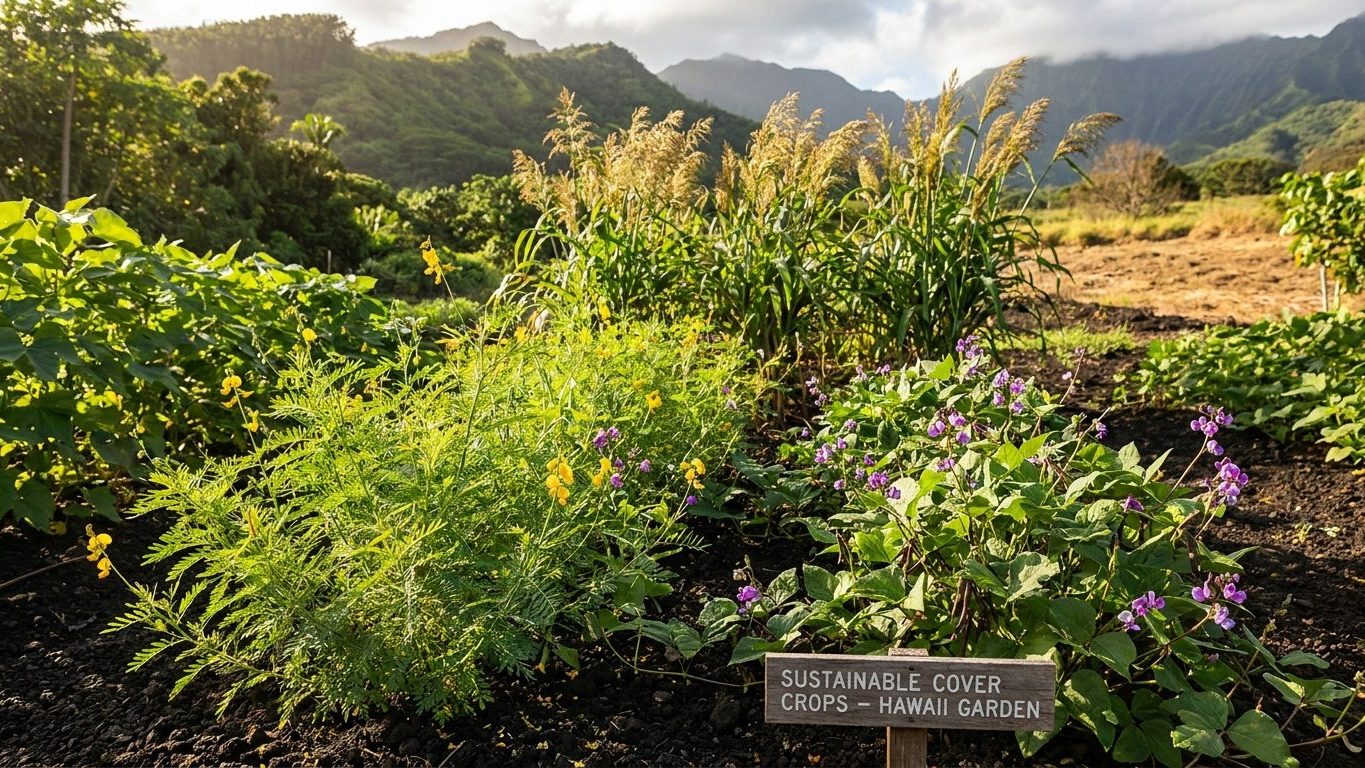

Winter rye (cereal rye) is the cover crop most Prince Edward Island growers reach for, and for good reason: it germinates in cool soil, keeps growing after light fall frosts, and holds the province’s erosion-prone red soil through winter. Oats and forage radish fill the quick, between-crop gaps that PEI’s short season leaves open.
The short answer for Prince Edward Island
Prince Edward Island works with an average frost-free window running from May 16 to October 17, based on the Charlottetown A station’s 1981-2010 climate normals. That’s a mean, not a guarantee: in one year out of two, frost arrives later than October 17 or lingers past May 16, so treat both dates as the middle of a range rather than a line you can plant right up to. Inside that window, and against a winter cold enough that the coldest month averages a minimum of -12.1°C, the cover crop decision on PEI comes down to matching species to how much of that window you actually have left after your cash crop comes off.
If you’re clearing a potato field, a vegetable bed, or any plot by late August or early September, winter rye is the default choice across the province. It’s the only widely grown cover crop here that reliably keeps photosynthesizing after several nights near freezing, and it resumes growth the moment soil warms in spring, which is exactly what’s needed on PEI’s sloped, red-soil fields where bare ground through winter means visible runoff into ditches and streams by April.
For a narrower window, oats or an oat-and-field-pea mix sown by early September will put on enough top growth before the average October frost to protect soil, then winterkill cleanly on their own once temperatures drop hard, leaving a dead mulch mat that’s easy to work into spring beds without extra tillage. Forage or tillage radish follows the same logic and adds a mechanical benefit: its taproot breaks up compacted clay that’s common on PEI’s heavier fields, then rots in place over winter.
Sow winter rye or an oat mix by early September if you want reliable fall cover on Island soil; waiting much later leaves too little growth before the mean October frost date to matter.
What will not work here
Warm-season cover crops built for long, hot summers don’t get a fair trial on PEI. Cowpea, sunn hemp, and sorghum-sudangrass need sustained warmth to establish root mass and fix meaningful nitrogen, and with a frost-free average of roughly five months bounded by mid-May and mid-October, and a maritime summer that rarely pushes into serious heat even in July and August, these species are still trying to get going when nights start cooling again. They’re a poor match for an Island season, not because the season is short in absolute terms, but because it’s short and cool at the same time.
Winter legumes bred for milder climates run into the opposite problem: cold, not length. Crimson clover and some hairy vetch selections that overwinter fine in warmer parts of eastern Canada or the northern US are asked to survive a PEI winter where the coldest month averages a minimum of -12.1°C. Without reliable snow cover insulating the crown, exposed plantings can be killed outright, which defeats the purpose of choosing an overwintering legume in the first place. If you’ve seen a variety recommended on a US gardening site, be cautious: American guides are built around USDA zones, and PEI’s Canadian-system zone doesn’t translate one-to-one with those charts, so a plant rated hardy on a US chart isn’t automatically hardy here.
Buckwheat has a narrower failure mode. It grows fast and smothers weeds well, but it’s frost-tender and needs its full 30 to 40 day cycle to do useful work. Sown much past early August, it risks still being in active growth when the average frost lands, which wastes the planting rather than protecting soil. It’s a good shoulder-season tool on PEI, not a fall-through-winter one.
Finally, any cover crop that depends on a long, dry finish to set seed or dry down for easy termination struggles against PEI’s humid maritime pattern, where damp fall weather is the norm rather than the exception.
What changes across Prince Edward Island
The Canadian hardiness zone cited for this province, 5b, comes from Natural Resources Canada’s reading for Charlottetown specifically, not from an average across the whole Island. PEI is small and largely flat, so it’s tempting to assume the climate is uniform, but that’s not how coastal exposure works. Land along the Gulf of St. Lawrence side tends to catch harder winter winds and less consistent snow cover than more sheltered ground along the Northumberland Strait, and snow cover is exactly what protects a marginal legume’s crown through a winter with a coldest-month minimum near -12°C. Two fields a short drive apart can behave quite differently for an overwintering cover crop even though both sit, on paper, in the same provincial zone.
This page can’t respectably hand a reader in Tignish or Souris a different zone number than Charlottetown’s, because that number isn’t on record here. What it can do is point at the actual source: Natural Resources Canada’s Plant Hardiness site lets you look up a specific municipality rather than relying on a single province-wide figure, and it’s built on seven climate variables rather than the single-variable approach behind the US system, so it’s answering a more detailed question than “how cold does it get.”
Check your own municipality on the NRCan hardiness map before assuming Charlottetown’s 5b rating applies exactly to a coastal or more exposed corner of the Island.
The practical takeaway: if your ground sits exposed to open water or tends to lose its snow cover early most winters, lean toward cover crops that winterkill reliably (oats, radish) rather than ones you’re hoping will overwinter, since the coldest-month figure used for planning purposes reflects Charlottetown’s shelter, not necessarily yours.
Where to check this for your own county
Prince Edward Island’s government agriculture page, at princeedwardisland.ca/en/topic/agriculture, is the right next stop, and it matters more here than it might on a larger, more uniform territory. PEI is split into three counties, Prince, Queens, and Kings, and soil type, exposure, and even typical harvest timing for the dominant potato and vegetable rotations shift enough between them that a single provincial recommendation is a starting point, not a final answer.
Look specifically for two things once you’re there: any current soil conservation or cover crop cost-share program details, since PEI has run provincial support for cover cropping tied to its long-running erosion concerns on sloped red-soil fields, and any county- or district-level guidance on which cover crop varieties have actually been trialled locally rather than just recommended generically. A provincial page can tell you that winter rye works broadly across the Island; a county-level program note is more likely to tell you which specific seeding rate or timing has performed well on soils like yours.
A county-level recommendation beats a province-wide one, and this page is deliberately the province-wide version. Treat what’s written here as the frame you check your own field against, not the final word on what to plant on a specific parcel in Kings County versus one near Summerside.
If the provincial site doesn’t have current cover crop trial data for your area, that’s worth knowing too. It means you’re working from the general pattern described above, which still holds reasonably well across most of the Island’s mixed farm and garden soils, but it’s honest to say the gap exists rather than filling it with a guess.
Checking this against your own garden
Every date on this page is a provincial average pulled from one weather station, so your own observations on the ground should carry more weight than the calendar once the season is underway. Three signs are worth tracking, and none require anything beyond your hands and eyes.
First, squeeze a handful of soil where you plan to sow. If it crumbles apart rather than smearing into a ball, it’s dry and workable enough for fall seeding or spring tillage; ground that stays cold and wet well into what the calendar calls a workable week is telling you your specific spot lags the provincial average, which matters most for timing an oat or radish planting before the real frost risk sets in.
Second, watch for the first bright green flush of regrowth on any winter rye you’ve overwintered. That flush is your cue that root activity has restarted, and it’s the signal to plan termination, ideally before the rye reaches the jointing stage where stems firm up and turning it under gets noticeably harder with hand tools or a small tiller.
Third, keep an eye on frost heave around any bed where you’ve left a radish or oat mat over winter. Heaving that visibly lifts the dead mulch or exposes soil is a sign your specific microclimate runs colder or wetter than the provincial coldest-month figure would suggest, and it’s worth noting for next year’s planning rather than assuming the provincial average applies evenly to that particular corner of the garden.
Watch for rye’s first green regrowth after snowmelt as the practical signal to plan termination, since it will vary by a week or more from one part of the Island to another regardless of what the provincial average predicts.