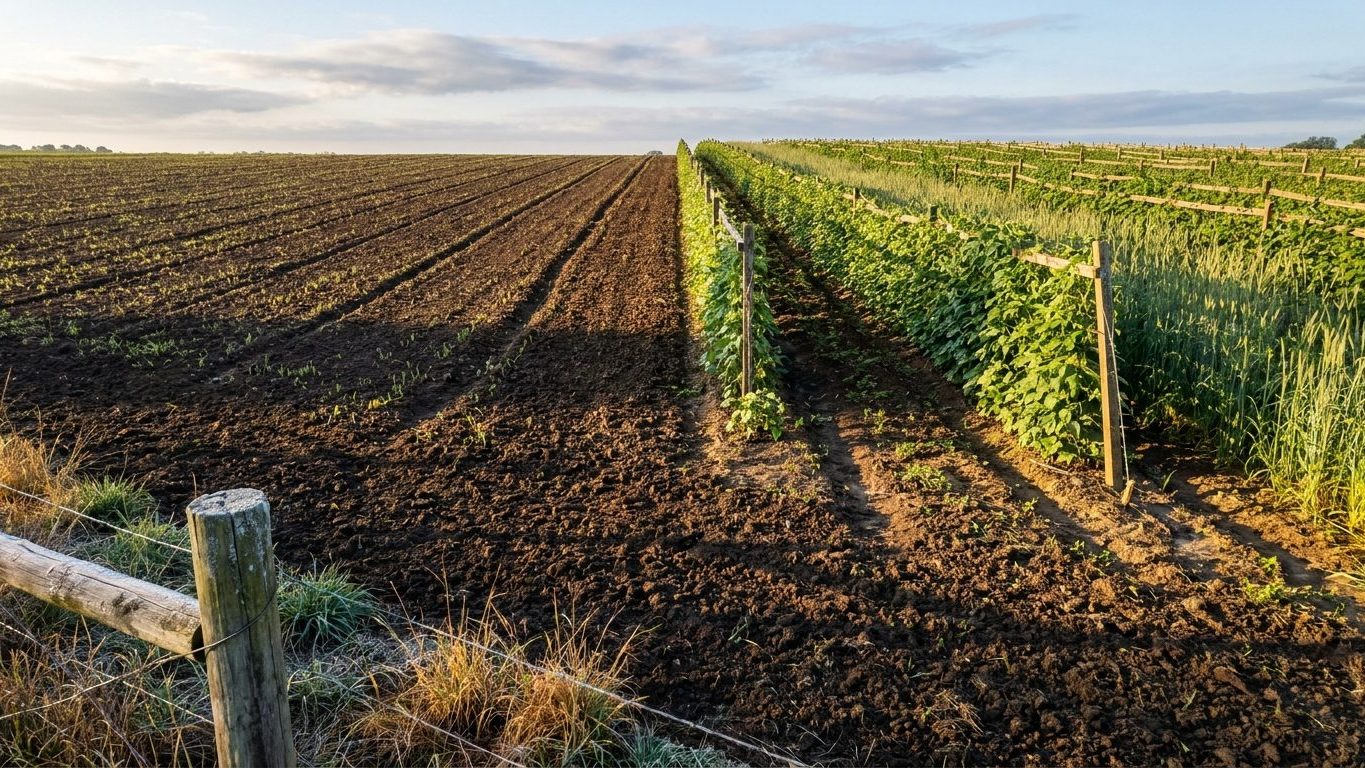

Cover crops in Quebec go into the ground twice a year: a fall planting right after the main harvest, timed to beat the average first frost of October 5, and a smaller spring window for fast species like buckwheat once the soil has warmed past the average last frost of May 6. Everything else on this page explains why those two dates matter more than any generic calendar.
The short answer for Quebec
Most gardeners and small-scale growers in Quebec are working with a fall-sown cover crop, planted into a bed that just finished producing tomatoes, beans, or squash. The species that actually work here (oats, field peas, annual ryegrass, oilseed radish) need roughly four to six weeks of active growth before a hard frost shuts them down. Count backward from the average first fall frost of October 5, and that pushes sowing to the last week of August through the first week of September for most of the province’s populated corridor.
That October 5 date is a mean, not a guarantee. Environment and Climate Change Canada pulls it from three decades of records at the Montreal/St-Hubert station, which means in roughly half of those years, frost actually arrived later. Sow on September 1 expecting a whole extra month and some years you’ll get it. Other years you won’t. The safer habit is to treat early September as the last comfortable date, not the last possible one.
Spring sowing is the smaller half of the picture but still useful, especially for a quick soil-building crop ahead of a late-planted vegetable bed. Buckwheat, in particular, germinates fast and tolerates the cool, wet soil that follows the average last spring frost of May 6. It won’t survive a real freeze, so gardeners at higher elevations or north of the St. Lawrence valley should wait past that date rather than sow to it exactly. Field peas and oats can go in slightly earlier than buckwheat since they tolerate a light frost, but none of these species should go into ground that’s still cold and waterlogged, which in much of Quebec means waiting into mid-May regardless of what the calendar mean suggests.
The practical takeaway is that Quebec runs on two sowing windows, not one: a fall window anchored to October 5 minus four to six weeks, and a spring window that starts loosely around May 6 and gets pushed later at altitude or in the north. Neither date is a promise from the sky. Both are averages built from a single reference station, and your own garden will tell you when it disagrees.
What will not work here
The biggest failure mode in Quebec is sowing a slow cover crop too late in the fall window and expecting it to catch up. Species like crimson clover or hairy vetch, which perform well with a long autumn in milder climates, need more like eight to ten weeks of fall growth to establish a root system that survives winter. Given a frost-free season averaging about 152 days between May 6 and October 5, there simply isn’t room to sow those species in September and expect a strong stand. Growers who try this end up with thin, patchy cover that winterkills without ever building the biomass or nitrogen fixation they were hoping for.
Winter survival itself is the second trap. The mean daily minimum of the coldest month at the reference station works out to -14.1°C, and that’s an average, not the coldest night on record. Cover crops marketed as “winter hardy” in seed catalogs are often rated against milder US zones. A species that overwinters reliably in a place with a coldest-month minimum a few degrees above freezing may simply die outright here, especially in a winter with thin or late snow cover, since snow is doing a lot of the insulating work that keeps roots alive at -14°C.
Dense, tightly-spaced sowing is a third mistake, though for a different reason. Quebec summers bring enough humidity that a thickly-sown stand of a broadleaf cover crop can develop fungal issues before it’s had time to do its job, particularly in a wet August. This isn’t a hypothetical; it’s the same humidity that pushes home tomato growers toward staking and pruning for airflow. Cover crops sown at the rate printed on a US seed packet, without adjusting for the local combination of a short season and a humid summer, tend to underperform compared to a slightly thinner stand sown on time.
None of this means cover crops are risky in Quebec. It means the species list has to match the season length and the winter minimum, not a catalog description written for a warmer state.
What changes across Quebec
Quebec is not one climate, and this page can only speak precisely for the reference station behind its frost dates, near Montreal, which sits at hardiness zone 5b in the Canadian system. That system is built from seven climate variables, not just winter minimum temperature, so it isn’t directly comparable to a USDA zone number a reader might know from an American gardening book. It describes the St. Lawrence valley corridor around Montreal and St-Hubert. It does not describe the Laurentians an hour north, the Gaspé, the North Shore, or Abitibi, all of which run colder and see a shorter frost-free season than the numbers on this page.
The practical shift for a reader outside the milder valley is straightforward even without exact numbers for their own area: push the fall sowing window earlier, and treat the spring window as starting later. A garden at higher elevation or further north loses growing days on both ends of the season, so the four-to-six-week fall establishment period needs to start closer to mid-August than early September, and spring sowing needs to wait until the soil has genuinely warmed rather than sowing to the May 6 average, which was measured at a station in the warmer south of the province.
There is no single sowing date for “Quebec.” A gardener in the Montérégie and a gardener in the Saguenay are working with meaningfully different seasons, even though both fall under the same provincial recommendations in general gardening advice. Rather than guessing at the gap, the most reliable move is to check where a specific municipality falls on Natural Resources Canada’s hardiness zone map, which is built for exactly this kind of local variation and won’t force a single valley’s frost dates onto a garden that experiences a very different winter.
Where to check this for your own county
This page gives Quebec-wide sowing logic built from a single reference station near Montreal. That’s useful as a starting frame, but a provincial page is never as precise as a local recommendation, and Quebec’s own agricultural extension service exists specifically to close that gap. MAPAQ, the Ministère de l’Agriculture, des Pêcheries et de l’Alimentation du Québec, publishes region-specific guidance that accounts for the province’s real variation in frost dates and season length, rather than a single averaged window.
When checking MAPAQ’s resources for a specific region, look for two things in particular. First, any regional planting calendar that adjusts sowing windows for the agricultural zone closest to the actual garden, since MAPAQ organizes much of its advice by region rather than by a single provincial date. Second, look for cover crop species that have actually been trialled or recommended for that region’s conditions, since a species list built for the milder south of the province won’t necessarily hold up in a colder, shorter-season area further north.
The general rule holds here as it does everywhere: a local recommendation beats a provincial one, and this page is the provincial one. Think of the frost dates and sowing windows above as the frame a regional calendar fills in, not a replacement for checking that regional source directly. If a reader gardens near the reference station itself, in the greater Montreal area, the numbers on this page will track closely with what a regional calendar shows. Further from that corridor, treat this page as a starting estimate and let the regional source correct it.
Checking this against your own garden
Frost dates and averaged windows get a reader close, but the garden itself gives more current information than any station thirty years of records can offer. Three simple observations, none requiring equipment, tell a gardener more about their own microclimate than a provincial calendar ever will.
The first is soil warmth by feel. Dig down two or three inches and grab a handful. If it feels cold and clammy even in mid-May, the ground hasn’t caught up to the calendar average yet, and sowing a warm-loving species like buckwheat should wait, regardless of what the May 6 mean frost date implies. Soil that feels loose, slightly warm, and crumbles rather than clumps is a much better signal that it’s ready.
The second is watching for the first true leaves on any early volunteer seedlings or a quick test patch. A cover crop’s first leaves after the initial seed leaves show real, active growth. Volunteer seedlings sprouting and thriving nearby, whether it’s self-seeded dill or a weed that’s typically frost-tender, is a reasonable sign that a garden’s own frost risk has genuinely passed, sometimes earlier or later than the station average suggests.
The third is watching how late into fall existing plants stay green and active. If squash vines or tomato plants are still pushing new growth into late September with no frost damage, that’s a strong local signal the fall sowing window can stretch a little later than the provincial average implies. If a light frost nips tender plants in early September, well ahead of the October 5 mean, that’s the opposite signal, and the fall cover crop sowing should move earlier next year. A garden’s own frost history over a few seasons outranks any single averaged date on this page.