
Sow winter squash outdoors in western Oregon from mid-May through the first weeks of June, well past this region’s official frost-free date. In central and eastern Oregon, the window closes earlier and opens later, so the state does not share one calendar. The rest of this page shows exactly why.
The short answer for Oregon
NOAA’s 1991-2020 climate normals put the last spring freeze at the Portland reference station between March 6 and March 21, and the first fall freeze between November 11 and November 27. That sounds like it hands winter squash a season of roughly eight months. It does not, and here is the mechanism that matters: those dates mark a 32F freeze probability band of 30 to 70 percent, meaning a freeze still has a real chance of happening even after the window closes. Winter squash has zero tolerance for that: one late touch of frost on a cotyledon and the seedling is gone.
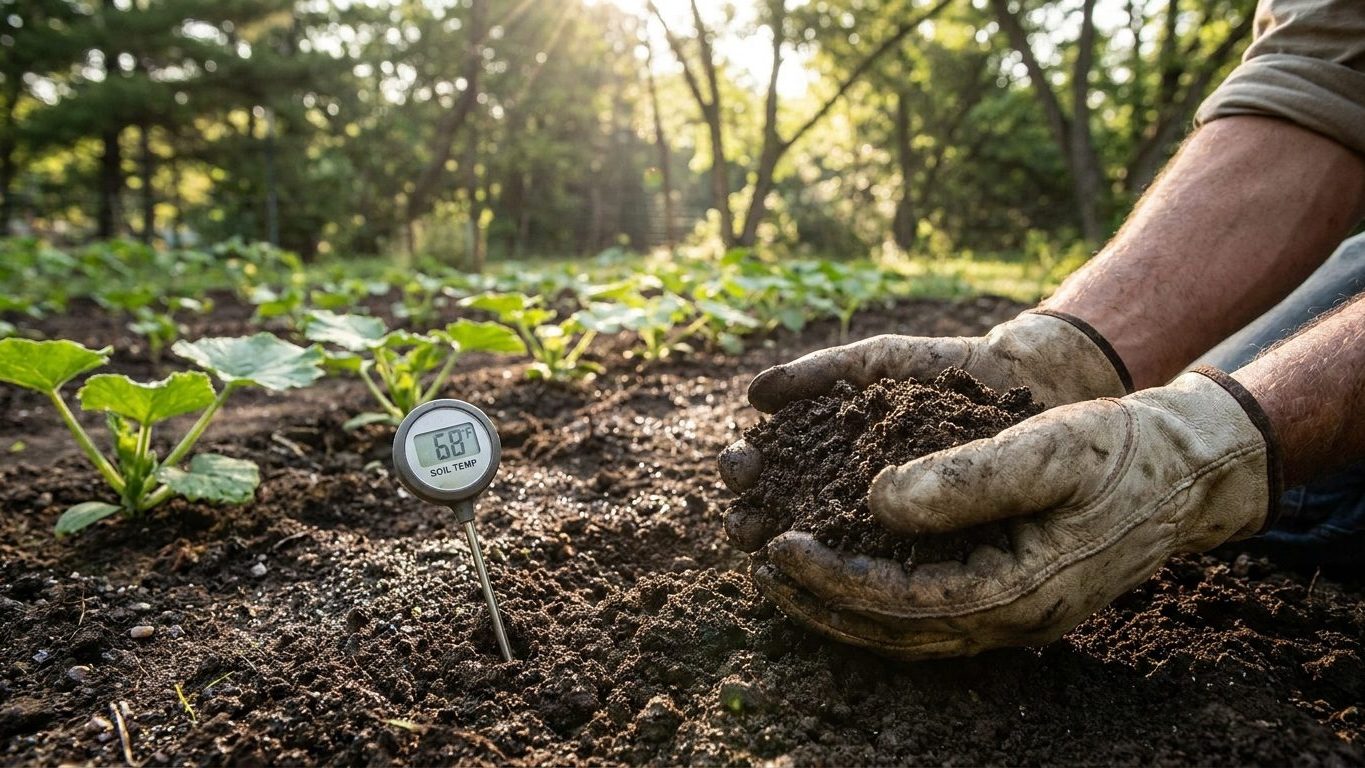
So growers do not plant at the frost date. They plant weeks after it, once the soil itself has warmed rather than just the air. In the Willamette Valley, that point typically lands in mid-May, sometimes stretching to the first days of June in a cool spring. Two paths get you there:
- Direct seed outdoors from mid-May to early June, once the risk implied by that 30-70 percent band has faded and the ground feels warm to the hand, not just the calendar.
- Start seed indoors in late April or the first half of May, and set transplants out on the same mid-May to early June schedule, gaining a two- to three-week head start on fruit set.
Work backward from the fall frost date to check the math. Most winter squash varieties need 80 to 110 days to mature. Counting back from November 11, the earliest edge of the fall frost window, a 100-day squash needs to be in the ground by roughly early August at the latest, which a mid-May to early-June planting clears with weeks to spare. The margin exists specifically because the west-of-the-Cascades season is long. That margin disappears fast east of the mountains, which is the subject of the next section.
What will not work here
Planting at the calendar frost date, not after it, is the single most common mistake. Because the March 6-21 window is only a 30-to-70-percent probability, not a guarantee, seed or transplants set out right at that date are gambling on the losing half of that range. Winter squash, unlike a cold-tolerant brassica, does not shrug off a light freeze; it dies at the stem.
Long-season varieties pushed too late are the second failure point, and it is a statewide one rather than a Willamette Valley one. A 120-day Hubbard or a similar long-keeper planted in late June is racing a first fall frost that, in the western valleys, can arrive as early as November 11. That is still workable there. It is not workable in the high desert basins of central and eastern Oregon, where elevation and continental air shorten the frost-free season well below what the Portland station records, and where the same variety choice, made off this page’s window rather than a local one, runs out of days before the fruit finishes sizing and curing.
Watering on a fixed weekly schedule is the third failure, and the numbers explain why. Summer rainfall across June, July and August averages only about 2.7 inches, with July, the peak of vine growth and fruit set, delivering just 0.51 inches on average. Meanwhile the reference station logs an average of 11.9 days a year at or above 90F, exactly the heat load that pulls moisture out of a squash leaf faster than a shallow root system can replace it. A single weekly soak, sized for an average week, leaves the plant short during any stretch that lines up with those 90-degree days, which is precisely when fruit is filling out. Squash roots need checking more often than a fixed schedule assumes, especially once the plants are fruiting.
Oregon’s dry summer also changes what disease risk looks like compared with a humid state. Spacing squash too tight is still a mistake here, but the main damage from crowding in this climate is drought stress and shaded-out fruit set rather than the fungal pressure that close spacing causes in a wetter region. Air movement matters less for mildew here than consistent soil moisture does for the plant simply surviving July and August.
What changes across Oregon
The USDA Plant Hardiness Zone Map lists Oregon as spanning zone 4a to zone 9b, based on average annual extreme minimum winter temperature. That is a five-zone-plus spread inside one state’s borders, and it means there is no single planting date that serves the whole territory honestly. The frost dates used above come from the Portland reference station, representative of the milder, wetter west side. They should not be read onto the rest of the state.
| Region | General pattern | What it means for squash |
|---|---|---|
| Willamette Valley / west of Cascades | Milder end of the state’s hardiness range, longer frost-free season | Wider sowing window, mid-May to early June, more margin for long-season varieties |
| Central and eastern Oregon, high desert | Colder end of the range, shorter growing season, greater elevation swings | Later last frost, earlier first frost, squeezed window that favors shorter-maturity varieties |
| Mountain valleys and higher elevation sites | Toward the 4a-5a end of the statewide range | Season length can rule out the slowest-maturing winter squash entirely |
A reader gardening at higher elevation, or east of the Cascades generally, should shift the whole schedule later on the spring end and earlier on the fall end than the west-side window given here, and lean toward the shorter end of the 80-to-110-day maturity range rather than the long-keeping types. This page cannot tell an individual reader which zone number applies to their own yard; that number depends on the exact site, not the state average.
Where to check this for your own county
The state-level numbers on this page come from one reference station and one statewide hardiness range. Neither substitutes for a county-level recommendation, and neither should be treated as the final word for a specific garden. Oregon State University Extension, at extension.oregonstate.edu, is the source built to close that gap.
Two things are worth looking for there specifically. First, a local planting calendar for the reader’s own county, which will already have folded in elevation, local frost records and microclimate in a way a statewide freeze-probability band cannot. Second, a list of winter squash varieties actually trialled in that county’s conditions, since a variety that performs well in the Willamette Valley’s long, mild season is not automatically the right pick for a shorter high-desert season further east.
A county recommendation beats a state one every time, for the simple reason that it is built on more specific ground. This page works at the state level because that is the scale a searcher usually starts at, but the correct next step for anyone planning an actual planting date is the county office behind the state extension link above, not this page.
If you follow the almanac, here is when to plant winter squash by the moon. It is a tradition, not a proven method.
Checking this against your own garden
Every date on this page is a normal, an average built from thirty years of station records, not a promise about this particular spring. The reader’s own garden outranks it, and three simple checks say more than any calendar.
- Soil warmth by feel: push a finger a couple of inches into the bed in the morning. If it still feels cold rather than merely cool, the soil has not caught up to the air temperature yet, and seed sown now is likely to sit and rot rather than germinate.
- The first flush of male flowers: winter squash typically opens several male flowers before the first female flower with its tiny swollen base appears. Seeing that first wave of male blooms is a sign the plant has moved past establishment and into its reproductive stage, on its own schedule, not the calendar’s.
- The first true leaves: the rounded seed leaves that emerge first are not the plant settling in; the first set of jagged, vine-shaped true leaves after them is. Their appearance, and how long it took to get there from sowing, is the clearest single readout of how warm this particular spring has actually run in this particular bed.
Watching those three signs over one season builds a better private calendar than any station average, because they measure the reader’s own soil, own slope and own microclimate directly, rather than a number recorded at an airport weather station miles away.