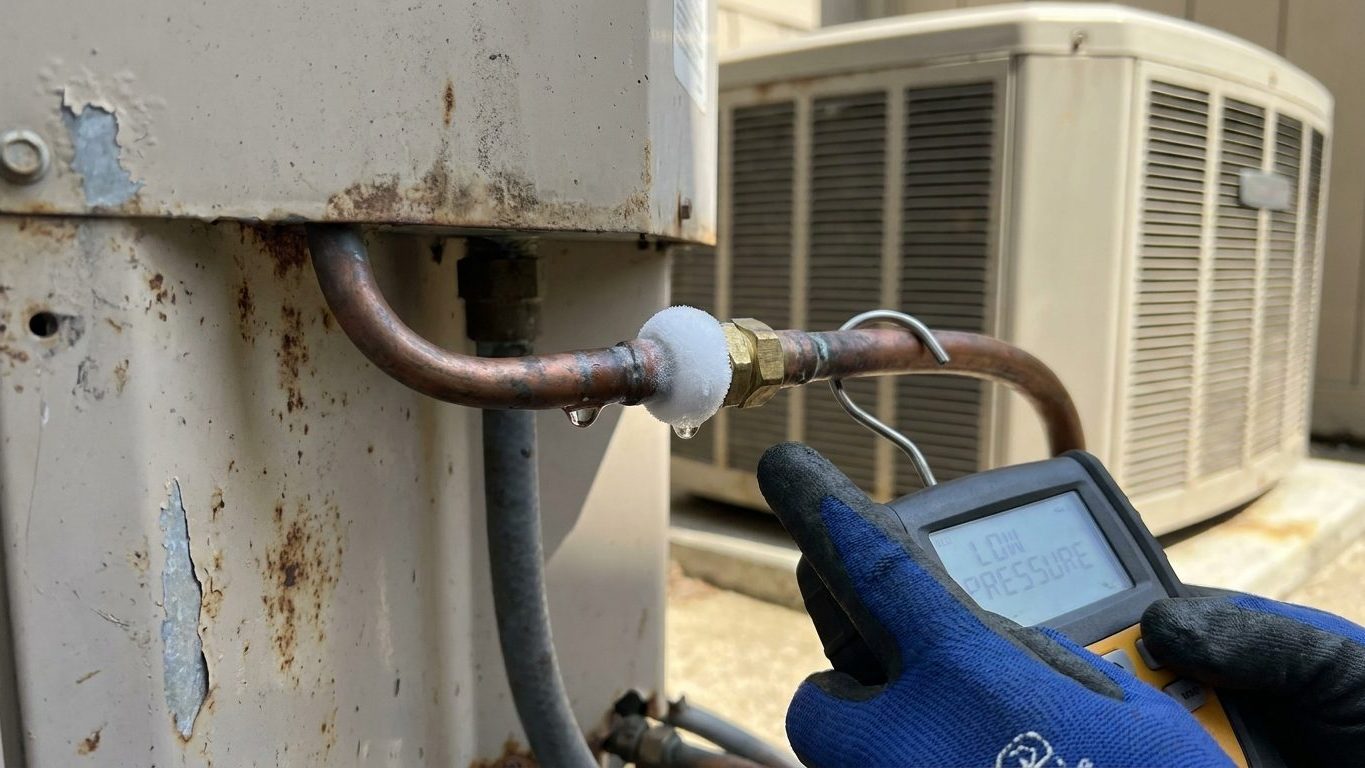

A system that keeps drifting low on refrigerant isn’t wearing out the way a filter or a belt does. Refrigerant doesn’t get consumed by the compressor or burned off during a cooling cycle. It moves through a closed, sealed loop, and a properly sealed loop holds its charge for the life of the equipment. If a technician keeps adding refrigerant year after year, the honest read isn’t “it runs low sometimes.” It’s “there’s a hole somewhere, and nobody has found it yet.”
It is not a consumable
Think of the refrigerant loop the way you’d think of the coolant loop in a car’s radiator, except sealed tighter and never meant to be opened for routine service. The refrigerant changes state, from liquid to gas and back, absorbing heat indoors and releasing it outdoors, then it returns to start the cycle again. Nothing in that process uses it up. A pound of refrigerant installed at the factory should, in a system with no leaks, still be a pound of refrigerant a decade later.
So when a technician says the system is “a little low” and tops it off, that’s not maintenance in the way that changing motor oil is maintenance. Oil actually breaks down with use. Refrigerant doesn’t. A low charge means the loop has a hole in it somewhere, whether that’s a pinhole in a coil, a loose fitting, or corrosion at a joint, and every top-up is a temporary patch on a problem that’s still there the moment the truck pulls away.
This gets said a lot more gently than it deserves, and not out of any bad intent. Plenty of homeowners have been told, in good faith, that seasonal top-ups are just part of owning a central air system, the same way you’d expect to mow the lawn or clean the gutters. That advice isn’t malicious. It’s often just incomplete, or it’s easier to deliver a quick fix on a hot afternoon than to schedule the diagnostic work a leak search actually requires.
The practical result is that a homeowner can pay for the same repair multiple times without ever getting the actual repair. One recurring top-up call per cooling season is the signal worth paying attention to. If that’s happened more than once with the same system, the conversation to have isn’t “can you add more,” it’s “where is it leaking, and what does it take to fix that.” Finding the leak is the harder job. It’s also the only one that stops the bleeding for good.
None of this means every AC issue traces back to refrigerant. Plenty of cooling complaints have nothing to do with the charge at all. But when the charge itself is confirmed low, the cause is mechanical and locatable, not something that happens on its own with age or use.
What a low charge looks like from inside the house
You don’t need a gauge set to notice that something’s off. A handful of signs tend to show up together when the refrigerant charge has dropped, and none of them require going anywhere near the outdoor unit or the electrical panel to observe.
| What you notice | Why a low charge causes it | Other common cause |
|---|---|---|
| Air from the vents is cool, not cold | Reduced refrigerant means less heat gets absorbed per cycle | A dirty condenser coil outside, or a thermostat sensor issue |
| The system runs and runs without hitting the setpoint | Weaker heat transfer means longer run times for the same result | Oversized ductwork losses, or a home losing cooled air fast |
| Ice on the indoor coil or the larger copper line | Low pressure drops coil temperature below freezing | Restricted airflow from a clogged filter or blocked return |
| A hissing or bubbling sound near the lines | Refrigerant escaping through the leak point itself | Rarely mimicked by anything else; worth mentioning specifically |
| Higher bills with no change in habits | The compressor works harder and longer to move less heat | A failing capacitor, dirty coils, or an aging blower motor |
Notice that almost every row has a second column. That’s deliberate, and it’s the part that gets skipped in a lot of quick explanations. A blocked return or a filter that hasn’t been swapped in months can produce cool-but-not-cold air, long run times, and even ice on the coil, with the refrigerant charge sitting perfectly fine. The U.S. Department of Energy’s ENERGY STAR program puts a number on how much that kind of restriction can cost you: “Airflow problems can reduce your system’s efficiency by up to 15 percent.” That’s a meaningful hit, and it happens with a fully-charged, leak-free system.
This is why the table above is a starting point for a conversation, not a diagnosis you make from the couch. Check the filter first, before assuming refrigerant is the culprit. If the filter’s clean and the return grilles aren’t blocked by furniture or a closed door, and the symptoms persist, refrigerant becomes the more likely explanation and a proper leak search is the next step.
The value in laying it out this plainly is that it keeps the list from turning into a source of dread. Most of these symptoms have a boring, cheap explanation more often than a dramatic one. Ruling out the boring explanation first saves a service call, and it saves you from paying for a leak search you didn’t need.
Why it makes ice
The ice part confuses people because it seems backward. Less refrigerant should mean less cooling, not more freezing, right? The mechanism is simpler than it sounds once you follow it in order. Less refrigerant in the loop means lower pressure on the low side of the system. Lower pressure means the evaporator coil runs colder than it’s designed to. A coil that’s colder than intended will drop below freezing, and the moisture that normally condenses on it as liquid, the way condensation forms on a cold glass, freezes solid instead.
Once that ice forms, it doesn’t just sit there quietly. It blocks the airflow across the coil, and blocked airflow makes the coil colder still, which grows more ice, which blocks more airflow. The fault feeds itself. A system that’s mildly low on charge in the morning can be wrapped in a solid sheet of ice by afternoon if it’s left running.
If you spot ice on the indoor coil or on the larger of the two copper refrigerant lines, the move is straightforward. Switch the thermostat’s fan setting to FAN ONLY and leave the compressor off entirely. Let the ice melt completely before running the system in cooling mode again. Running it while it’s still iced just extends the freeze-thaw cycle and can push water past the drain pan and onto the floor around the air handler.
Here’s the wrinkle worth remembering: too little airflow across the coil produces this exact same ice, with the refrigerant charge sitting at full and no leak anywhere in the system. A collapsed duct, a closed supply register, or simply a filter packed with a season’s worth of dust can starve the coil of the airflow it needs, dropping its surface temperature the same way low refrigerant does. That overlap is exactly why the filter gets checked before anyone talks about refrigerant. It’s the cheaper, faster thing to rule out, and it’s wrong far more often than it’s right to assume the coil froze because of a leak.
What to ask the person who comes out
Once a technician is standing in front of the outdoor unit, the questions you ask shape whether you get a real fix or another temporary patch. A short list, asked in order, changes the outcome more than almost anything else in the visit.
- Ask them to find the leak, not just top off the charge. A refill without a leak search is a delay, not a repair, and it’s worth saying that plainly before any work starts.
- Ask what refrigerant the system uses and whether it’s still readily available. Older systems and newer ones don’t all use the same refrigerant, and that matters for how a repair gets planned.
- Ask for the reading before the work and the reading after. That comparison is the only way to confirm the charge was actually corrected, not just estimated.
- Ask what the repair itself would involve; brazing a joint, replacing a coil section, or something else, so you understand what’s being fixed and not just that “it’s fixed.”
Notice there’s nothing in that list about pressures, charge weights, or dollar figures. Those numbers vary by equipment, by season, and by region, and quoting one here would do you no favors. What matters more is the sequence: find it, identify it, verify it, explain it.
Handling refrigerant itself is regulated work, not something for a homeowner to attempt with a gauge set bought online. That’s worth saying once, without turning it into a lecture. The same goes for anything involving a run capacitor inside the outdoor unit; it can hold a stored charge even with the power switched off, and that’s a job for someone trained to discharge it safely, not a DIY step. Ask for the before-and-after reading every time refrigerant work is done, and keep that paperwork. It’s the one piece of documentation that tells you, months later, whether the fix actually held.
Common questions
Can a central air system just naturally lose refrigerant over time with no leak?
No. A sealed system holds its charge indefinitely under normal operation. Any measurable drop in charge means refrigerant is escaping somewhere, even if the leak is too small to hear or see.
Is it safe to run the AC while it’s low on refrigerant?
Running it briefly won’t damage anything immediately, but continued operation risks icing the coil and can put extra strain on the compressor, which is one of the more expensive components to replace.
Will adding refrigerant fix the cooling problem for good?
Only temporarily. Without locating and sealing the leak, the charge will drop again, and you’ll be paying for another top-up down the road, often within the same cooling season.
How is a low charge different from a system that’s simply undersized for the house?
A low charge is a mechanical fault, refrigerant escaping through a leak point, and it’s fixable by finding and sealing that leak. An undersized system, by contrast, involves a load calculation that accounts for the home’s size, insulation, and layout, and that’s a separate conversation from a leak repair entirely.