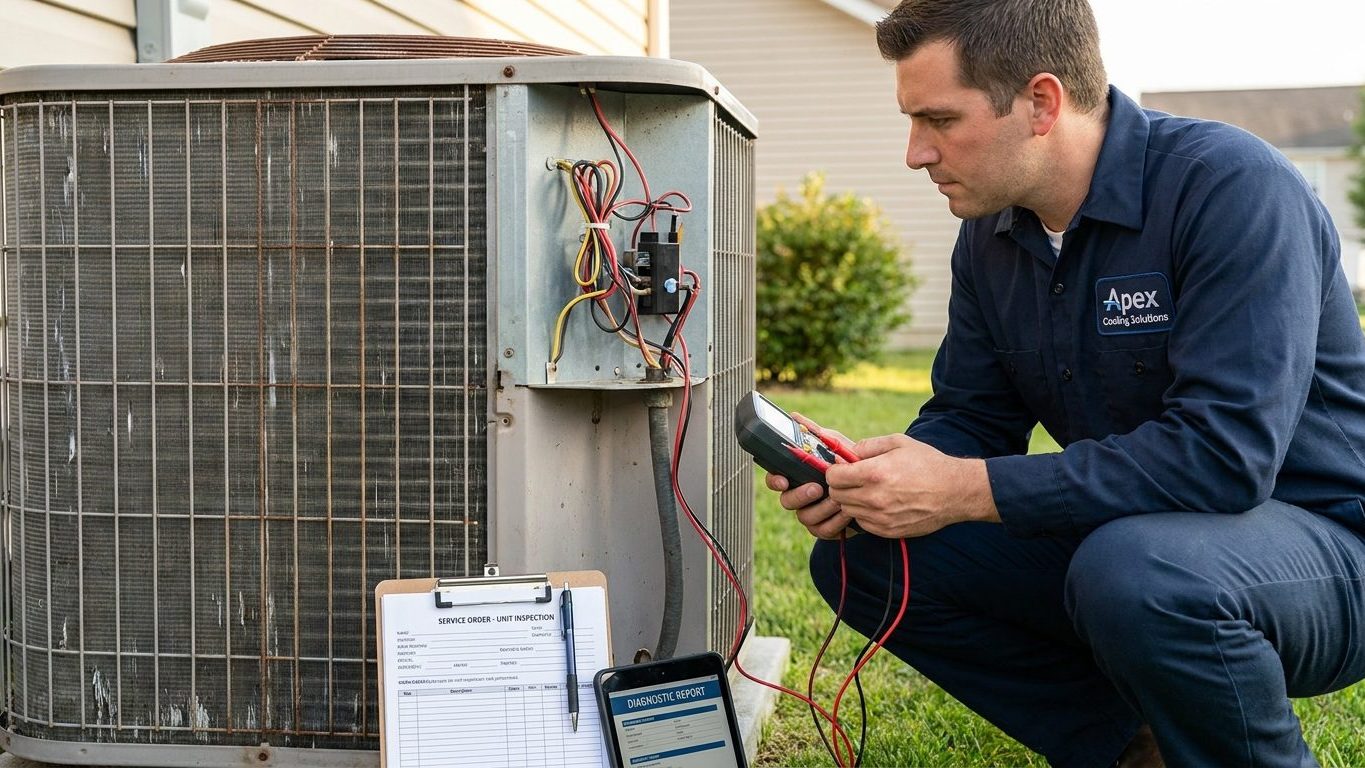

The short answer: what failed matters more than how old the system is. A blown capacitor or a stuck contactor is a routine repair on a unit of any age. A leaking coil or a failing compressor is a different conversation, because that’s a sealed-system fault, and whether the refrigerant it uses is still readily available can tip the scale further. A written diagnosis that names the actual part is what turns a guess into a decision.
Start with what failed, not with how old it is
Age tells you almost nothing useful on its own. A five-year-old system can have a failed compressor. A system that’s been running for decades can need nothing more than a fifteen-minute part swap. Two systems installed the same year, from the same builder, in the same neighborhood, can have completely different outcomes depending on maintenance, installation quality, and what specifically gave out. Treating “how old is it” as the deciding question skips past the one piece of information that actually drives the decision: which component failed, and what that failure implies about the rest of the system.
This is where homeowners get steered wrong, sometimes by their own instincts. A unit that’s been reliable for years suddenly stops cooling, and the assumption is “it’s old, it’s probably done.” But a technician showing up to that call is looking at a specific part, not a birthday. If the fix is a capacitor or a contactor, the age of the cabinet around it is close to irrelevant. If the fix involves opening the sealed refrigerant circuit, that’s a different category of problem regardless of how new or old the unit is.
The practical move is to ask a narrower question than “should I replace this.” Ask “what part failed, and is that part a wear item or a sign the sealed system is compromised.” Wear items are things designed to eventually give out and get swapped, the electrical equivalent of a light bulb. A sealed-system fault means the closed loop that holds refrigerant, normally never touched once a system is installed, has to be opened, repaired, evacuated, and recharged, which is a fundamentally bigger job with a different risk profile.
None of this means every sealed-system repair is a lost cause, or that every wear-item repair is automatically worth doing. It means the conversation with whoever is diagnosing the system should center on the failed part and what it means, not on a mental countdown based on the installation date. A contractor who leads with “this unit is old” before naming what actually broke hasn’t given you a diagnosis yet. Ask for the part.
Wear item, or sealed system
Some components are built to wear out and get replaced without touching anything else. Others are part of the sealed refrigerant circuit, meaning the loop that’s evacuated, charged, and closed at installation and not meant to be opened again except to fix a leak. Opening that loop is a bigger job than swapping an external part, and it raises the question of whether the rest of the sealed system, including the compressor, is still sound. Here’s how the common failure points break down.
| Component | Wear item or sealed system | Generally available | What it implies |
|---|---|---|---|
| Capacitor | Wear item | Yes, widely stocked | Isolated failure, doesn’t reflect on the rest of the system |
| Contactor | Wear item | Yes, widely stocked | Isolated failure, same as above |
| Fan motor | Wear item | Usually, though lead time varies | Isolated, but worth checking why it failed (bearing wear, debris, electrical strain) |
| Control board | Wear item | Depends on age and model, sometimes harder to source | Isolated electrically, but availability can drag out the repair timeline |
| Coil leak | Sealed system | Repair is possible, but requires opening the refrigerant circuit | Raises the refrigerant-availability question and compressor’s exposure to a low-charge condition |
| Compressor | Sealed system | The most consequential failure in the loop | Often the point where the size of the job changes the whole conversation |
Two things are worth saying plainly, without dramatizing either one. A run capacitor holds an electrical charge even after the power to the unit is off, which is why this is not a component for a homeowner to test or handle. And refrigerant is not a consumable that simply depletes with use the way gasoline does. A system that’s “low” on refrigerant has a leak somewhere in the sealed circuit. Topping off the charge without finding and fixing that leak means paying for refrigerant twice, once now and again later, while the leak keeps going.
The table above is also a rough map of how contained a repair is likely to be. Anything in the wear-item column can usually be swapped without touching the refrigerant circuit at all. Anything in the sealed-system column means a technician has to recover the existing refrigerant, make the repair, pressure-test the circuit, then evacuate and recharge it, which is a meaningfully different scope of work than replacing an electrical part.
The question about refrigerant
There’s a factor that rarely comes up unless you ask directly: which refrigerant the system runs on, and how easily it can still be sourced. This matters most for exactly the failures described above as sealed-system faults, because a coil leak or compressor repair means the refrigerant has to be recovered and eventually replaced. If the system uses a refrigerant that’s still in common production, that part of the job is straightforward. If it runs on something being phased down or harder to find, the same repair becomes more complicated and less predictable, even though the mechanical work involved is identical.
This is a moving target, and it changes by region, by supplier, and by year, which is exactly why it isn’t something to treat as settled information you already know. The refrigerant landscape shifts as rules and supply chains evolve, and what was routine to source a few years ago isn’t automatically routine now. The only reliable way to get a current answer is to ask the person doing the diagnosis: what refrigerant does this system use, is it still readily available in this market, and does that availability affect the practicality of this specific repair.
That question belongs squarely to whoever is quoting the job, not to a general rule of thumb. A technician looking at your specific unit, in your specific region, with current supply conditions, is in a position to give you a real answer. A blanket statement about “older systems” or “newer systems” isn’t, because refrigerant availability doesn’t track neatly with age in a way that holds up everywhere at once.
What this means practically: when a sealed-system repair is on the table, refrigerant availability is worth asking about as its own line item, separate from the labor and separate from the part. Two systems with an identical coil leak, diagnosed the same week, can lead to different recommendations once you factor in what each one runs on and how easy that refrigerant is to get. That’s not a detail to skip past when you’re weighing a repair estimate against a replacement quote.
Getting an answer you can trust
A decision this size shouldn’t rest on a verbal impression from a single visit. There’s a straightforward sequence that turns a diagnosis into something you can actually evaluate.
- Get the diagnosis in writing, with the specific part named. “The system needs work” isn’t a diagnosis. “The compressor has failed” or “the capacitor is out of range” is.
- Ask how that determination was made. A named part backed by a specific test or observation is a different level of confidence than a guess based on symptoms alone.
- Whenever the answer comes back as “replace,” get a second opinion. Replacement recommendations carry more weight, and more cost, than a repair, so they’re worth the extra step of confirming with someone else.
- If a replacement is being quoted, ask whether it includes a load calculation for your home, rather than simply matching the size of the unit being removed. A new system sized off the old one carries forward whatever sizing mistake the old one had, whether that meant it ran too long, cycled too often, or never quite kept up.
That load calculation question matters more than it sounds like it should. Ductwork, insulation, window area, and how the house is used all factor into proper sizing, and none of that changes just because a new unit is going in. A quote that skips straight to “same size as what’s there” is skipping a step that determines how well the new system will actually perform.
It’s also worth knowing that replacing like with like isn’t a requirement. Data from the U.S. Energy Information Administration’s 2020 Residential Energy Consumption Survey shows that among homes with air Conditioning nationally, 67% run central systems while 26% rely on individual equipment such as ductless mini-splits, window units, or portable units. That split isn’t uniform. In Connecticut, air conditioning is present in 90% of homes but central systems make up only 34% of that, with individual equipment filling a much larger share. Hawaii runs the reverse pattern, with 57% having air conditioning and 48% of that on individual equipment. plenty of homes across the country cool with something other than central air, and switching format at replacement time is a legitimate option worth discussing rather than an automatic decision to redo what was already there. For a closer look at how that alternative works, see our ductless mini-split guide.
Common questions
Is a failing capacitor a sign the whole system is on its way out?
No. A capacitor is a wear item that fails on its own timeline, unrelated to the condition of the compressor, coils, or refrigerant circuit. Its failure doesn’t say anything about the rest of the system.
If refrigerant is low, can a technician just add more and call it done?
Adding refrigerant without finding the leak means the level will drop again, because refrigerant isn’t consumed during normal operation. A “low” reading points to a leak somewhere in the sealed circuit that needs to be located and repaired.
Does a compressor failure always mean replacement?
Not automatically, but it’s the point where the conversation tends to get more serious, since the compressor sits at the center of the sealed system. Whether repair remains reasonable depends on the specific diagnosis, so this is exactly the kind of case where a written estimate and a second opinion earn their keep.
Why does the refrigerant question matter if the leak itself is fixable?
Because fixing the leak is only part of the job. The circuit still has to be recharged afterward, and how easily that refrigerant can be sourced, at what practical difficulty, affects the repair regardless of how straightforward the leak fix itself turns out to be. That’s a question for whoever is quoting the job, since availability shifts by region and by year.