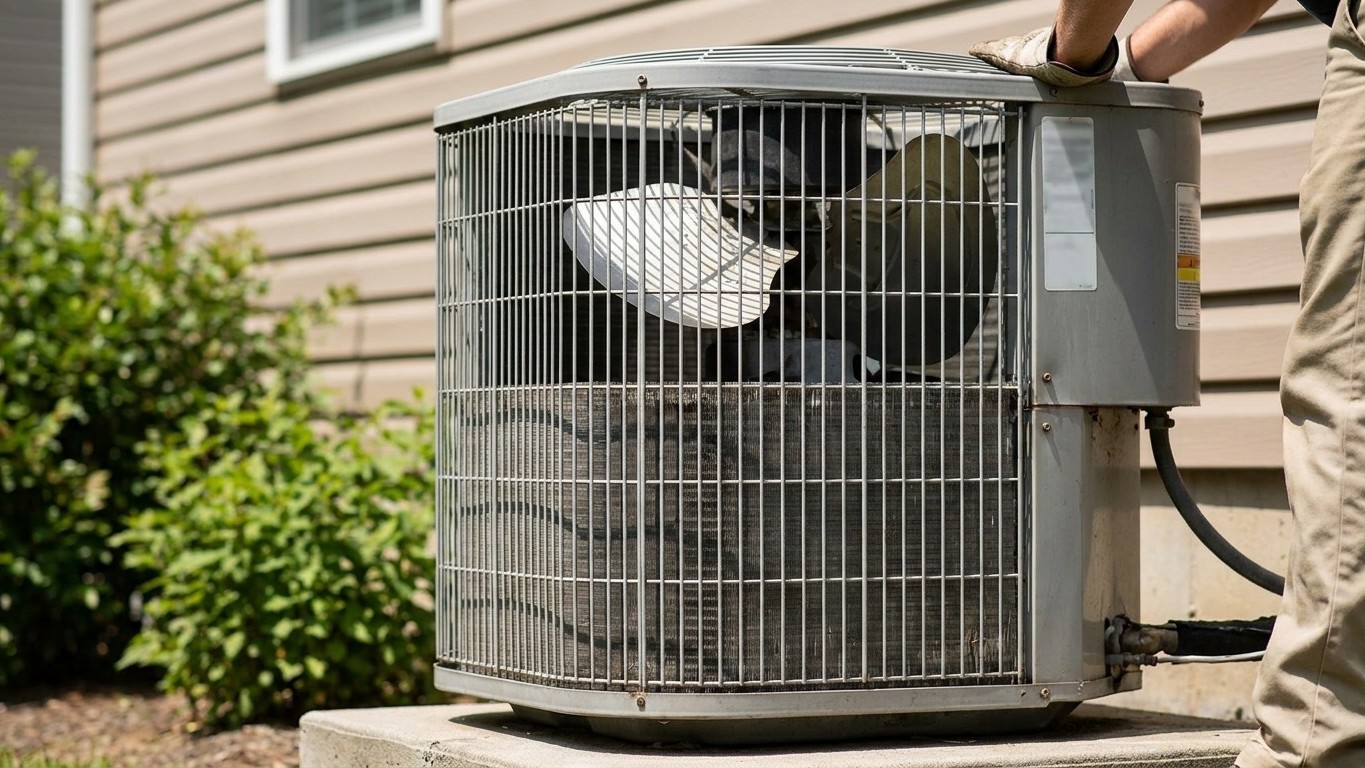

An outdoor AC unit that stays silent, or hums but never kicks in, points to one of three distinct problems, and the difference matters before anyone touches a tool. A dead unit often means the signal never reached it. A humming unit usually means the compressor is trying and failing. A unit that runs but never cools points to airflow or refrigerant. Each path is different.
Three states, three meanings
Stand at the outdoor unit and just watch and listen for thirty seconds before deciding anything. What you observe there, cross-referenced with what’s happening inside the house, narrows the cause faster than any guesswork at the breaker panel.
| What you observe outside | Indoor status | Likely cause family |
|---|---|---|
| Complete silence, no fan, no hum | Blower may or may not be running | Power supply or thermostat signal never reached the outdoor unit |
| A hum, then it stops (may repeat every few minutes) | Blower running, no cool air | Compressor is trying to start and cannot complete the cycle |
| Fan spins normally, unit sounds fine | Air moves but stays warm | Restricted airflow at the coil, or low refrigerant |
That table is the whole diagnostic map for this page. Everything below picks up wherever your own unit landed in that list, because chasing a refrigerant answer when the real problem is a tripped breaker just wastes an afternoon.
Nothing at all
When the outdoor unit gives you nothing, no sound, no motion, work backward from the thermostat before assuming the worst. Most of these cases end at a switch, not a repair.
- Check the outdoor disconnect. Most outdoor units sit next to a small metal or plastic box with a pull-out block or a switch. Confirm it’s fully seated or flipped to on. It’s a common spot for someone to leave it off after past yard work or a filter change.
- Check the outdoor breaker. Go to the main electrical panel and look for a breaker labeled for the AC or condenser. If it’s tripped, it usually sits in a middle position between on and off. Reset it once. If it trips again immediately, stop and call a technician, because repeated tripping means something downstream is drawing too much current.
- Confirm the thermostat is actually calling for cooling. Set it a few degrees below room temperature, confirm it’s on “cool” and not “off” or “heat,” and check that the display isn’t blank or showing a battery warning.
- Check whether the indoor unit is running. This tells you if the signal ever left the house.
You don’t need to walk outside to check that last one. Hold your hand near a supply register, the vents that blow air into a room. If you feel air movement, even if it’s not cold, the indoor blower is running and the thermostat signal is reaching at least part of the system. That’s an important clue: it means the problem sits between the indoor control board and the outdoor unit, or at the outdoor unit itself, not at the thermostat. If you feel nothing at any register, the whole system may be waiting on a signal that never left the indoor equipment, which shifts the search away from the outdoor unit entirely.
A hum, and then silence
This is the symptom people describe most vividly, because it sounds like the unit is trying and giving up. Usually, that’s exactly what’s happening. The compressor motor is getting power and attempting to start, but it can’t complete the process, so it hums for a second or two and cuts out, sometimes repeating that cycle every few minutes as an internal safety resets and tries again.
In general terms, a handful of things tend to cause this pattern: a start component that’s no longer holding its charge properly, a compressor that’s aging or has an internal fault, or a control that’s shutting things down as a protective measure. Without opening the unit and testing components, there’s no way to tell which of those is happening just from the sound.
Here’s where this page has to stop, and it’s worth being direct about why. A run capacitor, the small canister-shaped part responsible for helping the compressor start, stores an electrical charge even after power to the unit is cut. That’s true whether the breaker is off or not. This brief carries no testing procedure, no discharge method, and no way to walk through it safely in writing, because doing it wrong is genuinely dangerous. There’s also an old trick some people use to physically nudge a stalled compressor into starting with a stick or rod poked through the fan grille. It works sometimes. It also has put people in the hospital. Don’t do it, and don’t let a well-meaning neighbor try it either.
The honest version of this section is that the part causing a hum-and-stop pattern is usually inexpensive on its own. What you’re really paying for when you call someone out is the diagnostic visit, the multimeter work that confirms which component failed, and the labor to replace it correctly. That’s a fair way to think about the cost even without a number attached to it.
The fan runs and nothing gets cold
This is the trickiest case to self-diagnose, because the unit looks and sounds like it’s doing its job. The outdoor fan spins, the unit hums along normally, but the air coming out of the registers inside stays room temperature or close to it. Two very different problems produce this exact symptom, and one of them you can rule out yourself.
Start with what’s blocking the coil
Walk around the outdoor unit and look at the coil, the finned metal surface that wraps around the sides. It needs open air moving through it to release heat, and it’s easy for that airflow to get smothered without anyone noticing over a season. Common culprits include:
- Cottonwood fluff, seed pods, or fine debris packed into the fins
- Grass clippings blown in from mowing nearby
- A shrub or ornamental grass that’s grown in close enough to block one side
- Fins that have been bent flat from a hose, a dropped tool, or hail
- A unit tucked under a deck or in a tight side-yard with nowhere for hot air to exhaust
Any of these restricts the airflow the coil depends on, and the effect on performance is bigger than most people expect. According to U.S. ENERGY STAR, “Airflow problems can reduce your system’s efficiency by up to 15 percent.” That’s before anything is actually broken, just from restricted air movement.
If the outside is clear and it still won’t cool
Check the indoor air filter too, since a clogged one restricts airflow on the other end of the system just as effectively as a blocked coil. If the outdoor coil is clean, has room to breathe, and the indoor filter is fresh, and the system still isn’t producing cold air, the next question is refrigerant. Refrigerant isn’t a consumable that gets used up during normal operation. A system that’s low on it has a leak somewhere in the line, and simply adding more without finding that leak means paying for the same refrigerant twice. That’s a separate diagnostic path from anything covered here.
Common questions
Why does the outdoor unit hum but the fan blade doesn’t move at all?
That pattern often points to a start component or the fan motor itself rather than the compressor, since the compressor and the fan can be wired through separate parts even though they share the same outdoor cabinet. It still falls under the same caution as any hum-and-stop symptom: no home testing of capacitors or motors.
Is it safe to reset the outdoor breaker more than once?
Resetting it a single time is reasonable. If it trips again right away, that’s the breaker doing its job by Protecting the circuit from a fault, and repeated resetting just risks damage or worse. Call a technician at that point instead of cycling the breaker.
Can a dirty air filter really stop the outdoor unit from cooling?
Yes, indirectly. A blocked filter restricts airflow across the indoor coil, which can cause the whole system to protect itself by limiting operation, and it compounds any airflow problem already happening at the outdoor coil.
Does the outdoor unit ever shut itself off on purpose?
Yes. Modern systems include safety controls that stop the compressor if conditions look wrong, whether that’s restricted airflow, a pressure issue, or an electrical fault. A hum-and-stop cycle is often that protection working as intended rather than failing randomly.