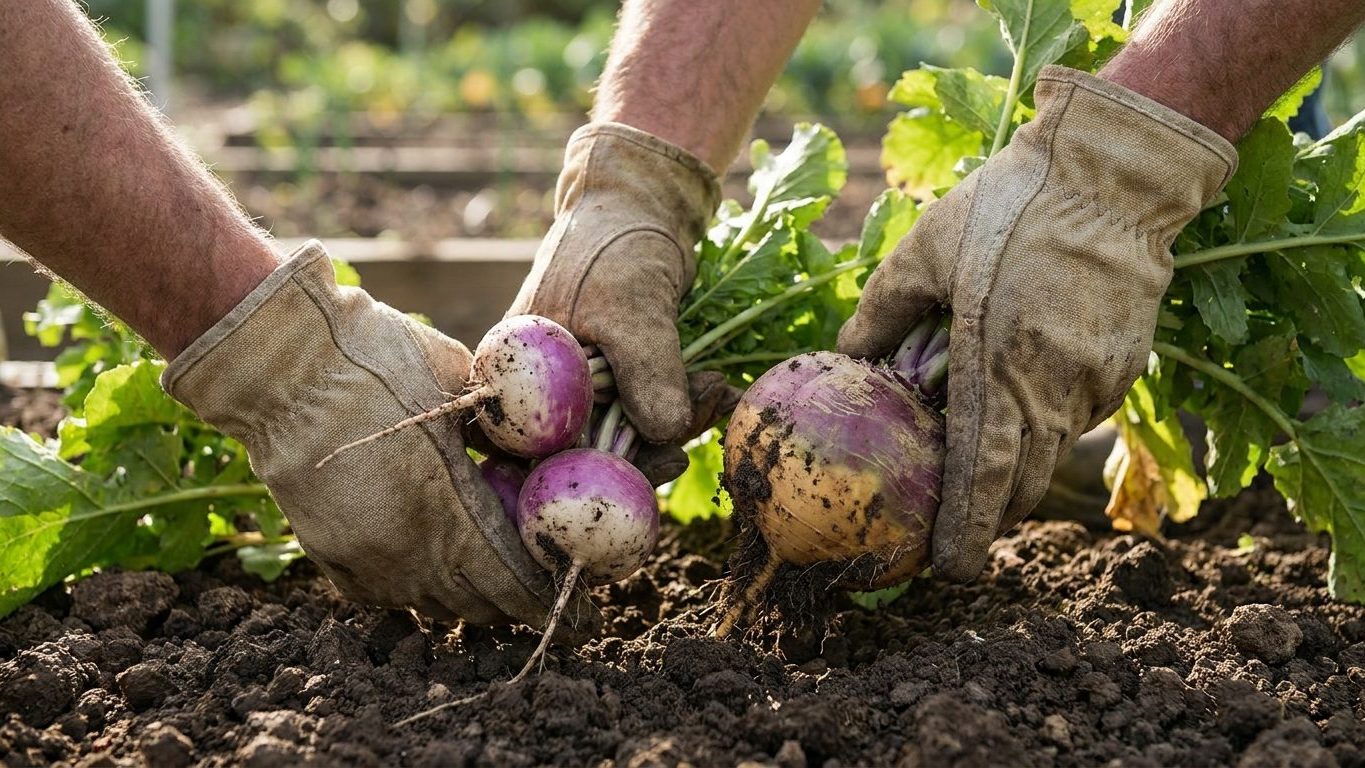

Turnips are best pulled small, generally under three inches across, while rutabaga can grow larger and still stay sweet, sometimes to four inches or more, because the two roots build sugar and fiber on different timelines. Lift by size and feel, not by the calendar, and check a few roots before pulling the whole row.
What is actually going on
A turnip and a rutabaga are not the same plant on a slower schedule. They are different crops with different sugar chemistry, and that difference is the whole reason size matters so much. A turnip is a fast root. It swells quickly, and once it passes a certain diameter, the tissue that was tender starts converting to fiber and the flavor that was mild starts turning sharp, sometimes bitter. Left in the ground past that point, a turnip does not get better. It gets woodier, and often it develops a hollow or pithy center that no amount of cooking fixes.
Rutabaga runs on the opposite clock. It is a slow, cold-hardy root that spends a long season building density, and part of what makes it worth growing is that patience pays off in flavor rather than punishing it. A rutabaga picked too early tastes thin and grassy. Given more time in cool soil, the same root turns dense, sweet, and better suited to roasting or mashing. That is the mechanism a gardener needs to internalize: for turnips, size is a warning sign past a certain point; for rutabaga, size within reason is closer to a reward.
This is also why naming a specific variety and a specific day count is the wrong way to teach this. Types within each species mature at different rates, and how fast either root swells in your soil depends on temperature, moisture, and how the bed was prepared. Your state extension service runs variety trials suited to your season length and can tell you which turnip and rutabaga types perform best in your region. That information is worth more than any generic number, because it accounts for the heat and daylight your garden actually gets.
One thing that does not shift with variety or region: both Turnips and Rutabaga are brassicas, in the same family as cabbage, kale, and mustard. That matters for two reasons that show up at harvest time. First, the same soil pests and root diseases that trouble your cabbage bed will trouble your Turnips and Rutabaga, so a root that looks fine at the surface can still be compromised underground. Second, a gardener who plants turnips into last year’s cabbage or kale bed has not rotated anything, no matter how the two crops looked different on paper. See our crop rotation guide for how to actually break that pest and disease cycle rather than just moving plants around within the same family.
In the garden
Deciding when to lift comes down to three things: judging size correctly for the type you planted, pulling the root without tearing the skin, and knowing what to do with the tops once it is out of the ground. Get any one of those wrong and you either lose the root to storage rot later or you damage a root that was otherwise ready.
| Step | What to do | What happens if you get it wrong |
|---|---|---|
| Judge the shoulder | Brush soil away from the top of the root where it meets the leaves. That exposed shoulder tells you the true diameter, since the underground bulk is often wider than what shows. | Judging by the leaf canopy alone leads to pulling roots too small, or letting oversized turnips sit because the tops still look modest. |
| Pull turnips small | Lift turnips once the shoulder reads roughly golf ball to tennis ball size, depending on type. Taste one if you are unsure; mild sweetness means ready, sharpness means past its best. | Left too long, turnips turn fibrous and often hollow at the core, a flaw you only discover after cutting one open. |
| Let rutabaga size up | Rutabaga can stay in the ground well past turnip size, and a light frost or two actually improves flavor by converting starch to sugar. | Pulled too early, rutabaga tastes bland and stays that way, since it does not sweeten once it is off the plant. |
| Loosen before pulling | Slide a garden fork into the soil a few inches from the root and lever gently before pulling by the leaves. | Yanking straight up, especially in dry or compacted soil, tears the skin or snaps the root, and any broken skin becomes an entry point for rot in storage. |
| Cut the tops, don’t twist | Trim the leaves to about an inch above the crown with a clean blade, rather than twisting or tearing them off by hand. | Tearing the tops wounds the crown, and a wounded crown is one of the first places mold takes hold once roots are stored together. |
| Handle for storage, not for show | Brush off loose soil but do not wash roots you plan to store; set them somewhere cool and shaded to dry off surface moisture for a few hours before moving them in. | Washing before storage keeps roots damp longer, and damp roots in a container are exactly the condition that lets mold spread from one root to its neighbors. |
Before any root goes into long-term storage, check it over one more time. A soft patch, a spot that weeps when pressed, or any mold at the crown means that root does not go in with the rest, no matter how solid the rest of it feels. A root that looks sound is not the same as a root that is sound, and one bad turnip left in a storage bin can take several good ones down with it.
What it depends on where you are
Everything above about size and technique holds true nationally. What does not hold true nationally is the calendar, and that is worth being honest about. Season length changes how long you can leave rutabaga in the ground before hard freeze forces the issue. Summer heat changes how fast turnips swell and how quickly they turn bitter, which is why a turnip that is perfectly timed in a cool coastal garden might already be past its best in a hot inland one planted the same week. Summer rainfall, or the lack of it, changes root density and how easily roots crack or split as they size up, especially if a dry spell is followed by a heavy rain right before harvest.
This page cannot know your first frost date, your soil temperature in October, or how much rain your garden got last month, and anyone telling you a specific date to lift is guessing on your behalf. What actually works is checking roots directly, the way described above, rather than trusting a number written for a different climate.
Two resources fill that gap better than a national guide ever could. Your state’s cooperative extension service publishes planting and harvest windows calibrated to your specific region, along with the turnip and rutabaga types that have actually performed well in trials there. And for a state-by-state look at how season length and climate shift the picture across the country, this site’s state guides break down regional timing in more useful detail than any single national figure could. Between direct inspection of your own roots and guidance suited to your specific climate, you have a far better answer than any calendar date could give you.
The mistake that costs the most
The single costliest mistake is leaving turnips in the ground because they still look small on top, while the root underneath has already swollen past its prime. Gardeners judge by the leaves out of habit, since that is how most other vegetables signal readiness, but turnip tops can stay modest even as the shoulder underground pushes well past the size where the flesh is still tender. By the time the root is pulled and cut open, the damage is already done: a fibrous, sometimes hollow center that no amount of cooking will soften back into something worth eating.
What to do instead is simple but requires breaking that habit. Brush soil away from a few shoulders in the row every week or so once the plants are established, rather than waiting for the tops to tell you something. Pull one and taste it. If it is mild and firm, the rest of the row is likely ready too, and it is better to lift a few days early than a few days late, since an early turnip is still usable while a late one may not be.
The same mistake in reverse costs rutabaga growers just as much, though less often, since impatience with the slower root leads to pulling it too soon and losing the flavor payoff that comes from letting it sit through a light frost or two. Either way, the fix is the same: check the actual root, not the leaves above it, and treat the size guidance for each type as a starting point to verify by hand rather than a fixed date to circle on a calendar. Combine that habit with the storage checks covered earlier, since a correctly timed harvest still needs a sound, unblemished root to be worth the effort of pulling it at all.