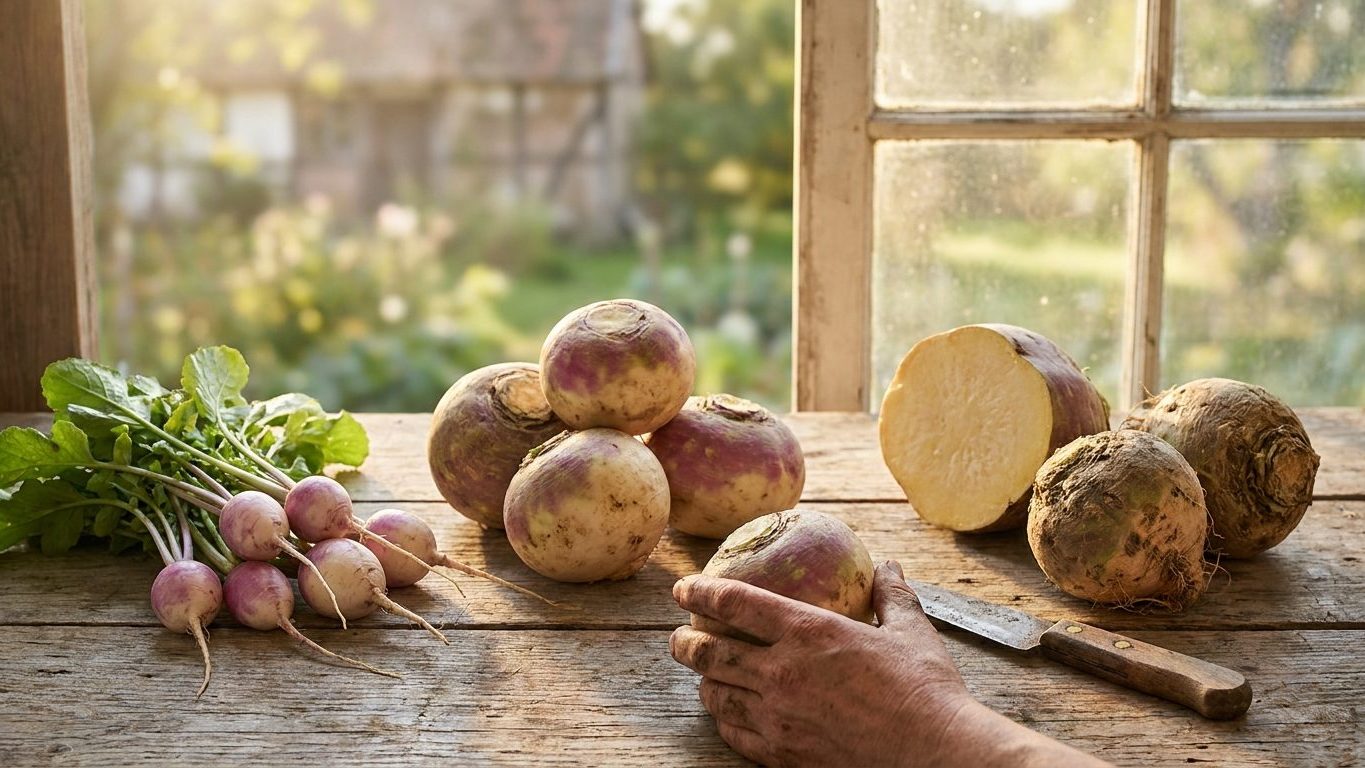

Turnips split into three practical types, and rutabaga is a fourth, related root, not a turnip variety. Salad turnips are grown fast, for tender raw eating. Storage turnips are grown slower, for a root that holds through winter. Fodder turnips are grown for bulk, for livestock or as a cover crop. Rutabaga, denser and slower still, outlasts them all in the root cellar.
What is actually going on
Salad versus storage: a matter of density
The thing to understand here is flesh density. A salad turnip is grown to be pulled young, while its cells are still full of water and its skin is still thin enough to eat unpeeled. That same tenderness is why it turns spongy and hollow within a couple of weeks in a refrigerator drawer, no matter how carefully it’s stored. A storage turnip is left in the ground longer. As it bulks up, the cell walls thicken, the skin toughens, and the root builds the kind of dense flesh that resists moisture loss for months rather than days.
Fodder turnips follow a different logic altogether. They’re bred for volume, not eating quality: a coarse, fibrous root or a leafy top meant to feed livestock or to be turned back into the soil as a cover crop. Flavor and texture were never the point, size and bulk were. A gardener who plants a fodder-type root expecting a delicate salad turnip will be disappointed, and one who plants a salad type expecting a full winter feed crop will run out of root fast.
Where rutabaga and fodder types fit
Rutabaga looks like a large, yellow-fleshed turnip but is a different species entirely, a natural cross that likely happened between turnip and a cabbage-type ancestor generations ago. It needs a longer stretch to bulk up, which is why it’s usually seeded earlier than turnips in most regions. That extra time builds the densest flesh of the group, along with a thick natural skin that, left on, protects the root through months of cold storage far better than a turnip’s thinner one.
All of these roots, turnip and rutabaga alike, are brassicas, in the same family as cabbage, kale, broccoli and mustard. That matters more than most gardeners realize: the pests that hollow out a turnip root and the diseases that blacken its leaves are the same ones waiting in any bed that grew cabbage or kale the year before. A rotation plan that treats turnips as separate from cabbage, and plants one where the other grew last season, has not rotated anything at all. See our guide to rotating brassicas for how to plan around that.
None of this is decided by the photo on a seed packet. The type determines the timeline, and the timeline determines whether what comes out of the ground is a quick lunch or a root that will still be sound in April.
In the garden
The four types side by side
| Type | Time needed | How it’s eaten | Keeping quality | When it goes wrong |
|---|---|---|---|---|
| Salad turnip | Shortest season of the group; ready before many other crops are up | Raw, sliced thin, or lightly sautéed with the greens | Days, not months, even refrigerated | Left in the ground past its point, it turns woody and bitter instead of mild and sweet |
| Storage turnip | A mid-length season, pulled once roots have thickened but before hard freeze | Cooked: roasted, mashed, added to stews | Weeks to a few months in a cold, humid space, if cured and stored correctly | Pulled too early, it never builds the dense flesh needed to keep; pulled too late, it can crack or turn pithy |
| Fodder turnip | Grown for bulk, often left in the ground the longest of the turnip types | Not typically eaten fresh by people; grazed, fed, or tilled in as a cover crop | Not usually stored for kitchen use | Left too long or grown too thick, roots split and rot before livestock ever reach them |
| Rutabaga | The longest season of the group; needs the most time to bulk up | Cooked, similar to storage turnips but sweeter and denser | The best keeper of the four, often the last root left in the cellar, if inspected regularly | A crown left uncut or a bruise left unchecked turns into a soft, weeping spot that spreads through the root |
Shared pests, shared risks
Whatever the type, the same pests come around: flea beetles peppering young leaves, aphids clustering underneath them, and root maggots tunneling into the swelling root itself, all shared with any other brassica in the garden. If cabbage or kale grew nearby or in that bed last year, expect pressure to be worse, not better, since the insects and soil-borne diseases carried over. Handling that pressure without leaning on a pesticide label is mostly a matter of covering young seedlings, watching for the pests’ active weeks, and rotating beds properly, covered in our guide to turnip and rutabaga pests.
Reading a root before it goes into storage
Storage decisions carry their own weight after harvest. A root can look perfectly sound on the outside and still be turning on the inside; the only real test is handling it. A soft patch under a thumb, a weeping spot on the skin, or a moldy crown at the top means that root is finished, whatever the calendar says about how long it should have kept. Roots that fail that check should be pulled from the batch and used right away, not returned to storage where one bad root spreads trouble to its neighbors.
What it depends on where you are
Season length and heat
Season length decides more about which type will actually finish than any seed packet. Salad turnips are forgiving almost anywhere with a real spring or fall window, because they’re built to be quick. Storage Turnips and Rutabaga are not so flexible: they need a stretch of cool, steady growing weather long enough to bulk up before the ground freezes solid, and that stretch is simply longer in some parts of the country than others. A gardener in a short-summer region may find rutabaga barely has time to size up before frost ends the season, while the same root sails through a longer, milder fall further south.
Summer heat changes the answer just as much as season length. Turnips of any type tend to turn hot and pithy if they mature during a stretch of high heat, which is why so many gardeners treat them as spring or fall crops rather than midsummer ones, and why a planting that works well in one region’s climate can bolt or turn bitter in another’s. Rainfall matters too: roots grown in a wet stretch swell fast and can split, while a dry spell at the wrong point leaves them small and woody regardless of type.
Frost timing complicates it further. A light frost late in the season is often treated as a benefit, since the cold triggers the root to convert some starch to sugar and turns a storage turnip or rutabaga noticeably sweeter right before harvest. But a harder freeze at the wrong point can damage the root itself, and how much frost counts as “light” versus “hard” depends entirely on how cold a given region actually gets and how used its soil is to freezing, exactly the kind of detail a state extension office tracks and a general guide cannot.
Where to get a local answer
Fodder turnips add another layer, since they’re often planted as part of a grazing or cover-cropping plan tied to a specific livestock season or a window between other crops, timing set by a farm’s own rotation, not by a national calendar.
None of that can be answered generically here. This page can explain what separates a salad type from a storage type from a fodder type and from rutabaga; it cannot tell a reader in one state what to plant this month. That answer sits with the local cooperative extension office, which tracks what actually performs in that state’s soils and season, and with our own state-by-state turnip and rutabaga guides, built around those regional differences. Extension offices can be located through the USDA’s national extension network directory.
The mistake that costs the most
Matching type to timeline
The single costliest error is treating turnip type as an adjustment of timing rather than a different root altogether, most often by leaving a salad turnip in the ground well past its point, hoping extra time will turn it into something that stores. It won’t. A salad type was never bred to build the dense flesh and thick skin a storage turnip or rutabaga develops naturally; extra weeks in the ground just push it toward woody, bitter and hollow, the opposite of the sweet, tender root it was planted to be.
The same mistake runs the other way too: pulling a storage turnip or rutabaga early because it “looks big enough,” on the same schedule a salad turnip would use. Doing that trades away the exact quality that makes the effort worth it, since the last stretch in the ground is when the dense, keepable flesh actually forms. A root pulled early from that group will taste fine at the table that week, but it won’t hold in a root cellar the way the same type would have with its full time in the ground.
The storage test that decides the rest
The fix isn’t a trick or a product; it’s choosing the type before the season starts, based on what the harvest is actually for, and then respecting that type’s own timeline instead of borrowing another’s. A packet or plant tag naming its intended use, salad, storage or fodder, is the starting point; a local cooperative extension service can confirm which types have actually performed well in a given region’s soil and season, since that answer changes by state in ways this page cannot.
And whatever type ends up in storage, the same rule applies at the end: a root earns its months in the cellar only by passing inspection first, and stays there only as long as it keeps passing it. A soft patch, a weeping spot or a moldy crown is the point where “how long will this keep” stops mattering, because that root is already out of the running. Everything else, the type chosen, the season length, the curing done right, only sets the odds; it never guarantees the outcome for any one root sitting in the dark.