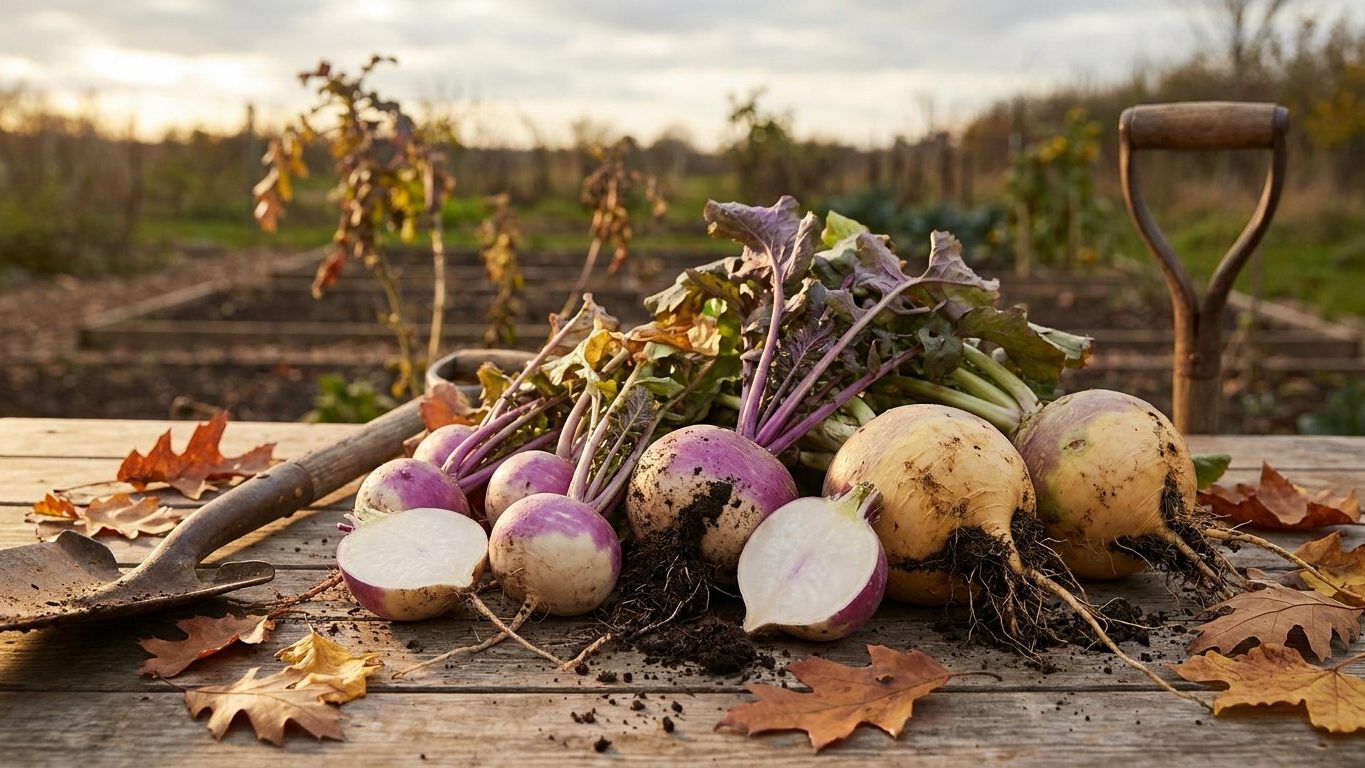

A turnip pulled in October tastes like a different vegetable than one pulled in June, and it’s not your imagination. Cool, shortening days concentrate sugars and keep the flesh tender, while a root racing toward summer heat turns sharp, woody, and quick to bolt. Rutabaga takes this further still: it needs a long, unbroken stretch of cool weather just to size up, which is why most growers treat it as a fall-only crop, full stop.
What is actually going on
The thing to understand here is heat and day length working together, not against each other. A turnip root sizing up while soil temperatures climb produces more of the sulfur compounds that give brassicas their bite, so the flesh turns sharp and the texture goes fibrous as the plant pumps lignin into the root to cope with stress. That’s the flavor most people remember from a bad experience with a spring-sown turnip: hot, hairy, almost radish-gone-wrong. It’s a predictable chemical response, not a flaw in the seed.
Day length adds a second layer. Turnips are biennial by nature, meaning the plant’s real goal is to grow a root one year, survive winter, then flower and set seed. A stretch of cool weather early in the seedling’s life can trick it into thinking winter already happened, a process called vernalization. When the days lengthen and warm up right after that cold exposure, the plant reads it as spring and bolts, sending up a flower stalk instead of bulking the root. That’s exactly the sequence a lot of early-spring sowings walk into: a cold snap in April, then a warm, lengthening May, and suddenly the turnip patch is flowering instead of filling out.
Sow in late summer instead, and both problems disappear on their own. The seedlings grow into shortening days, so there’s no bolting signal to receive. The root sizes as temperatures fall, which slows growth just enough to keep the tissue tender, and the plant actually converts some starches to sugars as a natural response to cold, which is why fall roots taste sweeter without anyone doing anything special. Types differ in how fast they get there. Quick salad-type turnips can size up in a matter of weeks, which is the main reason they tolerate a spring sowing at all, while the larger storage-type Turnips and Rutabaga need a longer, steadier cool season and rarely make a good spring crop anywhere. Your state’s Cooperative Extension Service will have a current list of the types that have actually performed well in local trials, which matters more than any general description.
One more thing worth knowing early: Turnips and Rutabaga are brassicas, in the same family as cabbage, kale, and mustard. They share pests and diseases with all of them, a fact that shapes almost every decision in the section below.
In the garden
Not every type handles a spring sowing the same way, and the differences explain most of the disappointment gardeners report. The table below lays out the general pattern, along with what tends to go wrong when the timing slips.
| Type and timing | What it’s good for | What goes wrong when mistimed |
|---|---|---|
| Fast salad-type turnip, sown early spring | A quick harvest before summer heat sets in, often ready well ahead of most other spring crops | A late frost-then-thaw cycle can trigger bolting; a late sowing lets the roots size right into the first hot spell, turning them sharp and pithy |
| Storage-type turnip, sown in late summer for fall harvest | Dense, sweet roots that hold well in the ground or in cold storage into winter | Sown too early, seedlings struggle in residual heat and draw heavier pressure from root maggot and flea beetle; sown too late, roots never reach a useful size before hard frost shuts growth down |
| Rutabaga, sown late spring to early summer for one long cool finish | A single, patient crop that fills out steadily as fall approaches, producing dense roots that store well | Sown too late, the roots stay small and disappointing; sown too early, they mature during summer heat and come out hollow, woody, or bolted before you ever taste them |
Succession sowing salad turnips through spring, stopping a few weeks before consistent heat arrives, and starting again as soon as summer eases off, is the closest thing to a workaround. It doesn’t change the underlying biology, it just times each sowing to a window where the biology cooperates.
Because turnip and rutabaga share their pest and disease pressure with cabbage, kale, and mustard, planting them where any of those grew the previous season isn’t really a rotation at all, it’s the same risk with a different label. Root maggot, flea beetle, and clubroot all build up in soil that keeps hosting brassicas, spring after spring. Managing that pressure is a practice, not a product: covering young seedlings, moving the bed each year, and clearing old brassica debris matter far more than anything sprayed on after the fact.
Storage deserves the same plain talk. No root should be trusted just because it looks fine on the outside. Before it goes into long-term storage, check for a soft patch, a weeping spot, or a moldy crown around the leaf scar. Any one of those ends the question for that root, regardless of how firm the rest of it feels.
What it depends on where you are
Everything above describes a mechanism that holds true nationally: heat and day length drive flavor, texture, and bolting in the same direction everywhere turnips grow. What this page can’t tell you is exactly when your cool season starts, how long it lasts, or how much summer heat and rainfall your soil sees between sowings, because that varies from a short, sharp fall in the upper Midwest to a long, mild autumn along parts of the Gulf Coast.
Season length sets how late you can sow a fall crop and still expect it to size up before growth stalls. Summer heat sets how early a spring sowing has to finish before quality collapses. Summer rainfall affects germination timing for both windows and how much irrigation a late-summer sowing needs just to get established in warm, dry soil. None of that is guesswork you should have to do alone.
The state-specific pages in this guide translate the general mechanism into local sowing windows, and your state’s Cooperative Extension Service keeps the most current, locally trialed guidance available. The USDA’s National Institute of Food and Agriculture maintains a directory to help you find the extension office serving your county, which is the fastest way to get dates and types matched to where you actually garden.
The mistake that costs the most
The single costliest mistake is choosing a sowing date off the calendar instead of counting backward from the weather. A gardener who sows turnips or rutabaga on the same date every year, regardless of how the season is running, will eventually hit a stretch where the roots finish sizing right in the middle of a heat wave, or a fall sowing that goes in during an unusually warm stretch and never catches the cool finish it needed.
The fix isn’t a better date, it’s a different question. For a spring sowing, ask how many weeks of cool weather remain before your area’s typical run of hot days begins, and only sow a type quick enough to finish inside that window. For a fall crop, ask how many weeks of growing time remain before your first hard frost, then count backward from there, favoring the slower storage types and rutabaga when that window is long enough, and salad-type turnips when it isn’t.
This is also where naming a specific variety would do more harm than good, because the type that finishes fast enough in one region may simply run out of season in another. Your state’s Cooperative Extension Service will have current recommendations for what’s actually held up in local trials, and that beats any general list this page could offer.
Get the timing right and the rest mostly takes care of itself: the flavor problem, the bolting problem, and the storage-quality problem all trace back to the same root cause, roots sizing in the wrong weather. Fix the calendar question and the biology stops working against you.