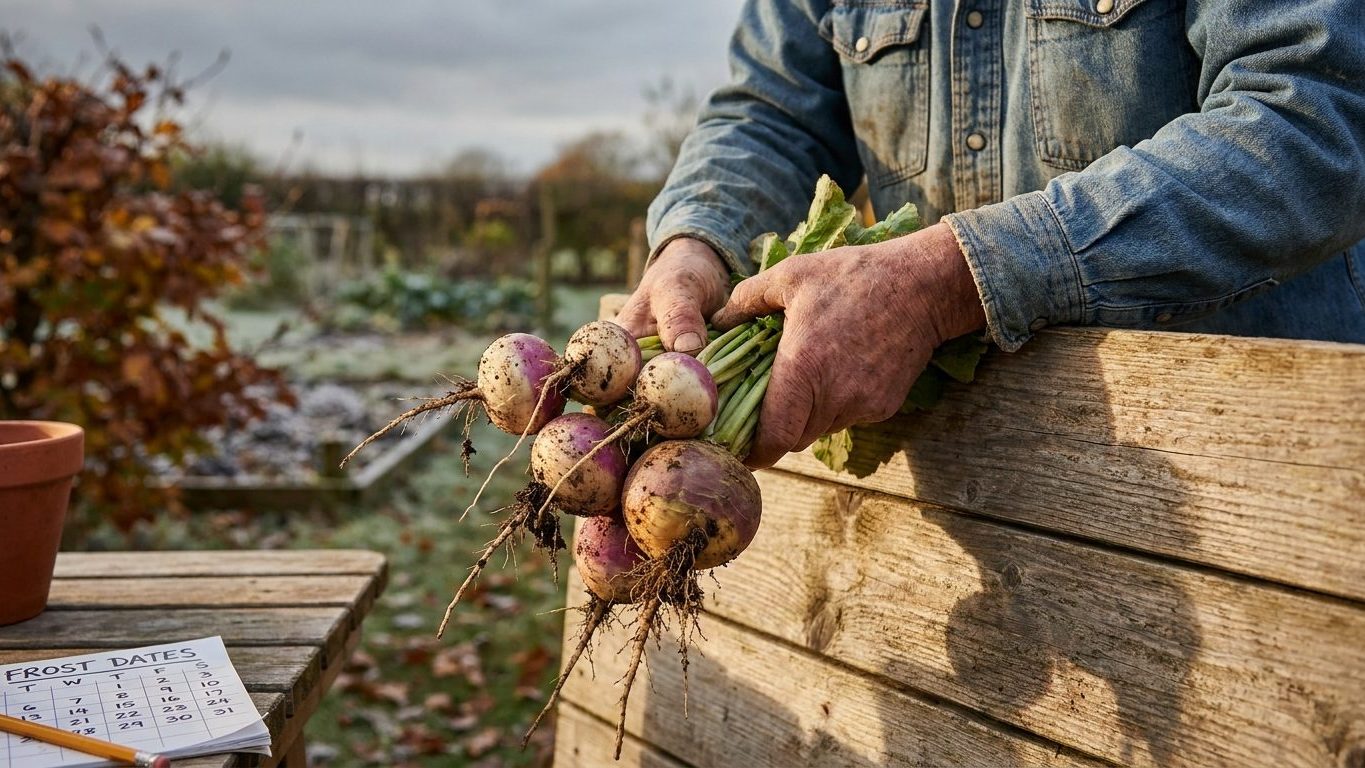

Count backward from your area’s average first fall frost date. Turnips need roughly six to eight weeks of growth before that date arrives; rutabaga needs closer to ten to twelve, because it grows slower and needs more time to size up before cold locks the ground. Sow too late for either, and frost catches a root that never got the chance to finish.
What is actually going on

The reason this window has a shape at all comes down to two separate jobs the plant has to finish, back to back. First it has to grow, building leaf and then root mass while the days are still warm enough to push growth along. Then, as temperatures drop, it needs a stretch of cool weather to convert starches into sugars, which is what gives a fall-grown turnip or rutabaga its better flavor compared to one pulled in the heat of summer. Miss the warm stretch and the root never sizes up. Miss the cool stretch and you’re left with a root that’s grown but hasn’t sweetened, or worse, one that’s been killed off by a hard freeze before it did either.
Turnips move through the growth stage quickly, which is why they tolerate a later sowing date than most root crops. Rutabaga is the slower cousin here. It’s essentially a cross with cabbage in its lineage, and it carries some of that plant’s patience, taking noticeably longer to bulk up a root worth eating. That difference in speed is the entire reason the two crops get different countback windows even though they’re planted, thinned, and harvested in almost the same way.
Both crops are brassicas, in the same family as cabbage, kale, broccoli, and mustard. That matters for more than taxonomy. It means the pests that go after your cabbage, root maggots, flea beetles, various caterpillars, will happily move to a bed of turnips or rutabaga planted nearby, and the soil-borne diseases that build up under one brassica crop build up just as fast under another. A gardener who pulls out spent cabbage in August and drops turnip seed into the same square of dirt hasn’t actually rotated anything, even if the crop name on the seed packet looks different. The site’s turnip and rutabaga pest and disease guide and the broader brassica rotation guide go into this in more depth.
None of this is about hitting an exact calendar date. It’s about understanding that you’re racing two clocks at once, a growth clock and a chill clock, and the sowing date is simply the point that gives both clocks enough time to run before frost ends the season.
In the garden
Once you know your area’s average first fall frost date, from a local weather record or your extension service, the sowing date for each crop is just subtraction. The table below shows the logic, along with what tends to go wrong when a gardener drifts outside it.
| Crop | Count back from first frost | If sown too late | If sown too early |
|---|---|---|---|
| Turnips | About 6 to 8 weeks | Roots stay small and fibrous, or frost kills the crop before harvest | Roots can grow woody and overly sharp-tasting in lingering summer heat |
| Rutabaga | About 10 to 12 weeks | Plant never sizes up a root worth storing; leaves may look fine while the root stays thin | Root matures before cold weather arrives, losing the sweetening effect and sometimes splitting |
Sowing too late is the more common mistake, mostly because gardeners are still harvesting tomatoes and peppers in late summer and the fall root bed slips their mind. A turnip sown even two weeks past its window can still produce something edible, since the crop is forgiving and the leaves alone are worth harvesting as greens. Rutabaga is far less forgiving. A late-sown rutabaga often produces a plant that looks perfectly healthy above ground right up until frost, with a root that never got past the size of a golf ball underneath.
Sowing too early creates a different, quieter problem. Both crops handle a light frost without trouble, and rutabaga in particular is often better for having gone through one or two, since that cold exposure is part of what triggers the sugar conversion. But sow either crop in the heat of midsummer instead of late summer, and you’re asking a cool-season plant to germinate and grow through conditions it didn’t evolve for. The result tends to be a root that bolts to seed, turns pithy, or develops an unpleasant, overly hot flavor, especially in turnips, which are more sensitive to heat stress at the root than the leaf.
Thinning matters here too, and it interacts with the countback window. Both crops need to be thinned to a reasonable spacing within the first few weeks after germination, and skipping that step effectively shortens the usable growing window, since crowded roots compete for the same weeks of growth the countback date was supposed to buy them.
When it comes time to store what you’ve grown, the countback window only got you a sound root, not a guarantee. Before storing anything, check for a soft patch, a weeping spot, or a moldy crown. Any of those ends the question regardless of how good the root looks otherwise; a root that fails inspection at harvest won’t improve in storage.
What it depends on where you are
The six-to-eight and ten-to-twelve week ranges above are national starting points, not fixed rules, because two things vary by location and neither one is something this page can know on your behalf: how long your season runs, and how your particular fall behaves as it turns.
Season length is the more obvious variable. A gardener in a short-season northern state is often sowing rutabaga in early to midsummer to get the full growth window in before frost, while a gardener in a long, mild fall region further south can push the sowing date well into late summer. Your average first frost date, easily found through your local USDA Plant Hardiness Zone Map reference or your state extension service, is the anchor the whole countback depends on, and it shifts by weeks, not days, from one region to another.
The second variable is quieter but just as real: how a particular fall actually behaves once it arrives. A region with a gradual, cool autumn gives both crops a gentle slide into the chill period that sweetens them. A region where summer heat holds late and then frost arrives abruptly gives the plant almost no transition, which can mean a root that hasn’t had time to convert sugars before the cold locks things down. Summer rainfall patterns play a role too, since a rutabaga sown into a dry, hot stretch establishes more slowly than one sown as temperatures start easing.
None of this is something a national gardening page can settle for you. It genuinely depends on where you garden, what your local fall usually looks like, and what varieties your state’s trial data has shown to perform well in your conditions. The site’s state-by-state turnip and rutabaga guides and your local extension service are the two places built to answer that local half of the question, and it’s worth checking both rather than assuming a countback range built for the whole country fits your particular backyard.
The mistake that costs the most
The single error that costs gardeners the most on this point isn’t picking the wrong week. It’s treating Turnips and Rutabaga as the same crop with the same clock, and sowing them on the same day.
They look alike in the seed packet, get planted the same way, and end up next to each other in most garden plans, so it’s an easy assumption to make. But the two to four extra weeks rutabaga needs isn’t a minor detail, it’s the entire crop. Sow both on the date that works for turnips, and the turnips will very likely come out fine. The rutabaga, though, is now racing a clock it can’t win, and the gardener usually doesn’t find out until harvest, pulling up a rutabaga plant with full, healthy leaves attached to a root barely bigger than a large radish.
The fix costs nothing but a little arithmetic. Find your area’s average first frost date once, then run two separate countbacks from it, one for each crop, rather than picking a single sowing weekend and using it for both. If your schedule only allows one sowing session, sow the rutabaga first, since giving it too much time causes far less harm than giving it too little. Turnips have enough flexibility built into their fast growth that a slightly later sowing rarely ruins the crop the way it will for rutabaga.
It’s also worth remembering that both crops belong to the brassica family, so whatever bed you’re counting backward into should be one that hasn’t grown cabbage, kale, broccoli, or mustard in at least the past couple of seasons. A perfectly timed sowing date planted into brassica-tired soil still runs into the same pest pressure and disease buildup described earlier, and no amount of correct countback arithmetic fixes a rotation mistake. Get the timing right for each crop individually, respect the family rotation, and the rest of the season tends to take care of itself.
Some gardeners also time this by the Moon: when to plant turnips by the moon, as almanac tradition rather than fact.