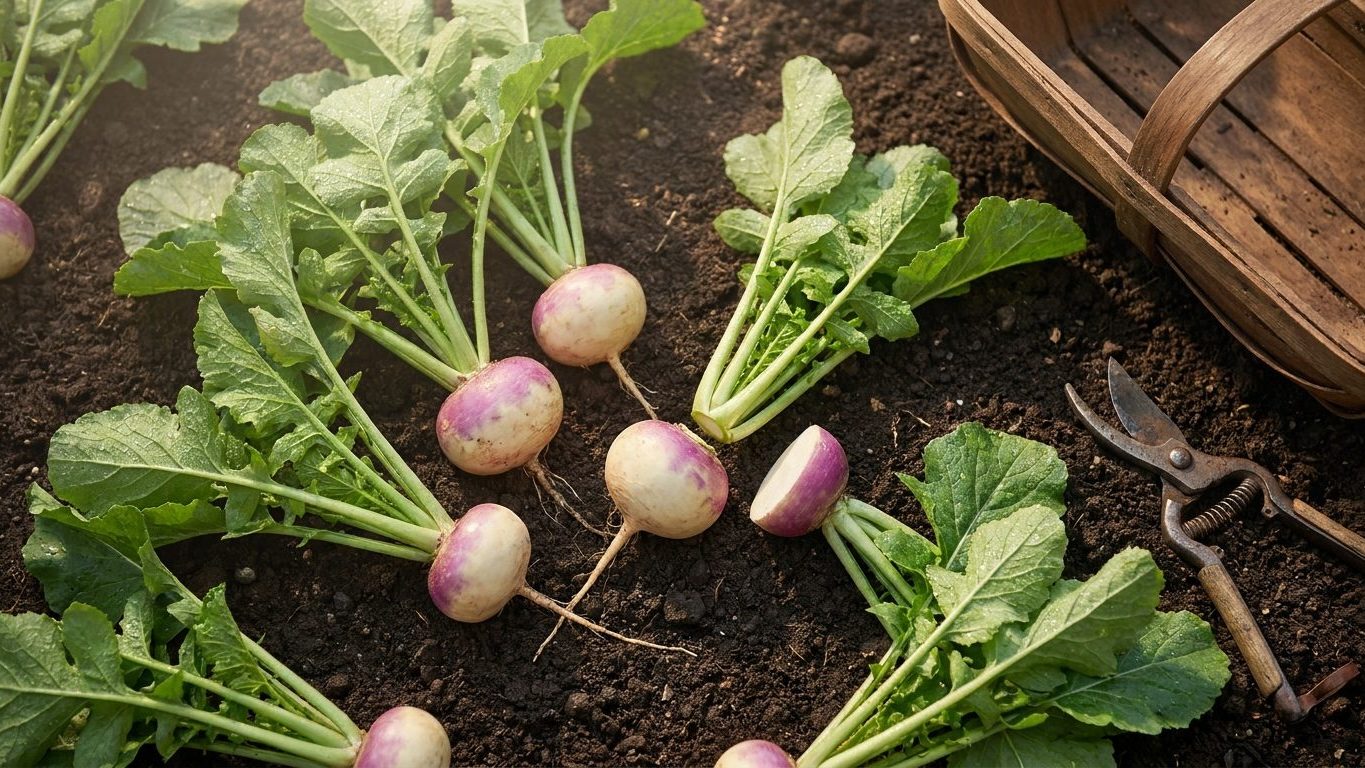

Turnip and rutabaga leaves are edible, nutritious, and in some strains the entire reason a gardener plants the seed. Most home growers compost them anyway, out of habit rather than necessity, tossing the greens on the pile while keeping only the root. That habit costs a second harvest for free.
What is actually going on
The thing to understand here is that the leaf and the root are not two separate crops growing side by side. They are one plant sharing one energy budget. Leaves capture light and turn it into sugars; the root stores a share of those sugars to swell underground. Cut the leaves and you cut the factory that feeds the root. Cut lightly, early, from a plant with plenty of leaf area to spare, and the root barely notices. Cut hard, or cut late, when the plant needs every leaf to finish bulking the root, and the harvest you wanted from below ground simply will not show up.
This is why seed catalogs and extension bulletins sort turnip and rutabaga varieties into rough types instead of one generic plant. Some types are bred and selected almost entirely for leaf production, with roots that stay small, fibrous, and unremarkable on purpose. Others are bred for the opposite: a root that bulks large and stores well, carried by leaves that are coarser, often waxier, and not bred for tenderness on the plate. In between sit dual-purpose types that give a reasonable showing of both, provided the gardener does not ask for too much of either. No two seed racks list quite the same names, and a variety that performs one way in a Georgia trial can behave differently on a Vermont hillside. The honest move is to talk in types, not names, and to check the current variety trial results from your own state extension service before choosing seed.
Turnip is Brassica rapa and rutabaga is Brassica napus, but both belong to the same brassica family as cabbage, kale, collards, and mustard. That matters more than it sounds. Flea beetles, cabbage aphids, cabbage worms, and diseases like clubroot and downy mildew move freely between all of these crops, reading them as one buffet rather than several. A garden bed that grew cabbage last season and turnips this season has not rotated anything, no matter what the calendar says. Planning turnip and rutabaga into a real rotation with non-brassica crops is worth its own read on our brassica rotation guide.
In the garden
How much leaf a gardener can take without shortchanging the root depends on the stage of growth and the purpose of the planting. The table below breaks it down by moment, with the failure mode spelled out for each, because a list of correct answers with no explanation of the wrong ones teaches nothing.
| Stage or purpose | What to take | What goes wrong if you take too much |
|---|---|---|
| Young seedlings, thinning stage | A few outer leaves per plant, thinned rather than stripped | Root development stalls before it starts; the seedling has no reserves left to establish |
| Dual-purpose type, mid-season | Outer, older leaves only, leaving the crown and inner leaves intact | Cutting into the growing point stops regrowth entirely and the root never resumes bulking |
| Root-focused type, approaching maturity | Little to none in the weeks before expected root swell | Root stays small and fibrous instead of filling out, even if it is left in the ground longer |
| Leaf-only type, full season | Continuous cutting of outer leaves, no root expected | Left uncut in heat, plants bolt and the leaves turn bitter and tough fast |
| Rutabaga, any type | Very light harvest only, since rutabaga leans on a longer season and a bigger stored root | Overharvesting leaves a plant with a long season ahead and no way to make up lost energy |
Rutabaga deserves its own line in that table because it behaves differently from turnip in ways gardeners underestimate. It typically needs a longer stretch of cool growth to size its root, which means the leaf canopy is doing sustained work over a longer window. A turnip planting can sometimes recover from a rough harvest because its season is shorter and forgiving; a rutabaga planting has less room to absorb the same mistake.
Once roots come out of the ground, whether you harvested leaves along the way or not, the storage question is separate from the growing question. Do not judge a root safe to keep just because it looks sound on the outside. Check the crown where the leaves were attached, check for any soft patch anywhere on the skin, and check for a weeping spot that suggests broken tissue underneath. Any one of those ends the question. That root goes to the kitchen now or to the compost, not to the root cellar.
What it depends on where you are
Some of this page is true everywhere turnips and rutabagas grow. The mechanism, leaf feeds root, is biology, not geography. But how much leeway a gardener has to harvest both leaves and root from the same planting is shaped by things this page cannot know about your yard: how long your cool season runs, how hard your summer heat arrives, and how much rain falls while the crop is in the ground.
A longer, milder growing season gives more room for a light leaf harvest without threatening the root, simply because the plant has more total time to recover the energy it spent regrowing leaves. A shorter season, or one that flips fast from cool to hot, punishes any leaf harvest that slows the root down, because there is no slack left in the calendar. Heat also changes the leaves themselves. Turnip and rutabaga greens grown through a stretch of high heat tend to toughen and turn bitter faster, and heat pushes the whole plant toward bolting, which ends leaf quality regardless of harvest habits.
Rainfall carries its own set of consequences, mostly through disease and pest pressure rather than through the plant’s energy budget directly. Wet, humid conditions favor the leaf diseases that spread across brassicas, while dry stretches shift pressure toward flea beetles and aphids instead. Neither pattern is universal, and both can flip within a single season in the same yard.
None of that can be answered in general terms with any honesty. Our state-by-state growing guides narrow things down to regional patterns, and your local Cooperative Extension office goes further still, with trial data and pest pressure specific to your county. The USDA’s land-grant extension directory is the fastest way to find yours.
The mistake that costs the most
The single costliest error is treating a root-focused type as though it were a leaf type, on the assumption that a plant will simply regrow whatever gets cut. It will not, at least not without a cost paid somewhere else in the plant. A gardener who plants seed meant to bulk a large storage root, then harvests leaves through the season the way they would from a dedicated greens crop, ends up with neither. The root stays undersized and the leaves, taken from a variety never selected for tenderness, are often coarser eating than what a leaf-type would have offered anyway.
The fix starts before the seed goes in the ground, not after the first cutting. Decide what this planting is for. If the goal is a root worth storing, choose a type suited to that and harvest leaves sparingly, if at all, and never in the weeks leading up to expected root maturity. If the goal is greens, choose a type bred for that purpose and stop expecting much from underground. If both matter, a dual-purpose type with a light, outer-leaf-only harvest is the honest middle path, not a root-focused type pushed to do double duty.
Two smaller habits reinforce the fix. Keep turnip and rutabaga out of any bed that grew cabbage, kale, collards, or mustard the previous season or two, since all of them share the same brassica pests and soil diseases and a short rotation solves nothing. And when the roots finally come up, inspect before you store: a soft patch, a weeping spot, or a moldy crown means that root is done, no matter how solid the rest of it looks. Getting the type right at planting and the inspection right at harvest is what actually separates a garden that gets two crops from one plant from a garden that composts half of what it grew.