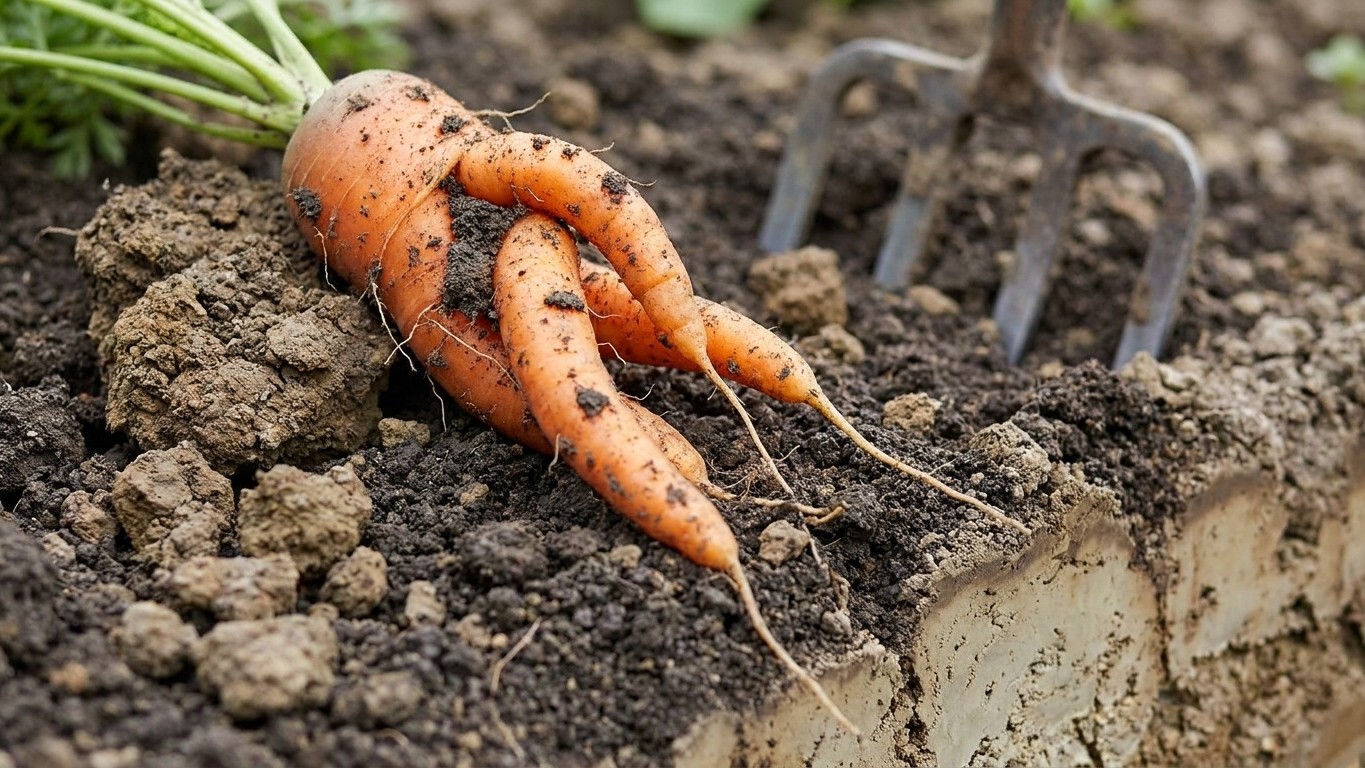

Pull carrots when the shoulder, the top of the root right at the soil line, reaches about three-quarters of an inch to an inch and a quarter across, and the color has gone from pale to deep orange. That’s the signal to trust. As a rough calendar backup, Clemson Cooperative Extension counts 65 to 75 days from seeding to harvest, while Utah State University Extension puts full maturity anywhere from 70 to 100 days depending on the variety and how the season runs.
When carrots are ready in Alabama
Two numbers, two extensions, and neither is wrong. Clemson’s window of 65 to 75 days reflects a straightforward harvest target for home gardens across the Southeast. Utah State’s wider 70 to 100 day range accounts for variety differences and slower growth in cooler or less ideal conditions. Alabama’s warm growing season tends to push carrots toward the faster end of that spread, but the root itself is still the better judge than the calendar square.
Scratch back a little soil at the top of a root or two before committing to a full pull. A shoulder still thin as a pencil needs more time. One that’s filled out and colored deep orange, with the top of the root sitting slightly proud of the soil surface, is ready now. Carrots don’t ripen the way a tomato does, with a hard stop, so a few extra days or even weeks in the ground rarely hurts flavor or size. Left too long, though, roots can get woody in the core or split from the inside.
Soil texture changes the pace
Alabama’s official state soil, the Bama series, is sandy (67 percent sand) and well drained, with a naturally acid surface pH around 5.3 and low organic matter near 0.8 percent. Loose, sandy ground like that lets a root size up evenly and push straight down without resistance. Heavier or rockier soil does the opposite: it slows sizing and forces roots to fork around obstructions, according to Utah State University Extension guidance on carrot growing conditions. The Bama series is a representative statewide profile, not a description of any one backyard. A garden built on river-bottom silt or compacted fill dirt from construction will behave nothing like it. A basic soil test at planting time settles what a state map can’t.
Keeping them, and for how long
Getting carrots out of the ground on time is only half the job. Clemson Cooperative Extension’s Home & Garden Information Center is specific about what happens next: store carrots at 33°F and high humidity to prevent wilting. That figure is worth pinning down, because 33°F sits just a few degrees above freezing, not the 45 to 50°F range a lot of people assume counts as “cold storage.” A root held at 50°F instead of 33°F won’t fail overnight, but it will soften and start sprouting in a fraction of the time.
The tops matter more than most gardeners expect. Clemson notes that bunched carrots, meaning the roots still wearing their leafy tops, keep for about 10 to 14 days. Trimmed carrots, with the foliage cut off close to the crown, last considerably longer under the same cold, humid conditions, because the leaves are no longer pulling moisture out of the root to keep themselves alive. Cutting the tops within a day of harvest is the single change that does the most for storage life.
None of these numbers are a guarantee. They describe a maximum, under close to ideal conditions of temperature and humidity held steady the whole time. A carrot bin that swings from 33°F one week to 55°F the next won’t come close to 10 to 14 days, let alone longer. Humidity matters just as much as temperature. Carrots stored dry, uncovered, in open air lose moisture and go limp well before any pest or rot problem shows up. A loosely closed perforated bag, or a layer of damp sand in a container, holds the humidity that bare shelving can’t.
Where in the house that actually is
Most home refrigerators run colder in the main compartment than 33°F, sometimes down near freezing, which can be harder on carrots than it sounds since ice crystals damage the cell walls and turn a firm root soft and translucent once thawed. The crisper drawer, set to the higher-humidity setting if the fridge has one, is usually the closest match in an Alabama kitchen to what Clemson describes. A refrigerator thermometer left in that drawer for a day is the only way to know for sure what a specific model actually runs. Kitchen appliances vary enough between brands and even between shelves that guessing gets expensive fast.
A heated living space is too warm for any meaningful carrot storage no matter the season; room temperature in an Alabama house sits well above the 33°F target even with the air conditioning running hard through a long summer. An unheated garage or an outdoor storage building swings with the outside air, which in much of the state means uncomfortably warm stretches from spring through fall and occasional near-freezing nights in winter, neither of which holds steady at the target. Traditional root cellars, dug into the ground to hold a stable cool temperature, are rare in Alabama’s warmer, humid climate compared to states further north, so most home growers are working with the refrigerator whether they’d prefer another option or not.
Skipping the thermometer check costs more than it seems to. A crisper drawer that reads 40°F instead of 33°F won’t ruin a batch of carrots in a day, but over the 10 to 14 days Clemson describes for bunched roots, that gap adds up to noticeably softer, less crisp carrots by the end of the window rather than the beginning.
What goes wrong here
Forked, twisted roots are the most common complaint, and the state soil profile explains why it happens so often. Ground with more clay than the sandy Bama series, or soil compacted by foot traffic and heavy equipment, blocks a straight taproot and sends it branching around whatever it hits. Utah State University Extension is direct about the fix: work in plenty of compost and double-dig the bed rather than hoping a different variety solves a soil problem. A raised bed filled with a loose, sandy-loam mix sidesteps the issue entirely for anyone gardening on Alabama’s heavier clay.
A damp, humid stretch of weather right at harvest time is the second trap. Carrots pulled into wet soil and left in a pile, even briefly, pick up moisture and soil contact that speeds rot once they’re bagged up. Brushing off loose soil (not washing, which adds moisture back) and getting roots into cold storage the same day cuts that risk substantially.
A bigger glut than any household can eat is the third, quieter problem. Carrots that stay in the ground because nobody’s ready to process a full row keep growing past their ideal size, and the ones that do get pulled all at once overwhelm a single crisper drawer’s worth of cold storage. Succession planting smaller batches, rather than seeding one long row all at once, spreads the harvest and the storage load out instead of dumping it all in one week. On the pest side, the Alabama Cooperative Extension System documents aphids and spider mites among the pests likely to show up on garden crops in the state; either can weaken foliage enough to slow root sizing if left unchecked, though neither is unique to carrots.
Common questions
Can carrots stay in the ground past their day count?
Yes, within reason. Since the day ranges from Clemson and Utah State are guidelines rather than deadlines, a root that hasn’t hit full shoulder size at day 65 or day 70 can stay put. Watch for woodiness or splitting as the upper limit.
Do carrots need to be washed before storage?
Brushing off loose, dry soil is enough. Washing adds surface moisture that speeds softening and rot during the storage window Clemson describes, even under correct temperature and humidity.
Is a root cellar worth building for carrots in Alabama?
For most home gardeners, no. The state’s warmer, humid climate makes a traditional in-ground cellar harder to keep at a stable low temperature than it is in cooler regions, and a refrigerator crisper drawer checked with a thermometer gets closer to the 33°F target with far less effort.
Why do some carrots come out forked or split?
Forking traces back to heavy or rocky soil blocking the taproot, not to the seed or variety. Splitting usually shows up on roots left in the ground well past full size, often after uneven watering swells the root faster than the skin can stretch.