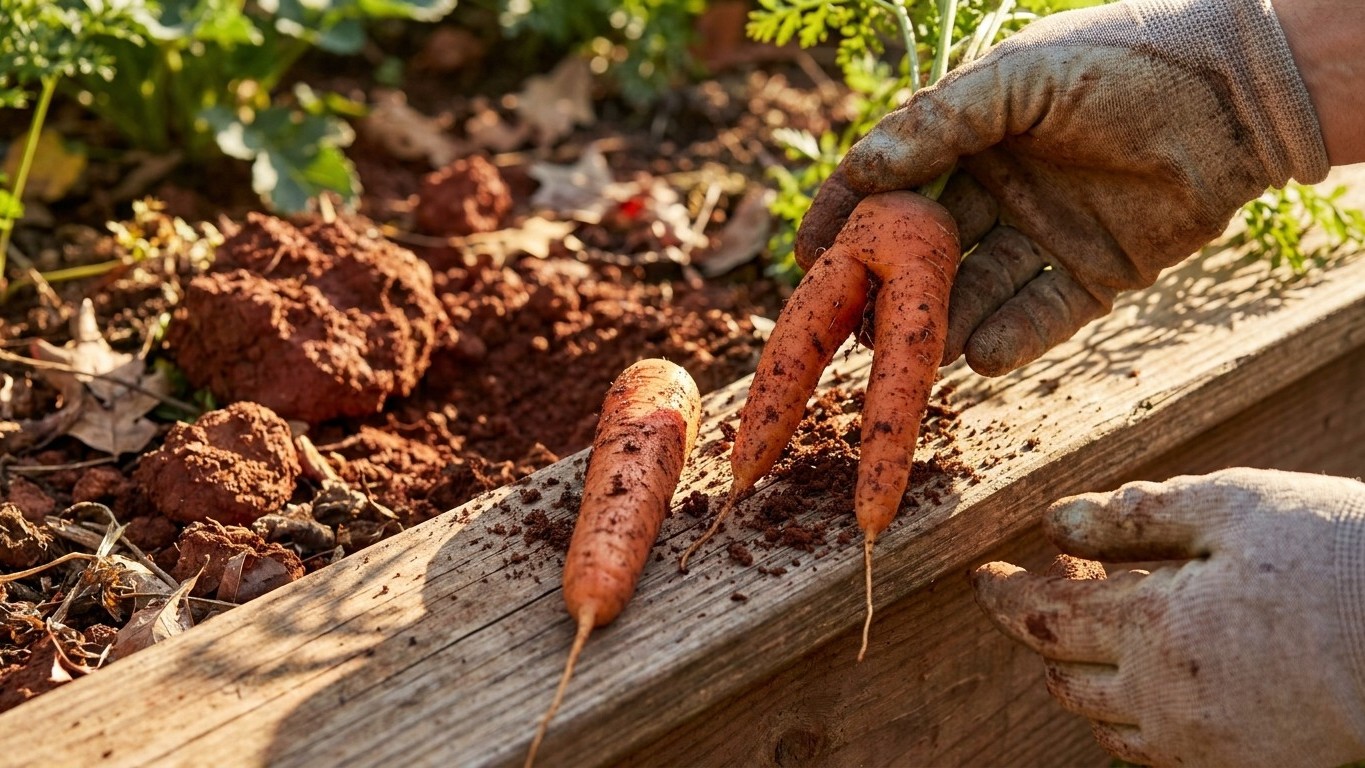

Alabama’s state soil, the sandy, well-drained Bama series, gives carrots a fighting chance at growing straight where it’s found. But that soil covers only part of the state, and plenty of Alabama gardens sit on heavier clay that will fork a carrot every time. The real answer depends on what’s under your own boots, not the map.
The short answer
Alabama’s official state soil is the Bama series, named by state law and classified as an Ultisol, an old, heavily weathered and leached soil type common across the Southeast. The surface horizon runs about 67 percent sand, 14 percent clay and 19 percent silt, according to USDA NRCS records for the series. That’s a sandy profile, and it drains well. The tradeoff is fertility: organic matter sits around just 0.8 percent, and the surface tests strongly acid, with a pH near 5.3.
Utah State University Extension is blunt about what carrots need to grow a single, unforked taproot: deep, sandy, well-drained soil rich in organic matter. Heavy or rocky ground makes the root split and fork as it pushes down and hits resistance, forcing it sideways or into two prongs. On that count, ground that resembles the Bama series has the right texture and drainage already built in. What it’s missing is the organic matter. At 0.8 percent, there’s not much cushioning for a growing root, and not much nutrient reserve either.
So if your garden sits on soil like this, the fix isn’t a different variety or a raised bed out of necessity. It’s compost, worked in generously before you sow, and enough depth that the taproot has nowhere to hit a wall. Extension guidance calls for exactly that combination in heavy soil: plenty of compost and double digging to loosen the profile a foot or more down. In sandy, well-drained ground, the same compost addition mostly just feeds the crop rather than rescuing it from a structural problem.
None of this describes every backyard in Alabama, and it shouldn’t be read that way. A single state can span hundreds of distinct soil series, shaped by different parent rock, drainage history and generations of farming or construction. The Bama series is the one lawmakers picked to represent the state as a whole, not a survey of what’s under your tomato bed. River bottoms tend to run heavier and wetter. Hill country in the northern part of the state often sits on shallower, rockier ground. Anywhere a builder has scraped topsoil and brought in fill, the original series underneath tells you almost nothing about what’s there now. Treat the state soil as a general tendency, sandy, acidic, low in organic matter, well drained, and then go find out what you’re actually working with.
The test that settles it in your own garden
- Dig a hole at least 12 inches deep in the spot where you plan to sow carrots. Look at the sides as you go. Note any hard, compacted layer, any sudden color change, or a dense clay band that would stop a taproot cold.
- Check what you pulled out for stones, gravel and hard clumps in the top foot of soil. Carrots fork around obstacles they can’t push through, so anything solid in that zone is a red flag regardless of what the county soil map says about your area.
- Grab a handful of moist soil from that hole and rub it between your fingers. Sandy soil feels gritty and falls apart. Clay feels sticky, smears, and can be rolled into a ribbon between your thumb and finger. Silt feels smooth, almost like flour, and holds a shape without much stickiness.
- Refill the same hole with water and watch how it behaves. Water that disappears quickly points to a sandy, well-drained profile similar to the Bama series description above. Water that sits for a long stretch before soaking in points to clay-heavy ground that will need amending or a raised bed before carrots go in.
- Compare what you found against the state soil profile: sandy, well drained, low in organic matter, strongly acid at the surface. The closer your dig matches that description, the more the compost-and-depth approach from Utah State University Extension applies directly. The more it diverges, especially toward heavier, stonier, slower-draining ground, the more seriously you should consider a raised bed filled with a loose, sandy-loam mix instead of fighting the native soil in place.
What goes wrong here
- Forking in heavy ground. Where the native soil runs closer to clay than the sandy Bama profile, a carrot’s taproot hits resistance early and splits into two or more prongs, or bends sideways looking for softer ground. Utah State University Extension’s fix is direct: work in plenty of compost and double dig the bed a foot or more deep before sowing, so the root has loose material the whole way down.
- Poor germination in a hot spell. Carrot seed is small and slow to sprout under the best conditions, and a hot, dry surface layer can crust over before the seed ever breaks through. Keeping the top inch of soil consistently moist, with light, frequent watering or a thin mulch layer, gives the seed the steady moisture it needs to germinate rather than sitting dormant or drying out.
- Splitting from uneven water. A dry stretch followed by a heavy rain or a deep watering can cause a carrot root to swell suddenly after a period of slow growth, splitting the skin open. Keeping the watering schedule steady rather than feast-or-famine, and mulching to hold moisture evenly between waterings, keeps the root growing at a consistent rate instead of lurching.
- Thin organic matter compounding a heavy texture. The Bama series surface tests around 0.8 percent organic matter, and a garden bed that’s been worked for years without regular compost additions can end up lower still. Low organic matter means less structure to resist compaction and less capacity to hold moisture evenly, both of which feed directly into the forking and splitting problems above. Working in compost each season, rather than as a one-time fix, addresses the root cause instead of one symptom.
Common questions
Does Alabama’s soil acidity affect carrot growth?
The Bama series surface tests strongly acid, around pH 5.3, according to USDA NRCS data. That figure describes the mapped series, not your bed specifically, so it shouldn’t be treated as your garden’s pH. If your own soil test comes back acidic, that’s a separate question from forking, tied more to nutrient availability than to root shape, and it’s worth addressing on its own terms with a soil test rather than assuming the state figure applies to you.
What carrot variety resists forking in heavy soil?
Utah State University Extension’s guidance on this point focuses on soil preparation, not variety selection, and doesn’t name a specific fork-resistant type. The fix it lays out, compost plus double digging, or a raised bed with looser material, applies regardless of which carrot seed you plant.
How deep does the soil need to be prepared for carrots?
Extension guidance calls for double digging heavy soil, which means loosening the ground well beyond the top few inches, roughly a foot or more, so the taproot has no compacted layer to hit as it grows down. A raised bed built to a similar depth with a loose, sandy-loam fill accomplishes the same thing without disturbing the native ground.
Since carrots are sown directly, when should I count the days to harvest from?
Carrots are sown in place and never transplanted, so the growing timeline runs from the seeding date, not from any later transplant. Any days-to-maturity figure on a seed packet should be read against the day you put seed in the ground.