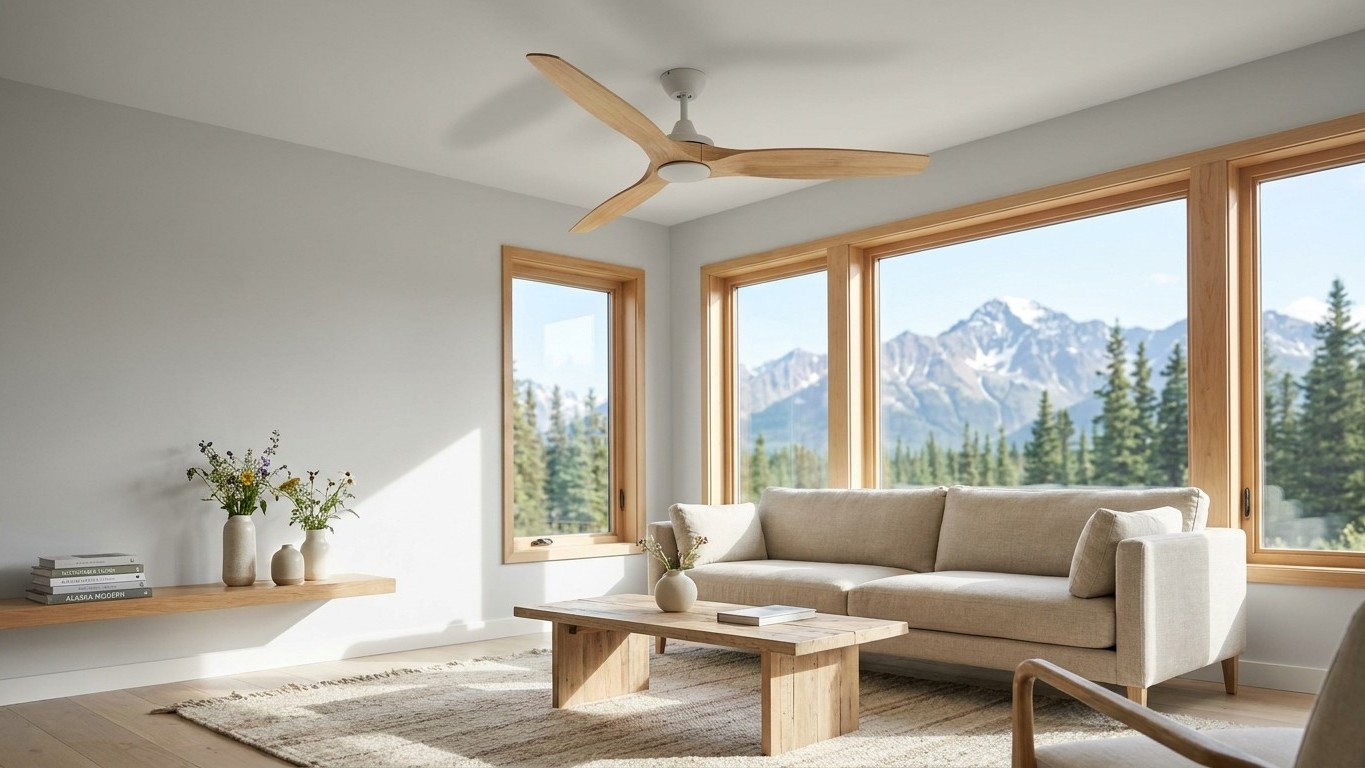

95% of Nebraska homes run some form of air conditioning, and the overwhelming majority of that cooling comes from a central system built into the house rather than a window unit or portable. Ceiling fans back up the mechanical cooling in most homes too. That’s the short answer, the rest is what shapes it and what it means for upkeep.
What homes in Nebraska actually cool with
The numbers from the U.S. Energy Information Administration’s Residential Energy Consumption Survey are specific: 95% of Nebraska homes use air-conditioning equipment of some kind, 86% run a central air-conditioning unit, and 14% rely on an individual unit, meaning a ductless mini-split, a window or wall unit, or a portable. Ceiling fans show up in 79% of homes, doing supplementary work rather than replacing mechanical cooling.
What’s worth noticing here is how tight the gap is between “has air conditioning” and “has central air.” In some states that gap is enormous. Connecticut, for instance, has air conditioning in 90% of homes but a central system in only 34% of them, meaning most of the cooling load there rides on window and wall units. Nebraska isn’t that state. With 86% central against 95% total, the individual-unit share sits at 14%, which tells you central ductwork is the default here, not the exception, and it has been for long enough that most of the housing stock was built with it in mind or retrofitted to include it.
That distribution follows construction history more than climate preference. A share of homes running on central air reflects what got built into the house when it went up, and later, what got added when owners upgraded. It isn’t a verdict on which system cools better, a well-maintained window unit in a small addition or a converted porch can do its job just fine. But it does mean that in Nebraska, the ducted system is the one most homeowners will actually be maintaining, sizing, and troubleshooting, and the individual-unit slice is a minority use case: supplemental cooling in a bonus room, a workshop, or an older home where extending ductwork wasn’t practical.
None of this is a recommendation for what a new build or renovation should install. It’s a record of what’s already out there. A homeowner shopping for a first air conditioner in Nebraska is shopping into a market where central systems dominate, parts and service technicians are geared toward that equipment, and the 14% running mini-splits or window units are the exception rather than the rule.
How much cooling the year actually asks for
NOAA’s Climate Normals for 1991-2020, measured at the Omaha reference station, put the mean count at 28.1 days a year reaching 90°F or more. That’s a count of days at one weather station, not a statewide average and not a temperature reading. It’s the number that matters for cooling load: it tells you how many days a year the outdoor air is hot enough that a house needs real mechanical help staying comfortable, not just a fan and an open window.
Twenty-eight days is a moderate number as these things go, hot enough to matter, but nowhere near the triple-digit day counts some southern states rack up. It sits solidly in the range where central air conditioning earns its keep across a full cooling season rather than sitting idle most of the year.
Here’s where it gets useful. The equipment mix and the heat load don’t automatically line up. A state can post a high day count and still lean heavily on window units, usually because a lot of its housing predates central air or was built without ductwork. Another state can have a mild summer and still run almost entirely on central systems, because that’s simply how the homes were built. The heat load and the installed equipment are two separate stories that happen to intersect or not.
In Nebraska, they line up. A meaningful heat load of 28.1 days above 90°F pairs with a housing stock that’s 86% central. That’s not a coincidence so much as a consequence: enough hot days to justify whole-house cooling, and a construction era and climate history that made ducted systems the standard answer rather than a room-by-room patchwork. A homeowner here isn’t fighting an undersized or mismatched setup relative to what the summer demands, the equipment on the ground matches the load the calendar hands out. That doesn’t mean every individual house is sized correctly, only that the state-level pattern isn’t a case of hot summers forcing people into window units because central air was never installed.
Wet heat or dry heat, and what it changes
Summer in Nebraska brings about 12.6 inches of rain across June, July and August, out of 31.9 inches for the full year, based on NOAA’s 1991-2020 monthly normals at the same reference station used for the temperature figures. July is the driest of the three summer months at 3.55 inches, with June at 4.44 and August at 4.6. That’s a measure of precipitation, not humidity or dew point, it says how much rain falls, not how sticky the air feels on a given afternoon.
Even without a humidity figure, the rainfall total tells you something practical about how an air conditioner spends its time. A unit does two jobs at once: it lowers the temperature, and it pulls moisture out of the air. Removing that moisture takes run time, the system has to keep cycling air across a cold coil long enough for water to condense out, and a unit that shuts off too fast never gets there. In a summer with meaningful rainfall spread across the season, like Nebraska’s, a chunk of an air conditioner’s job is drying the air, not just cooling it. A machine sized to blast the temperature down in a hurry and then shut off leaves a house feeling cold and clammy at the same time, because it hit the thermostat setpoint before it finished the moisture-removal part of the job.
The practical fixes here aren’t complicated, but they run against the instinct to buy bigger for faster relief:
- Favor a properly sized system over an oversized one, since a unit that’s too big cools the room quickly and shuts off before it has pulled real moisture out of the air.
- Let the system run longer cycles rather than short blasts, which is what actually removes humidity, not just heat.
- Use the “auto” fan setting rather than “on” for central systems, so the blower doesn’t keep circulating air past the point the coil has stopped condensing moisture.
Sizing a room unit, from the published chart
ENERGY STAR publishes a cooling-capacity chart for room air conditioners that ties square footage to BTU-per-hour capacity. It’s reproduced below exactly as published, with no rows added and no interpolation between the listed ranges.
| Area to be cooled (square feet) | Capacity needed (BTU per hour) |
|---|---|
| 100 up to 150 | 5,000 |
| 150 up to 250 | 6,000 |
| 250 up to 300 | 7,000 |
| 300 up to 350 | 8,000 |
| 350 up to 400 | 9,000 |
| 400 up to 450 | 10,000 |
| 450 up to 550 | 12,000 |
| 550 up to 700 | 14,000 |
| 700 up to 1,000 | 18,000 |
| 1,000 up to 1,200 | 21,000 |
| 1,200 up to 1,400 | 23,000 |
This chart is a starting point for a single room, not a method for sizing a whole-house system. A central air conditioner is sized through a load calculation that accounts for the entire building envelope: insulation levels, window area, orientation, ductwork, and more. Since 86% of Nebraska homes run central air, this table isn’t where most of the state’s cooling capacity gets decided, it applies mainly to the 14% of homes leaning on individual units, or to anyone adding a window unit or portable to a room the main system doesn’t reach well.
Oversizing is the mistake to avoid, and it isn’t a safety margin, it’s a fault. A unit rated well above what a room calls for cools the air fast, shuts off, and never runs long enough to pull moisture out. In a state with a wet summer stretch like Nebraska’s, that’s the exact failure mode described above: a cold room that still feels damp. Matching the chart’s range to the actual square footage, rather than rounding up “to be safe,” is the better bet.
What actually needs looking after here
With central systems running in 86% of Nebraska homes, the maintenance that matters most here is ducted-system upkeep, not the checklist for a window unit. ENERGY STAR’s own guidance starts with the cheapest, most-skipped task there is: “Inspect, clean, or change air filters once a month in your central air conditioner, furnace, and/or heat pump.” That’s monthly, not seasonally, and it covers all three pieces of equipment together, which matters for anyone who assumed filter care was a furnace-only chore.
A dirty filter doesn’t announce itself as a broken system. ENERGY STAR notes that “airflow problems can reduce your system’s efficiency by up to 15 percent,” which means a unit can be running, cooling, and never throw an error code, while still working harder than it should to hit the same temperature. That’s the case for treating the filter check as a monthly habit rather than something to remember when the house starts feeling warm.
Because central air is the norm here, ductwork condition is worth a look too. ENERGY STAR states that “in a typical house, however, about 20 to 30 percent of the air that moves through the duct system is lost due to leaks, holes, and poorly connected ducts.” That’s air paid for and never delivered, and it explains why a room can stay stubbornly warm even when the system itself is working fine, the cooled air simply doesn’t reach the vent. This caveat doesn’t apply to the state’s individual-unit households, since a window or wall unit has no ducts to leak from, but for the 86% on central systems it’s a real place to lose performance.
A seasonal pass covering the essentials looks like this:
- Check or change the filter monthly through the cooling season, not just once at the start of summer.
- Have ductwork inspected for leaks and poor connections, particularly in older homes where the system predates current sealing standards.
- Confirm the outdoor unit has clear airflow around it, and that vents inside aren’t blocked by furniture or curtains.
For equipment-specific detail, central air conditioner and heat pump maintenance guides on this site cover the deeper checks worth scheduling with a technician each year.