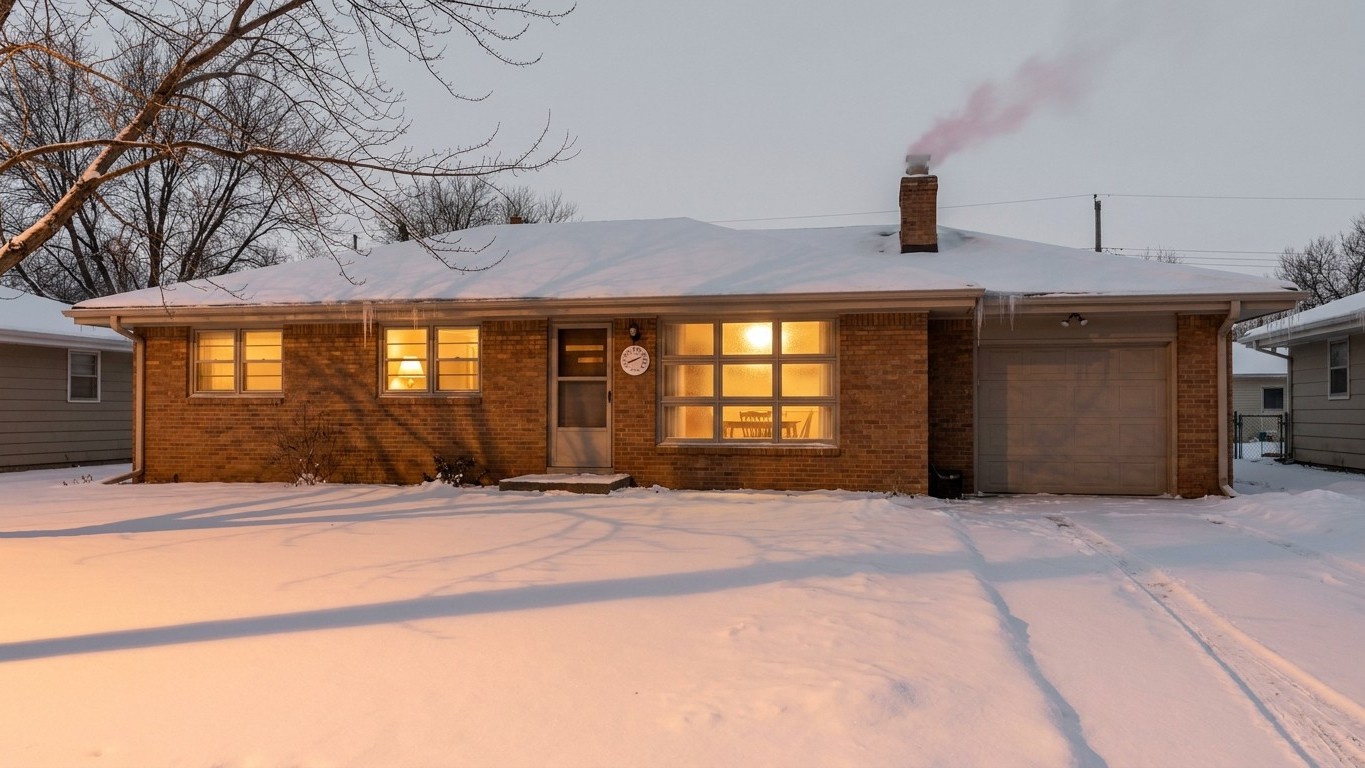

Nebraska winters mean a heating season that runs long and hits hard enough to reshape a household budget. Here’s what actually drives the cost: how cold it gets, how many months you’re fighting it, and if wood’s in the mix, what a cord really buys you.
How cold it gets, and for how long

The average daily minimum in the coldest month sits at 15.2°F at the Omaha reference station, based on NOAA’s 1991-2020 Climate Normals. That’s not a record low grabbing headlines during a cold snap. It’s the ordinary overnight low for the coldest stretch of the year, night after night.
That number matters more than any single-day extreme because it tells you how a furnace behaves over the long haul. A system running against 15-degree air isn’t cycling on for twenty minutes here and there. It’s laboring for hours, then doing it again the next night, then the night after that, from roughly November through March.
Compare that to a milder heating climate where the coldest-month minimum hovers closer to freezing. In that scenario, a furnace idles more than it strains. In Nebraska, the equipment works closer to its rated capacity for a much larger share of the season, which is exactly why sizing and insulation decisions here carry more weight than they would somewhere with a shorter, gentler cold stretch.
It also means the heating season itself stretches wide. Four to five months of consistent demand isn’t unusual across the state, and that duration is often a bigger cost driver than the occasional arctic outbreak. A single brutal week is a blip. Five months of steady sub-freezing nights is the actual budget line.
For anyone weighing supplemental heat sources, wood included, this is the backdrop: a long season with a genuinely cold baseline, not a mild winter with a few rough patches.
What a cord of wood is worth here
A cord isn’t a weight. It’s a volume, stacked 4 feet high, 4 feet deep, and 8 feet long, which works out to 128 cubic feet of space. That distinction is where a lot of firewood buyers get shorted, because a loosely thrown pile of short, crooked splits can occupy that same footprint while containing a fraction of the actual wood.
According to Michigan State University Extension, a cord of well-seasoned hardwood carries about 20 million BTU. MSU frames that in terms a homeowner can actually use: roughly the heat equivalent of 145 gallons of #2 fuel oil, or 215 gallons of LP gas. That’s the kind of comparison that makes the number mean something instead of just sitting there.
Cord dimensions at a glance
| Measurement | Value |
|---|---|
| Height | 4 feet |
| Depth | 4 feet |
| Length | 8 feet |
| Total volume | 128 cubic feet |
| Heat content (seasoned hardwood, average) | about 20 million BTU |
Given a heating season that runs four to five months against a 15.2°F coldest-month minimum, one cord is rarely a whole-winter answer on its own for anyone relying on wood as a primary source. It’s a meaningful chunk of supplemental heat, or a solid contribution alongside a furnace, but the math depends heavily on how much of the house’s heat load wood is actually meant to cover.
The 20 million BTU figure is an average. Species density and, more than anything, moisture content push that number up or down substantially. A cord of dense, properly dried hardwood delivers close to that figure. A cord of the same species still holding excess water delivers a lot less usable heat, because energy that should be warming the house gets spent boiling off water first.
How long wood takes to dry in Nebraska
MSU Extension puts the target at 20 percent moisture or less for good burning. Green, freshly cut wood can sit above 60 percent moisture, which is a steep gap to close. Split and stacked properly so air moves through the pile, wood typically reaches that 20 percent mark after one full summer of seasoning.
That’s a real caveat worth repeating: split and stacked, not left in rounds. Whole rounds dry from the outside in at a crawl, and a pile shoved against a fence with no airflow behaves nothing like one stacked with gaps for wind to pass through. The seasoning clock doesn’t start until the wood is actually split and exposed.
Red oak is the named exception. MSU points out that its cell structure slows moisture release, so it needs more time than the one-summer rule of thumb suggests. Anyone burning a lot of red oak should plan on a longer wait, not the standard timeline.
Burning too soon has consequences beyond a smokier fire. Wet wood spends its potential heat evaporating internal water instead of warming a room, so the same volume of wood puts out noticeably less usable heat. That incomplete combustion also deposits more creosote in the flue, which means a chimney needs sweeping sooner than it would with properly dried fuel. None of this is dangerous if it’s caught early, but it’s the kind of maintenance bill that sneaks up on someone who assumed “it’s been sitting outside for a couple months” was good enough.
Nebraska’s summer heat and generally low humidity actually work in a wood-burner’s favor for hitting that one-season target, provided the stack is set up to let air do its job.
Where to check before you buy
Everything above describes conditions around Omaha, the NOAA reference station for this data. Nebraska stretches from the Missouri River bluffs to the High Plains near the Wyoming and Colorado borders, and elevation, wind exposure, and local microclimate shift the details from one county to the next.
For guidance tailored to a specific area, the University of Nebraska-Lincoln Extension is the right place to start. They can speak to which firewood species are actually available and well-suited to local conditions, along with practical seasoning advice for the area.
Burn restrictions are also worth checking directly rather than assuming. These rules are set at the local or county level, tied to air quality conditions, and they can change from year to year. What was allowed last winter isn’t a guarantee for this one. A quick call or check with local county offices or the extension service before stocking up on wood saves the headache of finding out mid-season that conditions have shifted.