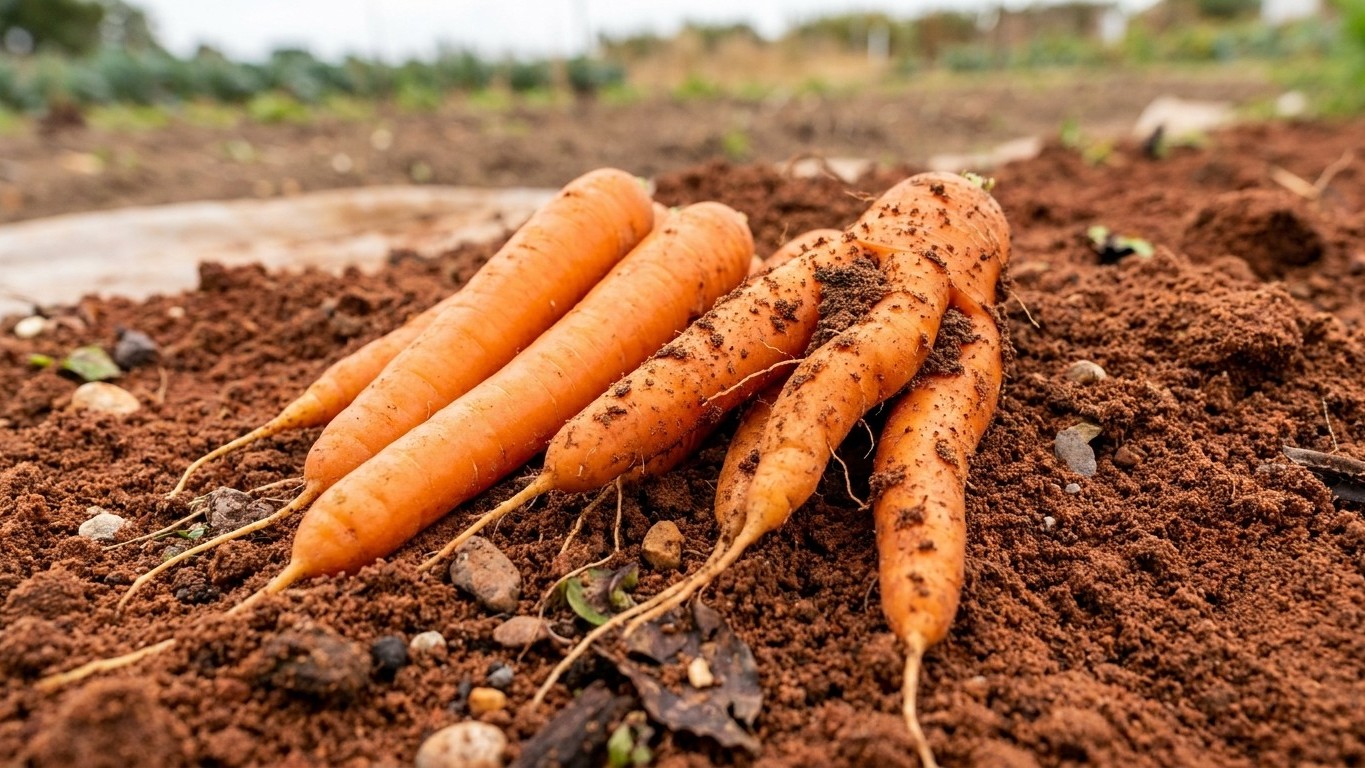

The root itself tells you when to pull it: once the shoulders push up through the soil line and the foliage starts yellowing at the tips, the carrot is ready, somewhere between 65 and 100 days from the day the seed went in, depending on which extension service you ask. What happens after that pull matters just as much. Get the temperature and humidity wrong in storage, and weeks of garden work vanish in a matter of days.
When carrots are ready in Alberta
Two extension services publish two different windows for the same crop, and both are correct for what they describe. Clemson Cooperative Extension puts harvest at about 65 to 75 days after planting. Utah State University Extension gives a longer span, 70 to 100 days, and it counts that span from the day the seed went into the ground, not from a transplant date, because carrots are sown in place and never moved as seedlings. That gap between the two figures is not a contradiction so much as a reminder that variety, soil, and a cool or warm season all shift the number. The plant’s own signal, shoulders showing at the surface and top growth starting to die back, settles the argument better than any calendar.
Soil texture changes that timeline more than most gardeners expect. Across the mapped agricultural soils of Alberta, the most common profile is a Chernozem, the deep, dark grassland soil the prairies are known for, running loam to silt (37 percent sand, 21 percent clay, 42 percent silt), with organic matter around 5.2 percent and generally good drainage, according to Agriculture and Agri-Food Canada’s Canadian Soil Information Service. That is a favorable starting texture for a root crop. But it is a provincial median, not a reading from any one yard. A garden built on scraped or filled ground, or sitting in a low, heavy pocket, can behave nothing like it.
Utah State University Extension is blunt about what happens when the texture runs heavier than that median: rocky or compacted soil makes the root fork, splitting into two or three legs instead of growing one straight taproot. The fix isn’t a different variety, it’s deeper, looser ground, worked with compost and double digging where the clay content runs high. A simple jar test or a lab soil test settles the question for a specific bed far better than any provincial average can, and it’s worth doing before the next seeding rather than after a season of forked roots.
Keeping them, and for how long
Clemson Cooperative Extension’s Home & Garden Information Center states the storage conditions plainly: keep harvested carrots at 33 °F and high humidity to prevent wilting. That number is not a rough guideline, it’s just above freezing, and it is the figure the source gives, not an average or a rounded estimate. Held there, bunched carrots, meaning the roots still wearing their tops, last about 10 to 14 days.
The tops are the catch. Leaves keep pulling moisture out of the root long after it’s out of the ground, which is exactly why a bunch with foliage attached fades within two weeks while a trimmed root, cut clean at the shoulder, can outlast it by months in the same cold, humid storage. Cutting the tops off before storage isn’t a cosmetic step, it’s the single change that determines whether a harvest lasts through a Prairie winter or turns soft by Halloween.
None of these numbers are a promise. They describe a maximum under close to ideal conditions, meaning steady cold, steady humidity, tops removed, and no bruising during harvest. Skip any one of those and the real shelf life drops well below what the source lists. A root nicked by a garden fork, or stored a few degrees too warm, won’t hold anywhere near 10 to 14 days, let alone the longer window trimmed roots can reach. Treat the figures as the ceiling, not the floor, and plan storage space accordingly rather than assuming every carrot in the bin will perform the same.
Where in the house that actually is
Thirty-three degrees is a narrower target than it sounds. A typical kitchen refrigerator runs somewhere in the mid to high 30s, which is close enough to work if the carrots go in the crisper drawer, trimmed and kept slightly damp, ideally wrapped or bagged to hold the humidity Clemson’s figure calls for. It is not the same as a dedicated root cellar, but for most Alberta households it’s the most reliable stand-in available, and it doesn’t swing with the weather outside the way a garage does.
An unheated basement corner or a genuine cold room gets closer to the ideal, provided it actually sits near freezing rather than at a comfortable room temperature. That’s the part worth checking rather than assuming: a cold room that reads 45 or 50 °F on a real thermometer will let carrots sprout and soften long before the 10 to 14 day mark Clemson describes for bunched roots, and even trimmed roots won’t hold their long window at that temperature. Put a thermometer in the actual storage spot and read it over a few days before trusting a bin, a bag, or a corner of the basement with a season’s harvest.
A garage is the option to be wary of here. Through an Alberta winter it will drop far below freezing, cold enough to turn the roots to mush the moment they thaw, and through the shoulder seasons it can swing warm enough on a sunny afternoon to undo any humidity you built in. Neither end of that swing matches the steady, just-above-freezing target the source describes, which makes a garage the least dependable spot in most houses for this particular crop, regardless of how convenient the shelf space is.
What goes wrong here
A cold room or root cellar that actually freezes is the most common failure in this climate, and it’s a design problem more than a bad season. A storage spot built against an exterior wall, or one without enough soil or insulation above it, will track outside temperatures closely enough to drop well under 33 °F during a hard cold snap, turning firm roots to mush as soon as they thaw. Moving the storage bin to an interior wall, or burying a bin of damp sand a foot or more into the ground, keeps it closer to the steady cold the crop actually wants.
A damp, mild autumn causes the opposite problem: roots that go into storage without curing, or storage boxes with no airflow at all, breed mold before the humidity Clemson calls for ever gets a chance to help. Let the surface dry for a few hours before boxing carrots up, skip the pre-storage wash, and leave some air movement in the container rather than sealing it airtight.
Foliage damage before harvest can force an earlier, all-at-once pull that leaves a household with more carrots than the fridge or cellar can actually hold. Montana State University Extension, Urban IPM, documents grasshoppers and thrips among the pests active in this bordering region’s gardens, alongside brown marmorated stink bug, miller moths, and social wasps, and grasshoppers in particular can strip enough top growth late in the season to push a gardener toward pulling everything early rather than letting roots size up on their own schedule. Staggering the harvest where pest pressure allows, and having trimmed, chilled storage ready before that pull, keeps a good year from turning into a glut nobody gets through before it softens.
Common questions
Do carrots need their tops cut before storage?
Yes. The tops keep drawing moisture from the root after harvest, which is why bunched carrots with foliage attached only last about 10 to 14 days at 33 °F and high humidity, while trimmed roots hold up far longer in the same conditions.
Can carrots be stored in a regular refrigerator?
A kitchen fridge’s crisper drawer, kept damp and used for trimmed roots, is the closest match most households have to the cold, humid conditions Clemson Cooperative Extension describes, though it runs a few degrees warmer than the 33 °F figure the source gives.
Why did my carrots fork instead of growing straight?
Utah State University Extension attributes forking to heavy or rocky soil. Loosening the bed with compost and double digging, or testing the soil to check its actual texture, addresses the cause rather than the symptom.
How long can carrots stay in the ground before pulling?
The window given by extension sources runs from about 65 to 100 days from seeding depending on the source, but the more reliable check is the plant itself: shoulders visible at the soil surface and foliage starting to yellow at the tips.