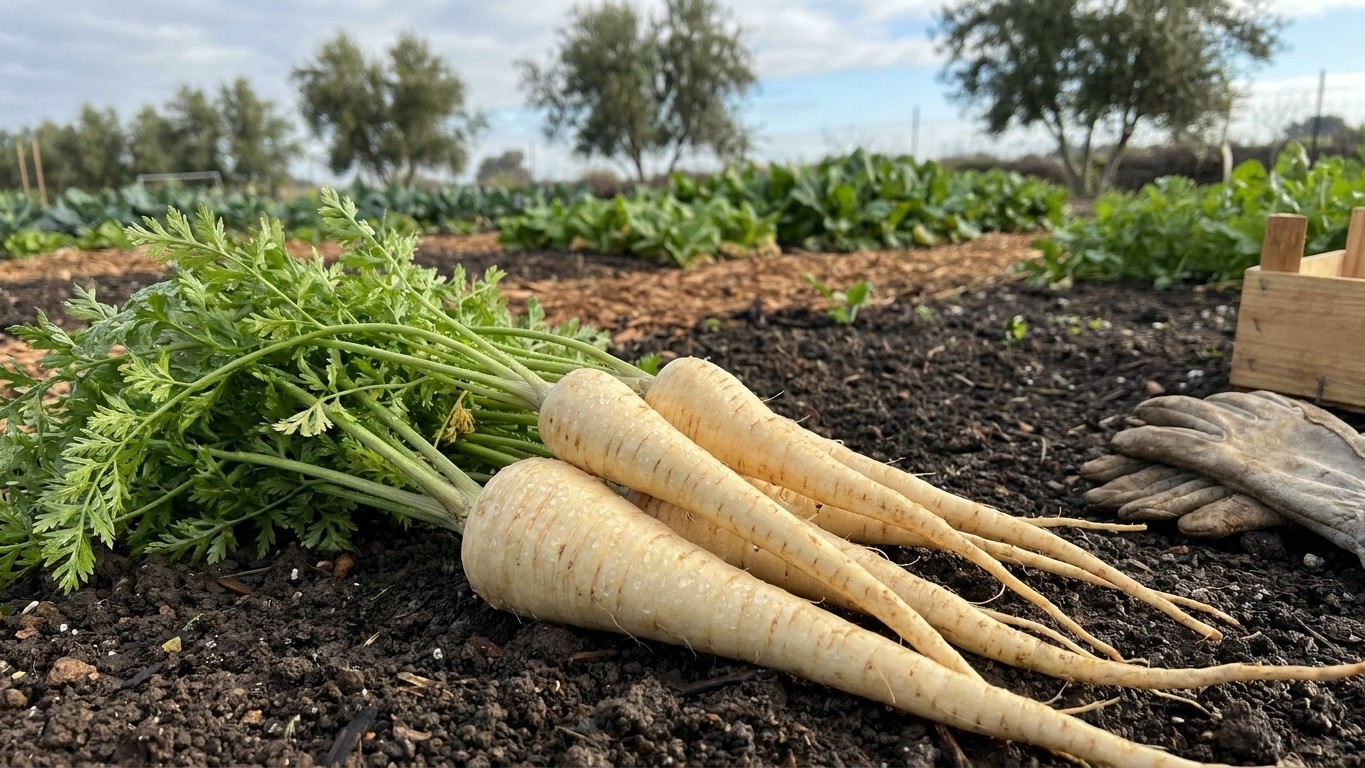

South Carolina gardeners growing parsnip mostly deal with general-feeding insects rather than a root-specific pest: stink bugs, leaffooted bugs, cabbage looper, corn earworm, and aphids or whitefly on the foliage. None of these targets parsnip exclusively, which is actually good news for a slow, 100-to-120-day root crop that spends most of its life quietly underground before frost turns its starch to sugar.
Which pests attack Parsnip in South Carolina
The Clemson Cooperative Extension Home and Garden Information Center documents ten insect pests for home vegetable gardens in this territory: brown and green stink bugs, cabbage looper, corn earworm (Helicoverpa zea), diamondback moth (Plutella xylostella), leaffooted bug (Leptoglossus phyllopus), silverleaf whitefly and potato aphid, spotted cucumber beetle, squash vine borer, striped cucumber beetle, and tobacco and tomato hornworms. That’s the full list for this territory. Not all ten belong on a parsnip bed.
Four of them can be crossed off right away because they’re specialists tied to a different plant family entirely. Diamondback moth is a brassica feeder, its larvae need cabbage-family leaves and won’t settle on a carrot-family root like parsnip. Spotted cucumber beetle and striped cucumber beetle both key in on cucurbits, squash, cucumber, melon, and largely ignore anything else in the bed. Squash vine borer is even narrower, boring into squash and pumpkin stems specifically. Tobacco and tomato hornworms need nightshade-family foliage, tomato, pepper, eggplant, tobacco, and have no reason to touch a parsnip leaf.
That leaves five that plausibly show up on parsnip because they’re general feeders, not crop specialists: brown and green stink bugs, leaffooted bug, cabbage looper, corn earworm, and the silverleaf whitefly and potato aphid pairing. Stink bugs and leaffooted bugs are sap-suckers that move across whatever’s green and available, including umbellifer foliage and seed heads. Cabbage looper and corn earworm are both broad-diet caterpillars that will chew on parsnip tops even though they prefer other crops first. Aphids and whitefly colonize the undersides of leaves on almost any vegetable, parsnip included, whenever conditions are mild.
The coastal reference station near Charleston posts a coldest-month average low of 38.9°F, which matters here beyond frost dates: it’s mild enough that sap-feeding insects like aphids and whitefly can persist through much of the cool season instead of dying back completely, unlike in a harder-freezing state further north.
When each one shows up, and what it does first
Parsnip is sown directly in place, not transplanted, and Utah State University Extension notes that seed is typically put down two to three weeks before the last frost. In this territory, the last spring frost falls somewhere between February 28 and March 17, so that’s the anchor point for a sowing date, not a calendar month. Germination takes 14 to 21 days, which matters because a bare-looking bed at day ten is normal, not a failed planting.
Once seedlings are up, aphids and whitefly are usually the first visitors, arriving on the undersides of the earliest true leaves within the first few weeks. The tell is a fine stippling or a slightly sticky, shiny film on the foliage before any wilting shows. Stink bugs and leaffooted bugs tend to arrive later, once the plant has bulked up some canopy, and they favor the seed stalks and flower heads if the crop is left in the ground long enough to bolt, more than the young leaves.
Cabbage looper and corn earworm show up as ragged, irregular chewing on the leaf margins, usually mid-season once the foliage is dense enough to hide a caterpillar during the day. Look for the damage before you look for the insect, since both feed mostly at night or tuck into the leaf whorl by daylight. Frass, small dark droppings on the leaves below the feeding site, is often the first sign a gardener actually notices.
The crop’s own calendar runs on the opposite end of the season from most of this feeding pressure. Parsnip roots are left in the ground through the cool months because the sweetening comes from several weeks of exposure to frost, not from any hardiness zone rating. With a first fall frost landing between November 20 and December 5, a root sown right after the spring frost window has time to hit its 100-to-120-day mark and then sit through the season’s first cold snaps before harvest.
Telling the damage apart from everything else
Parsnip has a habit of producing symptoms that look like insect damage but aren’t, and getting this wrong wastes a season. A forked or misshapen root is the classic case: it can come from heavy or stony ground that deflects the taproot as it grows, or separately, from overwatering that encourages branching roots. Those are two different causes, not one, and neither has anything to do with an insect underground.
A parsnip that grows fine but tastes flat and starchy rather than sweet isn’t pest-damaged either. That’s simply a root that hasn’t gone through enough frosty weeks yet, a milder stretch of winter than the crop needed, not a symptom to treat.
| Symptom | Likely cause | What tells them apart |
|---|---|---|
| Forked, split taproot | Heavy/stony soil or overwatering | No leaf damage; check soil texture and watering habits, not the foliage |
| Sticky film, stippled leaves | Aphids or whitefly | Insects visible on leaf undersides with a hand lens or by tapping the leaf over white paper |
| Ragged leaf margins, dark droppings | Cabbage looper or corn earworm | Frass present below chewed area; caterpillar often hidden in the leaf whorl by day |
| Bland, starchy roots at harvest | Insufficient frost exposure | Roots otherwise healthy and full-sized; no insect or disease signs |
| Sap-sucking on stalks/seed heads | Stink bugs or leaffooted bugs | Usually on bolted, flowering plants left in the ground past normal harvest |
Yellowing or wilting that doesn’t match any of these patterns could be a soil nutrient issue or a disease rather than an insect at all. That call needs a closer look than a home gardener can usually make from a photo, which is exactly what the local extension office is for.
What actually works here, and what is a waste of time
On a short-season root crop like this, timing beats treatment. Sowing right at the two-to-three-week mark before the last spring frost (February 28 to March 17) gets seedlings established before aphid and whitefly populations build up later in the season, and it gives the root the full 100-to-120 days it needs before the first fall frost arrives.
Floating row cover laid over the bed right after sowing keeps stink bugs, leaffooted bugs, and egg-laying moths off young foliage without needing to identify the insect first. It has to go on before pests find the row, not after damage appears, and it needs to come off (or be lifted for pollinators) if the crop is allowed to flower and set seed. Hand-picking caterpillars off leaves in the early morning, when they’re easiest to spot, works reasonably well on a home-garden scale for cabbage looper and corn earworm, since both tend to stay put during daylight.
What’s a poor use of time on this crop: spraying preventively on a calendar schedule regardless of whether any pest is actually present, since parsnip’s real pest pressure here is light and general rather than a guaranteed annual outbreak. Treating a forked root as a pest problem is another dead end, no product fixes soil compaction or overwatering. And chasing “bad taste” with any kind of treatment misses the point entirely, since bland roots are a frost problem, not a pest problem.
Any actual insecticide use, timing, and what’s labeled for use on root vegetables in this state, is a question for the local extension service rather than this page, since product registrations change and vary by state.
Where to check this for your own county
Everything above comes from the Clemson Cooperative Extension Home and Garden Information Center, which documents pest pressure at the state level. That’s a useful baseline, but it’s not a guarantee of what’s actually in a specific garden. Pest presence varies from one county to the next, and even from one side of a county to the other, depending on nearby crops, soil, and microclimate.
Coastal counties near the Charleston reference station run milder winters, meaning aphids and whitefly can linger longer into the cool season than they would further inland. Upstate counties see a tighter frost window at both ends of the year, several weeks shorter than the coast, which shifts the whole planting and pest calendar earlier in spring and earlier in fall.
The next move for a gardener seeing actual damage is a call or visit to the county extension office, which can confirm what’s actually feeding on the plant rather than guessing from a symptom list. Clemson’s Home and Garden Information Center is the starting point for that contact, and county offices can also speak to what’s specific to that soil and season, information a state-level list can’t cover on its own.
Common questions
Does parsnip need to be replanted if nothing sprouts after two weeks?
Not necessarily. Germination takes 14 to 21 days, so a bare-looking bed at the two-week mark is often still on schedule rather than a failed sowing.
Can parsnip be grown in heavy clay soil in South Carolina?
It can, but heavy soil needs to be double dug first; otherwise the taproot is more likely to fork or split as it pushes against compacted ground.
Why does a healthy-looking parsnip taste bland?
It hasn’t had enough frosty weeks yet. The sweetening comes from cold exposure after the plant matures, not from the variety or the growing conditions earlier in the season.
Are the cucumber beetles and hornworms on Clemson’s list a threat to parsnip?
No. Cucumber beetles and squash vine borer target cucurbits, and hornworms target nightshade-family plants like tomato and pepper. Neither group has a documented reason to feed on parsnip.